![Top 3 Mistakes Made By Trainers Using BAT]()
by Liz Wyant | Jun 30, 2015 | Training Methods
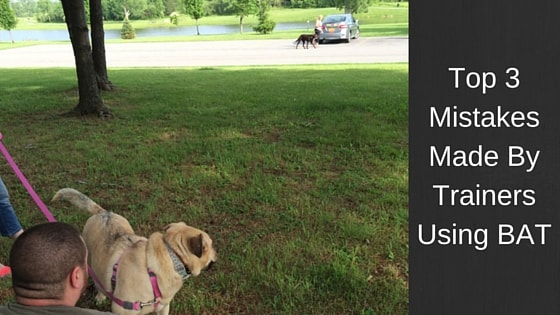
This is part 3 of a 3-part series on Behavior Adjustment Training (BAT), created by Grisha Stewart. In the first posting you learned about the basics of BAT and how a “perfect” session should look. In part 2, you learned why it is so effective for reactive/aggressive dogs. This final installment is to discuss the three most common mistakes made by trainers utilizing BAT. Though the technique is simple in theory, perfecting it takes time.
1. Leading The Dog
 Letting the dog pick his own direction and speed of movement is probably the hardest thing for trainers and clients to do. BAT is very calm, and it is easy to slip into the mindset of, “he’s doing really well, so let’s encourage him to go a little closer to his trigger!” BAT is about empowering the dog and allowing him to make his own correct choices.
When doing BAT, you want the dog to investigate his surroundings and sniff his way around. Even though it may seem like he is ignoring the trigger/decoy, he knows it is there and is gathering information in his own manner. As a trainer, you want to encourage your client to stand back and follow the dog’s lead. Even subtle body shifts on the behalf of the handler can encourage the dog to move faster than he is comfortable doing, so make sure you encourage your clients to remain entirely neutral regarding movement.
2. Letting The Dog Go Over Threshold
Remember in part one where the lifeguard analogy was used? It is your job as a trainer to help the client keep the dog from “drowning,” or getting too close to his trigger. You want the dog close enough that he is aware of the trigger and is gathering information in a very relaxed manner. If you see him start to tense up, or stare a little longer, or start moving faster, you need to help his owner guide him a little further back up the beach into safe territory.
As stated above, it is too easy to think that the dog is unaware of the trigger. This is where your expertise in body language becomes critical. You need to help your clients learn to see that minute changes in the dog’s body that indicate he is starting to get a little over aroused, and then ensure they have the leash skills necessary to gently guide him away.
3. Guiding The Dog Into “Training Mode”
Since most, if not all, of your BAT clients will be proponents of force free training, their dogs are probably very familiar with what treats mean: TRAINING. And they love training, because training = TREATS! Obviously this is not a bad thing by any means. However, when doing BAT, you want to try to keep the dog out of training mode. By training mode, I mean that lovely “what do you want me to do next for you, huh huh huh???” attention that the dogs often go into due to their eagerness to work with their owners. Training mode is a lovely thing to see. Just not during BAT!
Dogs in training mode often are very good at tuning out many lesser distractions. This means they may not notice their trigger until they’ve worked their way too close, at which point they rapidly go over threshold. You want the dog to stay in relaxed leisure mode. This is why it’s so important that if you are going to “seed” the ground with some treats to encourage sniffing and exploring, that you do so when the dog is not watching you.
Want To Learn More?
BAT is very complex and one little series of blogs does not do it the justice it deserves. To learn more, you can watch a lovely free BAT Overview video that Grisha offers.
You can also watch a full 2 hour BAT Intro Webinar that Grisha put out. It is $29 but well worth the money if BAT is something you’d like in your toolbox.
Finally, to get the full immersion and become more proficient and comfortable in its use, you can take an online course called BAT 101.
Get Dog Training Business Tips!
Receive valuable dog training business tips and resources every week! Subscribe to The Modern Dog Trainer now by submitting your name and email below.
[mc4wp_form]
![IAABC Animal Behavior Conference 2015, Day 2]()
by Liz Wyant | May 29, 2015 | Training Methods
Due to the generosity of IAABC President Michael Shikashio, The Modern Dog Trainer was able to send a writer to the Animal Behavior Conference in Chicago, IL. Notes from day 1 can be found here.

Living With And Loving A Pet With Behavior Problems, by Kristin Buller, LCSW and Kelly Ballantyne, DVM
Kristin and Dr. Ballantyne conducted a small research project on the impact that living with a pet with behavior issues can have on the owners. The research consisted of 63 participants, 40 of whom answered all questions. The questions covered how their pet’s behavior impacted their social and personal lives. Their results showed the impact is huge, sometimes devastating. Owners feel stress, guilt, embarrassment, and socially isolated from friends and family. Couples can have increased arguments due to disagreements on how to manage/care for the pet. People can feel judged by society, friends, and even family.
They spoke about how even professionals occasionally come across as judgmental to those with difficult pets. How many times have you heard, “there are no bad dogs, only bad owners.” Imagine the impact that one simple statement has on a person who has tried their hardest and still has a difficult dog.
They said that as trainers, we have a responsibility to keep in the mind how any management instructions we give our clients will impact their lives and possibly create isolation from friends and family. Most of the participants said that their trainers and veterinarians provided hope and trust. That’s not to be taken lightly! Kristin runs a support group for people living with difficult pets, where owners can come and talk to other people who truly understand. No training tips, just emotional support.
They spoke about euthanasia for maybe two minutes, and how it is the last show of love we can give our pets, yet people often don’t extend this grace when the decision is made for a behavioral/mental illness in the pet. This leaves owners again feeling judged and blamed. Just a personal note here, but just in the couple of minutes that this was discussed, the entire room was sniffling and many were wiping eyes. It was profound to me to see how many of us had obviously been touched by a shared experience of euthanizing a beloved pet or helping somebody else come to that decision.
To end, they discussed how trainers are first responders – people reach out to us in a time of crisis. This is a huge responsibility. We might not have the tools for dealing with the emotional crisis and that’s okay. We cannot be trainers and therapists or we get compassion fatigue and burnout. We don’t have to have all the answers. So what can we do?
- Let clients know it’s normal to have these feelings; validate them.
- Let them know it’s okay to still love their pet. When people accept the dog they have, instead of the dog they wanted, everybody is happier.
- Use reflective and empathetic listening.
- Use self-care to avoid compassion fatigue.
- Read a book entitled “Trauma Stewardship: An Everyday Guide to Caring for Self While Caring for Others” by Laura van Dernoot Lipsky.
Introducing Highly Reactive And Aggressive Dogs by Ken Ramirez

The author of this blog having a fangirl moment with Ken Ramirez.
Ken received a grant to do research on introducing three reactive/aggressive dogs to each other, using the same techniques used in zoos and aquariums. The research is still proprietary so cannot be shared to those who were not present at the seminar. However, trust me when I say it was fascinating and you should definitely keep your eyes peeled for when it becomes available to the general public.
Simplifying Complex Training Tools by Ken Ramirez
Ken considers an advanced concept anything that ventures beyond “reward desirable behavior and ignore unwanted behavior.” He made sure to specify that just understanding the theory isn’t enough – you must have the practical skills before using a tool, let alone introducing it to a client. He said that training is all about adapting and changing procedures based upon the animal’s behavior. He discussed many different tools that trainers should have in their toolbox:
- Keep Going Signal/Intermediate Bridge/Tertiary Reinforcer
- Jackpots
- No Reinforcement/Reward Markers (NRM)
- Time Outs
- Least Reinforcing Scenario/Stimulus (LRS)
- Differential Reinforcement of Alternate Behaviors
- Recall Signal (not a tool but included in lecture due to frequency of misuse)
- End Of Session Signal
For each of these, he discussed what the science has shown, how and when to use them, and whether he personally uses them or not. He ended by talking about how all tools exist for a reason. Many are very specialized and seldom needed, but we shouldn’t throw them out of the toolbox. We need to understand all the tools and how to use them if we want to help people STOP using them. On the other hand, don’t use a tool just because you have it. Successful use of complex tools depends on thorough understanding of the benefits and challenges of their use.
Final Thoughts Of This Writer
I cannot thank Michael Shikashio and the IAABC enough for his generosity in providing The Modern Dog Trainer a ticket to this conference. It was an absolutely amazing experience and I learned so much. It is frustrating as I know the blogs I wrote of this conference cannot convey the sheer brilliance of the speakers that were present, nor the massive amount of information they so generously shared with all of us.
Get Dog Training Business Tips!
Receive valuable dog training business tips and resources every week! Subscribe to The Modern Dog Trainer now by submitting your name and email below.
[mc4wp_form]
![5 Things You Should Know About Being A Service Dog Trainer]()
by Laurie Schlossnagle | May 27, 2015 | Training Methods
Helping someone train his/her own service dog or training service dogs for their handlers is a time-consuming commitment, but one that is extremely rewarding. This is a time for a trainer to be able to be involved long-term with a dog/handler team with specific goals in mind. Working with service dogs and service dogs in training requires a somewhat unique skill set and body of knowledge. Being a prepared service dog trainer is important.
1. Americans with Disabilities Act (ADA)
Know and understand the Americans with Disabilities Act (ADA). This is the only thing overseeing service dogs at the federal level. Also, know any legislation your particular state may have regarding service dogs and emotional support animals.
2. Document, Document, Document!
Document everything you do. This serves many purposes over time – it can help you troubleshoot, it can help you formulate training plans, it shows the work you have done to ensure a safe, well-trained, appropriate service dog, etc.
3. Be True To Yourself
Know your limits and experience. For example, if you have no experience training an alert dog, refer your client to someone who does. Then ask if you might be able to observe and learn about the training.
4. Research
Do your research. There are no particular certifications or registrations required for service dogs and emotional support animals. Know the difference between service dogs, emotional support animals, and therapy animals. Incorporate evaluations like the Canine Good Citizen and Canine Life and Social Skills evaluations into your clients’ training plans.
5. Public Access
Public Access Training is a vital part of service dog training. Having a service dog or service dog in training in the public eye is under a great deal of scrutiny and observation. Ensure the teams you work with understand this and are committed to excellence in public access. Utilize a public access test to evaluate teams. Look online for test examples such as the Assistance Dogs International Public Access Test.
Your best resource when working with service dogs and service dogs in training is the handler — the person the dog is working for! They are going to be the one living with, and benefiting from, their service dog; talk to them about their ideas for how this is all going to work to work together to a mutually beneficial end result of an awesome, well-trained service dog.
Get Dog Training Business Tips!
Receive valuable dog training business tips and resources every week! Subscribe to The Modern Dog Trainer now by submitting your name and email below.
[mc4wp_form]
![Mental Stimulation Ideas For Dogs]()
by Laurie Schlossnagle | May 21, 2015 | Training Methods
Dogs need both mental and physical exercise to be balanced and healthy. Finding ways to do this can be challenging.
Understanding the need for and providing opportunities for physical exercise is relatively common knowledge among dog owners. But the concept that having a dog or dogs is a partnership and that your dog wants and needs to spend QUALITY time with you, is more difficult. It is not enough to spend time cuddling with them; dogs want to use their brains! They have wonderfully intelligent, creative brains that need to be challenged and stretched to help prevent boredom-related behavior issues. Using some of the ideas listed will not only help dogs’ brains, but will also improve relationships with our dogs.
**Most of these ideas are intended for the owner to be involved or for the owner to supervise the dog. There is a section at the end of things to leave for the dog when s/he is left alone.
Create A Challenging Meal
Feed at least one meal a day in a mentally stimulating and challenging way:
- In a food puzzle (Kyjen puzzles and slo feeders, Kongs and Kong Wobbler, Premier Tug-a-Jug, Barnacle, Squirrel Dude, and Mushroom, Buster Cube, Treat Ball, IQ Ball, Nina Ottosson puzzles) – these are not meant to be left unsupervised with the dog (with the exception of Kongs, Barnacle, Squirrel Dude)
- Throw the food into the yard.
- Put the food in an empty, dry (labels, rings, and caps removed) pop bottles, milk jugs, water bottles.
- Put the food in boxes (see “Toys” section for more information).
- Put the food in a muffin tin (see “Toys” section for more information).
- Use the food in a training session.
- Almost any of the ideas listed below will work to feed a meal.
Games
Get creative and encourage owners to play games with their dogs. Here are a few games that are simple and quick to play every day.
- Hide and seek – with people, toys, and food
- Rapid recalls
- Round Robin recalls
- Tag
- Musical chairs – play music, play with your dog, when the music stops ask your dog to execute a behavior on a mat or a rug, when the music starts again, play again
- What can you do? – get your clicker and treats, ask your dog “what can you do?” start clicking and treating offered behaviors (your dog will probably do SOMETHING to get you to click/treat – use these behaviors to play this game – when we play this, the dogs must offer different behaviors to get the click/treat. Note: this is not a shaping exercise; this is a game.)
- 101 Things to Do With a Box (or a laundry basket)
Toys
Toys come in all shapes and sizes. They are great tools to prevent boredom and enrich a dog’s life.
- Flirt pole (make your own – directions can be found online; I like the Kong version because it’s easy to change out the toy at the end of the line).
- Long line with a grocery sack on the end – your own version of lure coursing (think greyhound racing and chasing the lure). **Don’t let your dog chew on or ingest the bag!**
- Ice sculptures – bowl or bucket or bottom half of a gallon jug – fill with water, toys, treats (carrots and apples work really well!) – freeze – put outside for your dog to play with, interact with, get the toys and treats out of.
- Boxes – start with one box, put some treats or a favorite toy in it, have your dog get the treats/toy out of the box. Progress to nesting boxes with the treats/toy in the innermost box. (This can also be used to feed meals.) Make it more interesting by using peanut butter, spray cheese, or cream cheese in one of the boxes.
- Muffin tin – put treats or kibble in each hole, cover some or all of the holes with tennis balls or crumpled paper. You can also use canned food, rehydrated foods, peanut butter, spray cheese, yogurt, and cream cheese
- Yoga mat – unroll, sprinkle treats, roll back up. Have your dog unroll the mat and get treats.
- Small round basket – put treats or a toy under the upturned basket and have your dog figure out how to get them.
- Perches – phone books covered in duct tape or small, stable stools. Play with different things your dog can do with these. Two paws on (front, back, right, left), four paws on, two paws on move around, etc.
- Hol-ee ball stuffed with fleece strips and small treats or kibble
- Make a “burrito” out of an old towel or blanket, folded up with treats in the folds.
 Other Activities
- Take a class – either in person or online – the Fenzi Dog Sports Academy has some great online courses. If you can’t find a class locally or online you are interested in, consider working with a certified, experienced trainer (again, in person or online) to help guide you, answer questions, and help you stay on track. (Scent or nosework classes are a great class for dogs who need to be stimulated/challenged!)
- Join a walking group that takes regular walks with their dogs (I DO NOT recommend off-leash, play group type walks – the walk should be as much about you and your dog as the social aspect for you with the other humans. It should NOT be about the dogs physically socializing.)
- Teach the dog tricks – Do More With Your Dog is a great online program for earning certificates/titles for teaching the dog tricks.
- If the dog likes to dig, create a place him/her to dig – a sandbox, an area of your yard – digging is a natural canine behavior and many dogs reduce stress and get a lot of stimulation when they dig.
Things You Can Leave With The Dog Unsupervised
If it is a multiple dog situation, I only recommend these if each dog is in a crate while you are gone to prevent any issues with resource guarding.
- Stuffed and frozen Kongs, Squirrel Dudes, Barnacles
- Bully sticks – freeze these too so they last longer
- Stuffed and frozen tracheas
- Ears – cow, pig, lamb
Mental stimulation is as important as physical stimulation for dogs. Encourage your clients to plays games and work with their dogs to build their bond and prevent boredom in their dogs.
Get Dog Training Business Tips!
Receive valuable dog training business tips and resources every week! Subscribe to The Modern Dog Trainer now by submitting your name and email below.
[mc4wp_form]
![8 Topics To Include In Your ‘Preparing Dog For Baby’ Seminar]()
by Monica Callahan | May 6, 2015 | Training Methods
One of the most important services you can provide as a dog trainer is helping parents to prepare their dogs for the upcoming baby. Parents-to-be are nervous for what to expect for their own life, but add in their dog, and they are nervous for how their dog will also feel. I have been providing a PowerPoint presentation for parents-to-be over the past three months and out of the 20 or so parents I have spoken to, at least 90% of them have said they are nervous about how their dog will feel since they currently get so much of the owner’s attention. So, what exactly is important information for parents-to-be to have to help them and their dog feel better about the new family member?
1. Bite Statistics
I start my PowerPoint of with basic bite statistics, stating how many people are bit a year, how many of them are children, and how many of them were unsupervised. I believe parents-to-be need to know that dogs are dogs, and should be treated as such for the dog and child’s benefit. I believe it also helps drive home the fact that a dog and baby should never be left unattended together, and that the owner should always be able to get to the baby before the dog. Always.
2. Canine Body Language
One of the most important things parents-to-be can do is to know when their dog is uncomfortable. I like to include Lilli Chin’s drawings of body language and fear body language for my parents-to-be. They are a light-hearted way to show what to look for and owners really take a liking to the pictures. They enjoy going over the hand outs with me and then I point them to more detailed information such as Youtube videos or books on body language. I tell them what stress looks like in a dog and what a relaxed dog looks like.
3. Basic Obedience Cues
As a parent, they will be using many basic cues throughout the day to keep the dog and baby safe and out of the way when things get hectic. I like to include their name, sit, down, a place cue, and wait/stay. I tell them to start incorporating these cues into their every day schedule. Small training sessions can also be mentally stimulating. I also suggest group classes for appropriate dogs as a way to bond with their dog and spend time with them before the baby comes.
4. Behavior Modification
I tell parents-to-be to start working on behavioral issues as soon as they find out they are pregnant because they will not magically go away after the baby comes, and can often times behavior issues can worsen after the baby arrives. I include a slide on what the difference between a trainer, behaviorist, and behavioral consultant are and where to find a reputable professionals for assistance.
5. Desensitization
Helping the dogs to become comfortable with all the new things going on is one of the most important things that can be done before baby comes. I advise families to set up all their child paraphernalia as soon as they receive it so that the dog can become comfortable around it. Slowly incorporate the swinging swing, the moving stroller, and any other object that may move or make noise. Also, I show them how to desensitize their dog to handling of the ears, muzzle, tail, paws, and torso. I make sure to include that children should never be able to ride or handle their dogs roughly, but if an accident ever occurs, we want our dogs to be as prepared as possible.
6. Household Preparation
This includes mental stimulation, relax stations, and quiet areas. Frozen food toys can be prepped before baby comes so parents have something quick to give the dogs if they have an emergency with their child and cannot entertain their dogs at that moment. It lets them know their dogs are doing something productive so they can focus on their child.
Relax stations are places parents feel confident leaving their dogs while they deal with their child, or places the dogs can learn to relax while around the child. These include the dog’s crate, baby gating off special areas, Xpens for dogs who are good with barriers, and tethering systems in the same room so dogs can see and be a part of the family, but cannot reach the child. Tethering systems are good to recommend when the dog normally sleeps with the owners, as they can still be on the bed but cannot reach the baby when they wake up at night. Reinforcing their dogs when they are calm around the baby in these relax stations will help the dogs learn to relax around baby. Quiet areas are places that baby and dog can go when they need to get away from each other. I generally recommend that the nursery be dog free, and the crating area for their dog be child free. The nursery can either be gated off or they can start barrier training before baby comes.
7. Introductions
When the time comes for introductions, things are kept low-key. I think parents-to-be are sometimes surprised to hear how low-key introductions should be kept. Parents should be calm and quiet when they decide to introduce their dogs and baby. If other people are in the house or the parents are stressed or worried, I let them know it is ok to hold off introductions. They don’t need to be rushed. When the time comes, they should be holding baby or have them somewhere up higher that is sturdy. Dog and baby never need to meet face to face. I tell parents the most important information I received was, “This is MY baby, not my dog’s.” Dogs will get to know baby through smell and every day routine with the baby. They should never have free access to the baby in the beginning, and a parent’s arm should always be between dog and baby in case something needs to be interrupted. Baby carriers such as slings or wraps can be used in the beginning to keep baby close to the parents and give the parents two hands to use with their dogs. Carriers are also nice for prey driven dogs because it keeps baby’s arms and legs from moving and becoming enticing to the dogs.
8. Routine
Most dogs do well with a routine, but babies are never good with a routine. I let the parents know they should be keeping their dog’s routine as close to normal as possible during the transition. Dog walkers can help keep their dog’s physical exercise up those first few weeks while they get used to being new parents. I mention my day training program that is perfect for mental and physical exercise. If they can’t get their dog out as much as usual, recommend a variety of different ways they can mentally stimulate their dog with toys and their breakfast and dinner. I also tell the parents that it is important to give their dog attention throughout the day, not just when baby is napping.
Preparing for a baby can be very stressful, as well as exciting, for a family, so I try to give my families as much information as possible to help make the transition smooth. Parents walk away feeling relief after this presentation because it touches on a lot of topics they never even thought of before. It is our job as professional dog trainers to make sure parents are prepared, and that the dog has as easy a transition as possible. What other topics would/do you include in your dog and baby presentation?
Get Dog Training Business Tips!
Receive valuable dog training business tips and resources every week! Subscribe to The Modern Dog Trainer now by submitting your name and email below.
[mc4wp_form]
![3 Reasons To Use BAT With Reactive Dogs]()
by Liz Wyant | May 5, 2015 | Training Methods
This is part 2 of a 3-part series on Behavior Adjustment Training (BAT), created by Grisha Stewart. Part 1 can be read here. In the first part you learned about the basics of BAT and how a “perfect” session should look. In part 2, you will learn why it is so effective for reactive/aggressive dogs.
1. BAT Respects The Dog
As a modern dog trainer, you know that the dogs on the other end of your leash deserve respect as thinking, feeling creatures. Too many trainers feel that dogs need to be flooded to help them “get over” their fears or reactivity. Even the best of intentioned force-free trainers may sometimes keep dogs right at their threshold point for counterconditioning and desensitization purposes. BAT, however, never forces a dog to get closer to their trigger than they are comfortable doing.
2. BAT Gives The Dog Choices
As stated above, BAT gives the dog the ability to choose whether and how to approach their trigger. Giving a dog the ability to make choices empowers him. Empowering a dog can make a fearful dog more confident and help a reactive dog learn other, more appropriate ways of dealing with their triggers. Letting the dog choose their speed and approach also keeps stress at a minimum, which makes learning easier.
3. BAT Teaches Dogs They Can Move Away
Though this may sound odd, sometimes dogs haven’t learned that they are capable of moving away from their trigger. Starting at a safe distance allows them to learn this skill before they reach the point of no return and get magnetized to their trigger. Teaching dogs that they have the power to retreat can keep a fearful dog from lashing out and give a reactive dog another option.
Want To Learn More?
Though BAT is simple, it is not easy. If you are interested in learning more, you have the following options:
You can watch a lovely free BAT Overview video that Grisha offers.
You can also watch a full 2 hour BAT Intro Webinar that Grisha put out. It is $29 but well worth the money if BAT is something you’d like in your toolbox.
Finally, to get the full immersion and become more proficient and comfortable in its use, you can take an online course called BAT 101.
Get Dog Training Business Tips!
Receive valuable dog training business tips and resources every week! Subscribe to The Modern Dog Trainer now by submitting your name and email below.
[mc4wp_form]

 Letting the dog pick his own direction and speed of movement is probably the hardest thing for trainers and clients to do. BAT is very calm, and it is easy to slip into the mindset of, “he’s doing really well, so let’s encourage him to go a little closer to his trigger!” BAT is about empowering the dog and allowing him to make his own correct choices.