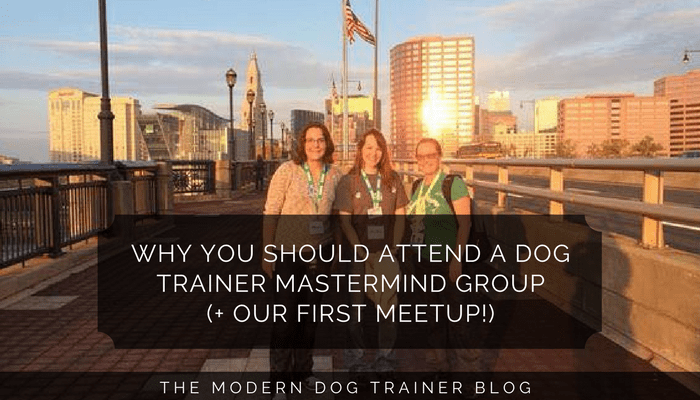
by Ines | Aug 31, 2017 | Business, Events
Ever wish you had a group of local, friendly dog trainers to talk to? What about a group of dog trainers you felt comfortable bouncing ideas off of?
A networking event, or better yet a Mastermind Meetup (otherwise known as a peer advisory board), can be extremely useful to gain traction when you’re first starting out or even if you’re stuck in a rut in your current businesses. Getting an outsider’s perspective from someone that’s been in your shoes can be the best way to open new opportunities for you and your business.
A mastermind meetup is a group of like-minded individuals that get together from time to time to share their goals, obstacles, experiences, and insights to benefit the group as a whole. You learn from each other, you keep each other accountable, and you support and help each other. There are many benefits, both tangible and intangible, to having a group like this to turn to as you start your own dog training business or grow a business you already have.
1. You Can Make Life-Long Friends And Partnerships
When you’re meeting with like-minded people that are passionate about the same things you are, you’re able to connect on a whole new level. You’ll feel like you’ve found “your people” and share business and personal challenges, goals, or experiences that are helping you succeed or inhibiting your progress. You’ll have an instant, reliable, supportive network to turn to as you start and grow your business.
Not to mention, the endless opportunities for collaboration and cross promotion that will result in having a strong support network of like-minded trainers in your area! Just because a group of trainers service the same area doesn’t mean you necessarily overlap in target audiences, skillsets, availability, types of services, and more! These days, there is usually more business coming in than many dog trainers can handle. The mindset you should have if you’re looking to network and find a mastermind group is that there truly is an abundance of business and dog training clients that need your help.
2. You Discover New, Creative Solutions For Your Business
The benefit of speaking to others who have been in your shoes and are like-minded is that you can collect valuable, honest, and relevant feedback about your business choices and initiatives. You can hear how others of similar backgrounds and passions would approach your challenges and generate ideas to overcome them.
When you’re surrounded by other like-minded individuals, you’ll feel validated that you’re on the right path to reach your goals and your dream. Seeing others succeed will help to motivate you to keep going as well.
Additionally, a facilitator or someone who hosts/organizes the mastermind meetup, also has a wealth of knowledge and resources to share with the group and is going above and beyond to help others grow and succeed as well. They bring their own skill set and experiences to the table.
3. You’ll Be Accountable To Make Improvements
Ideas are great, but taking action is better!
One of the most valuable aspects of having a mastermind group is that you can hold each other accountable so you all make progress in your businesses.
Mastermind groups are more than just a networking event. You actually sit down, share your goals, and work together to make actionable plans to make improvements within your businesses. When you share your goals and action items with someone else, you’re more likely to take those steps and reach your goals!
The connections you make in a mastermind group go much further than a handshake at a networking event. You’re truly in it together to help each other stay accountable so everyone in the group can succeed.
 4. You’ll Gain Industry Insights Found Nowhere Else
When you get together with other people from within your industry, you can gain insights you won’t find online, in books, or in seminars. Each person brings their own unique learning experiences to the table for all to learn from. One person’s challenge becomes a learning experience for everyone in the group. There is just nothing like it! There is nowhere else to find this kind of knowledge.
5. You Find Relief In Knowing You’re Not Alone
Typically, when you’re starting your own dog training business, you’re considered a “solopreneur” or solo-entrepreneur. It can be isolating when you have no one to turn to or relate to. You have to figure everything out on your own and while you should always trust your gut and do what feels right, you don’t know what you don’t know. Speaking to others who are or have been in your shoes is a great way to build connections and find relief in knowing you aren’t completely alone in this adventure. Others might bring up experiences or insights that you hadn’t thought of or experienced yourself. Mastermind groups help you expand your awareness of what it takes to run a successful dog training business.
6. You Get To Work ON Your Business Instead Of IN Your Business
While learning how to post on Instagram or writing up thorough client notes is important, mastermind group discussions should focus more on the bigger picture. You’ll be able to take a step back, reflect, analyze, learn, and plan your next big business goals.
Many times as solo business owners we spend a lot of time working in our businesses – creating documents, sending emails, working directly with clients. This time away from the office allows you to refresh and reinvigorate yourself for your next business steps.
7. It’s Electrifying
When else will you be able to be completely honest with a group of people? Share the highs and lows of starting your business. Share your expectations versus the reality of what it actually is like. Vent about the challenges your experiencing or share your success with others who understand what it means! Finding your “kind” of people is invigorating! You don’t have to go at it alone.
One of my main missions with this blog is to help other positive dog trainers (or whatever you want to call dog trainers that follow Least Intrusive, Minimally Aversive (LIMA) principles in training) succeed with their businesses. There is often a ton of focus on learning the science of training dogs with little acknowledgment of how to run the business side of things. However, if you’re in this profession for the long haul, you have to pay attention to both. Without a thorough understanding of how to run a business, you will not be able to take your passion for dog training full-time or be able to sustain it full-time for many years.
Receive valuable dog training business tips and resources in your inbox.
by Kat Camplin | Jul 28, 2017 | Business, Communication, Events
With the registration date for ClickerExpo coming up, I began to think about what learning goals to concentrate on this year, who I wanted to hear speak, and if there should be a theme or if I should just see whatever sounded interesting. I then began to think about the other part of going to conferences; meeting people and networking. So many times I’ve seen someone I haven’t seen in years passing by in between sessions and had that 7 second drive-by conversation, “Hi! How are you doing! Great to see you! Let’s meet for lunch or something!” The other person responds, “Great!” and then that’s the end of it. This year, I really want to make a plan.
1. Put people you want to meet on your schedule.
I always have the best of intentions and every conference I fail. This year I’m putting people on my schedule. Message people and ask them for a time to meet or share a meal or have a drink. Put the appointment on your schedule with a reminder so you don’t become that person that stood someone up at a training conference. You have 3 meals a day, after conference drinks, breaks in between speakers, and skipped session periods you can fill. Fill them. If meals are coordinated and prepaid you might consider skipping one and doing a DIY lunch at least one day to accommodate people who aren’t purchasing meals.
Related: Are drinks after the conference your favorite part of attending conferences? Do you like meeting online friends in-person? Ever wish you had a group of local, friendly dog trainers to chat with to continue the conversation? Check out our latest project: Mastermind Meetups for Modern Dog Trainers
2. You don’t have to fill every session.
I actually learned this when I got violently ill at a conference. Fatigue set in and I needed to prioritize my energy instead of my desire to see everything. There were some session slots where there just wasn’t anything that really perked my interest or I had seen all the presentations already. I skipped that period and took a nap, waking up refreshed for the speakers I really wanted to see. When I skipped and didn’t take a nap, I met a bunch of people that were also skipping! If you’re just trying to fill time by seeing a speaker, meet up with people instead.
3. Introduce yourself to people sitting or eating alone.
If you haven’t filled a meal period with a scheduled meet up then scan the dining area and look for people wearing the conference badge who are sitting alone. Go introduce yourself and ask if they want company. Please don’t push in if the person says they’d rather be alone. Conferences can be overwhelming and some people need quiet time. I’ve had many amazing conversations eating with strangers. Meeting and talking to people way outside your normal circle can be more educational than some presentations. This practice also makes everyone feel welcomed and interesting. Which brings us to number 4.
4. Remember to get cards or contact information for people you meet.
I’m putting this on a post-it note on my forehead this year, “Please give me your business card.” After introducing myself and eating with a stranger and having a lovely conversation, it inevitably happens that the conference bell rings and you’re off and running to the next session. The number of times I’ve grabbed my things and said, “Thank you for the wonderful lunch!” then sprinted away is embarrassing. Take a moment, get a card or have the person put their email address in a note for you. When you get seated at your Must Get To session, make a note of where you met them, what you did together, and the general topic of conversation. Even if you never message them you will have a reminder if you see them at the next conference.
5. Organize meetups with your virtual friends.
We all have them, people we “know” from Twitter, Facebook, certification organizations, clubs, and schools. Schedule a meetup and get a few people you want to meet in one place. On Twitter you can create a hashtag and have people retweet or reply they’d like to join. You can create calendar and Facebook events so other people can invite other people. While it may seem fun to set these up for dinner at a restaurant, some trainers are on a budget. You might consider doing these in hotel common areas instead of restaurants so everyone can bring their own food yet still have dinner together. Remember to send reminders to everyone who was interested when you get to the conference.
Check out our latest project: Mastermind Meetups for Modern Dog Trainers
Did we miss anything? What is your go-to strategy for attending conferences? Tell us in the comments!
Receive valuable dog training business tips and resources in your inbox.
![Top 10 Dog Training Conferences for 2017]()
by Kat Camplin | Dec 14, 2016 | Events, Training Methods
We’ve compiled the Best Dog Conferences for you to attend in 2017 because we’ve done that every (2016, 2015). Explore science topics, learn better training skills, concentrate on motivation or the human-animal bond. It’s all here. Let’s go!
Conferences are listed in chronological order due to the author’s inability to decide which should be first.

1. ClickerExpo
ClickerExpo will be held in 3 locations throughout 2017. This year ClickerExpos have slightly different labs and workshops depending on the location.
Portland, OR
When: Friday, January 27-29, 2017
Where: Portland, OR
Why: Educational Themes are back for 2017. Themes are labs and presentations focusing on a certain concentration. Themes include: Trainer Skill Development, Teaching People, Aggression and General Behavior Management, and Veterinary Environments. Feel free to follow a single theme or skip around and explore a variety of topics. There’s something for everyone! CCPDT, IAABC, and KPA Continuing Education Units are available for professionals attending this event.
More Information: http://www.clickertraining.com/clickerexpo/portland/registration
Stamford, CT
When: Friday, March 31-April 2, 2017
Where: Stamford, CT
Why: A complete Equine Theme which includes Husbandry, Saddling, Trailer Loading, and much more continues for 2017. This is in addition to the Themes listed for Portland above. CCPDT, IAABC, and KPA Continuing Education Units are available for professionals attending this event.
More Information: http://www.clickertraining.com/clickerexpo/stamford/registration
ClickerExpo Europe
When: Friday, November 3-5, 2017
Where: Denmark
Why: The ClickerExpo 2017 schedule for Denmark has not been released yet. It will be released by 15 February 2017.
More Information: http://www.clickertraining.com/clickerexpo
2. WOOF!
When: Friday, February 10-12, 2017
Where: University of Nottingham, United Kingdom.
Why: It’s back! It’s’ back! The very successful WOOF! European Behaviour & Training Conference has been on hiatus since 2013, but it’s back for 2017. 3 full days of brilliant seminars with Bob Bailey, Susan Friedman, Kay Laurence, Jean Donaldson, and Clive Wynne.
More Information: http://www.domesticatedmanners.com/woof2017
3. Canine Science Symposium
When: Saturday, March 11-12, 2017
Where: San Francisco SPCA in San Francisco, CA
Why: Bringing together professors of Psychology, Anthrozoology, Behavioral Neuroscience, and Behavior Analysis, this symposium covers the science of welfare for shelter dogs, training, and canine aggression. Enjoy two days with some of the leading canine science minds with Julie Hecht, Monica Udell, Sheila D’Arpino, and Erica Feuerbacher. CCPDT and IAABC Continuing Education Units are available for professionals attending this event.
More Information: https://www.sfspca.org/get-involved/events/CSS2017
4. IAABC Animal Behavior Conference
When: Saturday, April 8-9, 2017
Where: Culver City, CA
Why: The International Association of Animal Behavior Consultants has creatively merged their multiple species Conferences into one event. Choose to follow the Dog, Cat, Parrot, or Horse tracks, or pick and choose which presentations you’d like to join. The conference features speakers discussing the latest science, treatments, and protocols for managing and modifying behavior in all species.
(Read about our experience at the 2015 IAABC Conference.)
More Information: https://iaabc.org/conference/2017
5. DogEvent 2017
When: Thursday, April 14-17, 2017
Where: Rambouillet, France
Why: 4 days of dog training, behavior workshops, and demos on the outskirts of Paris! Each day has a theme: Clicker Training, Motivation, Aggression, Canine Sorts, and more. Speakers include Emily Larlham, Chirag Patel, Nando Brown, Denise Fenzi, and Lori Stevens. Presentations will be given in English.
More Information (in French): https://www.weezevent.com/dogevent-2017
More Information (in English): https://www.eventbrite.co.uk/e/dogevent-2017-tickets-27382612130?aff=es2
6. Animal Management Behavior Alliance (ABMA) Annual Conference
When: Sunday, April 23-28, 2017
Where: Cincinnati, OH
Why: The Animal Behavior Management Alliance (ABMA) specializes in animal care and training through enrichment. This year’s theme is “Back to Basics: Crossing The Bridge Between Training and Conservation.” Conference locations include multiple zoos. This year’s keynote speaker will be Megan Parker, PhD, Co-founder & Director of Research, Working Dogs for Conservation discussing ways to use dogs’ extraordinary sense of smell to protect wildlife and wild places.
More Information: https://theabma.org/abma-annual-conference/
7. Fenzi Dog Sports Academy Training Camp
When: Thursday, June 22-25, 2017
Where: Linn County Expo Center, Albany, Oregon
Why: It’s back! The Ultimate Dog Sports Training Camp covers Obedience, Rally, Agility, Nosework, Freestyle, and Rally FrEe! Join the energizing dog sports goddesses Denise Fenzi, Deb Jones, Hannah Branigan, Julie Flanery, Loretta Mueller, Nancy Gagliardi Little, Shade Whitesel, Amy Cook, Julie Symons, and Stacy Barnett for 4 days of fun. Work on heeling, scenting, retrieves, utilizing play to build motivation, and so much more. Priority registrations will be given to students that have previous enrollments in FDSA online courses.
More Information: http://www.fenzidogsportsacademy.com/index.php/camp
8. International Society for Anthrozoology (ISAZ) Conference
When: Thursday June 22-25, 2017
Where: Davis, CA
Why: The International Society for Anthrozoology (ISAZ) annual conference covers new and intriguing ideas in Human-Animal Interactions. The speakers and program for 2017 is pending. Stay tuned to the link below to keep up as this conference program develops.
More Information: http://www.isaz.net/isaz/conferences/
9. International Society for Applied Ethology (ISAE) Conference
When: Friday, August 7-10, 2017
Where: Aarhus, Denmark
Why: The International Society for Applied Ethology (ISAE) annual conference covers the presentation and discussion of advances in applied animal behaviour science and education and. The speakers and program for 2017 is pending, but topics include, Animal learning and cognition, Social behaviour of animals, Animal stress responses, and Human-animal interactions. Stay tuned to the link below to keep up as this conference program develops.
More Information: http://conferences.au.dk/isae2017/
10. APDT Annual Conference and Trade Show
When: Wednesday, October 18-21, 2017
Where: Richmond, Virginia
Why: You’re a professional dog trainer, this is your Association. The Association of Professional Dog Trainers Annual Conference is full of prestigious speakers and engaging seminars. The speakers and schedule for 2017 is still pending. This entry will be updated as information becomes available.
(Read about our experience as a volunteer APDT Border Collie.)
More Information: https://apdt.com/conference/
Dog Training Business Tips
Receive valuable dog training business tips and resources right in your inbox! Subscribe to The Modern Dog Trainer now by submitting your name and email below. Don’t forget to let us know what you want to learn more about!
[mc4wp_form id=”2494″]
![Guest Post: What Breed is That Doggy in the Shelter Window?]()
by Guest Poster | Mar 5, 2016 | Events, Research, Training Methods
This post is written and provided by Lisa Gunter, MA. Lisa is a PhD student at Arizona State University in the Department of Psychology and conducts her research under the mentorship of Clive Wynne in the Canine Science Collaboratory. She has presented her research at numerous conferences including the Association of Professional Dog Trainers, the Interdisciplinary Forum for Applied Animal Behavior, the Veterinary Behavior Symposium and the International Society of Anthrozoology.

What Breed is That Doggy in the Shelter Window?
Chihuahua. Chow Chow. Pointer. Irish Wolfhound. When thinking about unique breeds and the range of physical differences that exist with man’s best friend, it’s hard to believe that a tiny toy lap dog and another that’s as tall as a human are of the same species [1].
For centuries, we’ve bred dogs for the purpose of aiding us in our work, such as in hunting (Labradors), herding (German Shepherd), and livestock protection (Great Pyrenees) [2]. Our influence on how dogs look and act brings along with it expectations about different dog breeds. When I say “Golden Retriever,” you likely think of a fluffy blonde dog that enjoys playing with children. When I mention a Border Collie, you probably imagine a wickedly smart black & white dog that plays fetch for hours.
In the United States, there are a little over 80 million dogs living with us with 20% of those dogs adopted from shelters [3]. As many of you have experienced firsthand, the way animal shelters operate today has changed from what homeless animals experienced just fifteen years ago. Before 2000, dogs usually stayed on average for about 10 days at the shelter. Then, over half were euthanized, and the others were either adopted or redeemed [4]. Today, the situation is better. While almost 4 million dogs are entering animal shelters each year, only 30% are euthanized [5]. While we’re pleased with these improvements, one of our main foci of research in the Canine Science Collaboratory at Arizona State University is to further increase adoptions and reduce euthanasia rates for pet dogs.
Given the importance placed on appearance in our culture, it should come as no surprise that looks matter in canine adoption, too! Researchers from the American Society for the Prevention of Cruelty to Animals (ASPCA) [6] found that appearance was the single most important reason people gave for why they adopted the dog they did. In our own lab we found that when potential adopters were presented with photographs of dogs that had been either adopted or euthanized they were able to distinguish which dogs had met which fate solely because the adopted dogs were more attractive than those that had ended up euthanized [7].
The Pit Bull Label
If you work in animal sheltering, you’ve likely heard of the term “pit bull.” While there is a specific breed of dog known as the American Pit Bull Terrier, more conventionally this label has been applied to many breeds that are short-haired, muscular and blocky-headed such as American and English bulldogs, Staffordshire bull terriers and American Staffordshire terriers as well as mixes of these types of dogs [8].
Recent studies into dog adoption [11, 7, 12-13] have found breed to be associated with different outcomes, including but not limited to increased euthanasia and length of stay. With the big role that physical appearance plays in dog selection, our lab was interested in understanding how breed labels could influence how attractive a dog seemed to be.
So what is the basis for the negative perceptions about pit bulls? The pit bull terrier does have a past that includes bullbaiting and dogfighting (which still occurs illegally in some areas of the US), and reports of aggression towards humans, specifically dog bite injuries and even deaths, have likely contributed to the unfavorable public opinion of these dogs as well [14-18]. Yet while an association may exist between certain types of dogs and aggression towards people, the reliability of breed characterizations in positively identifying dogs involved in these types of incidents is hotly debated [8, 19].
Labels vs. DNA Analysis

Photo by Erin Bessey
Which leads us to wonder what breeds of dogs are there shelters? It’s a more complicated question than it may appear, because breed assignment is usually based on the way the dog looks. Yet, researchers from Western University of Health Sciences [20-21] have found discrepancies between breed identification and the results of DNA analysis, and researchers in Florida found at one shelter that 50% of dogs that were labeled as belonging to a pit-bull-type breed lacked the DNA breed signature [22].
In our own lab, we’re wrapping up a multi-shelter study using the MARS Wisdom Panel. While it’s too early to talk about our specific findings, what we can say is that these shelter dogs show a range of breed diversity (over 150 breeds were identified at each shelter!), there are much fewer purebreds than we anticipated, most dogs have more than two breeds in their breed heritage and correctly identifying the breeds of a mixed breed dog via visual identification alone is an extremely difficult task.
Canine Science Symposium
Research questions like the ones I’ve mentioned here are just some of the questions we attempt to answer in the Canine Science Collboratory. If you enjoy learning about the latest research in canine science, you may want to consider attending our Canine Science Symposium. Now in its fourth year, the Symposium will be taking place at the San Francisco SPCA on April 16 & 17.
 While most of the speakers at the Canine Science Symposium are former or current students of Clive Wynne (the director of the Canine Science Collboratory), our research interests are diverse as evidenced by this year’s Symposium topics. Our presentations include decoding dominance in dogs; canine sociability and attachment; using advanced behavioral principles in dog training; applying cognitive, behavioral and physiological measures to improve shelter dog welfare; using play as training and enrichment; understanding visitor behavior in shelters to increase adoptions; exploring canine olfaction and interpreting canine body language. We want those that come out to learn with us to be able to walk away with new techniques and approaches to try in their interactions with shelter dogs, dogs that they train and the dogs they live with.
For more information on the research studies I mentioned above, check out the journal articles references below. If you’re interested in attending the Canine Science Symposium, head on over to the SFSPCA website for all the details including speaker bios, presentation descriptions and online registration (at the bottom of the page). Our early-bird registration ends March 2nd, so those that want to attend should sign up now!
References
1. Coile DC. The dog breed bible. Hauppauge: Barron’s Educational Series; 2007.
2. Serpell J. The domestic dog. Cambridge: Cambridge University Press; 1995.
3. American Pet Products Association. U.S. pet-ownership estimates from the APPA for 2012. Available: http://www.humanesociety.org/issues/pet_overpopulation/facts/ pet_ownership_statistics.html#.U0oh8uZdW_A. Accessed 30 January 2014.
4. Wenstrup J, Dowidchuk A. Pet overpopulation: Data and measurement issues in shelters. J Appl Anim Welf Sci. 1999;2(4): 303-19.
5. American Society for the Prevention of Cruelty to Animals. FAQ, Pet statistics, 2012. Available: http://www.aspca.org/about-us/faq. Accessed 19 September 2014.
6. Weiss E, Miller K, Mohan-Gibbons H, Vela, C. Why did you choose this pet?: Adopters and pet selection preferences in five animal shelters in the United
States. Animals. 2012;2(2): 144-59.
7. Protopopova, A, Gilmour, AJ, Weiss, RH, Shen, JY, & Wynne, CDL. The effects of social training and other factors on adoption success of shelter dogs. J Appl Anim Welf Sci. 2012;142(1): 61-8.
8. Lockwood, R, Rindy, K. Are “pit bulls” different? An analysis of the pit bull terrier controversy. Anthrozoos. 1997;1: 2-8.
9. Posage, JM, Bartlett, PC, Thomas, DK. Determining factors for successful adoption of dogs from an animal shelter. J Am Vet Med Assoc. 1996;213(4): 478-82.
10. Lepper, M, Kass, PH, Hart, LA. Prediction of adoption versus euthanasia among dogs and cats in a California animal shelter. J Appl Anim Welf Sci. 2002;5(1): 29-42.
11. Brown, WP, Davidson, JP, Zuefle, ME. Effects of phenotypic characteristics on the length of stay of dogs at two no kill animal shelters. J Appl Anim Welf Sci. 2013;16(1): 2-18.
12. DeLeeuw, JL. Animal shelter dogs: Factors predicting adoption versus euthanasia. Doctoral dissertation, Wichita State University. 2010. Available: http://soar.wichita. edu/bitstream/handle/10057/3647/d10022_DeLeeuw.pdf?
sequence=1
13. Clevenger, J, Kass, PH. Determinants of adoption and euthanasia of shelter dogs spayed or neutered in the University of California veterinary student surgery program compared to other shelter dogs. J Vet Med Educ. 2003;30(4): 372-378.
14. Sacks, JJ, Sattin, RW, Bonzo, SE. Dog bite-related fatalities from 1979 through 1988. J Am Vet Med Assoc. 1989;262(11): 1489-1492.
15. Sacks, JJ, Lockwood, R, Hornreicht, J, Sattin, RW. Fatal dog attacks, 1989-1994. Pediatrics. 1996;97(6): 891-895.
16. Sacks, JJ, Sinclair, L, Gilchrist, J, Golab, GC, Lockwood, R. Breeds of dogs involved in fatal human attacks in the United States between 1979 and 1998. J Am Vet Med Assoc. 2000;217(6): 836-840.
17. Kaye, AE, Belz, JM, Kirschner, RE. Pediatric dog bite injuries: A 5 year review of the experience at the Children’s Hospital of Philadelphia. Plast Reconstr Surg. 2009;124(2): 551-558.
18. O’Brien, DC, Andre, TB, Robinson, AD, Squires, LD, Tollefson, TT. Dog bites of the head and neck: an evaluation of a common pediatric trauma and associated treatment. Am J Otolaryngol. 2015;36(1): 32-38.
19. Patronek, GJ, Sacks, JJ, Delise, KM, Cleary, DV, Marder, AR. Co-occurrence of potentially preventable factors in 256 dog bite–related fatalities in The United States (2000-2009). J Am Vet Med Assoc. 2013;243(12): 1726-1736.
20. Voith, V, Ingram, E, Mitsouras, K, Irizarry, K. Comparison of adoption agency breed identification and DNA breed identification of dogs. J Appl Anim Welf Sci. 2009;12(3): 253-262.
21. Voith, VL, Trevejo, R, Dowling-Guyer, S, Chadik, C, Marder, A, Johnson, V et al. Comparison of visual and DNA breed identification of dogs and inter-observer reliability. Am J Sociol Res, 2013;3(2): 1729.
22. Olson, KR, Levy, JK, Norby, B, Crandall, MM, Broadhurst, JE, Jacks, S et al. Inconsistent identification of pit bull-type dogs by shelter staff. Vet J , 2015.
23. Patronek, GJ, Glickman, LT, Moyer, MR. Population dynamics and the risk of euthanasia for dogs in an animal shelter. Anthrozoos. 1995;8(1): 31-43.
24. Salman, MD, New, Jr, JG, Scarlett, JM, Kass, PH, Ruch-Gallie, R, Hetts, S. Human and animal factors related to relinquishment of dogs and cats in 12 selected animal shelters in the United States. J Appl Anim Welf Sci. 1998;1(3): 207-226.
![Modern Training for Modern Dog Trainers]()
by Ines | Jan 28, 2016 | Events
The internet is a powerful resource for continuing education. As our industry progresses into the modern age, trainers are discovering new ways of learning, including online classes. One class that has really struck me is Michael Shikashio’s class on dog aggression through Dog Trainers Connection. The DTC is an online course platform where you can find a variety of mini-webinars by world renowned professional dog trainers.
What Makes an Online Class Great?
While nothing beats a hand-on approach to learning new dog training skills. Online classes allow trainers from all over the globe to access teachers and education they might not otherwise have the ability to access. Additionally, online classes are usually less expensive than in-person seminars.
What makes an online class stand out though? How do you know you’ll get valuable information from it? You’ll want to make sure the class includes some or all of the following:
- Video – Dog training is a very visual skill. Most trainers need to see it in action to understand new concepts so video allows people online to watch and learn.
- Written Material – Whether the written material is a copy of the slides or additional handouts, written material will help you refer back to what you learned for years to come and is extremely helpful.
- Live Instruction – Some of the best online courses offer a live webinar portion. You can learn a lot from watching a trainer work with a dog live – with no edits. Dog training is all about problem solving so watching an instructor problem solve in real time can be very valuable.
- In-depth Structured Outline – Just like any class, the online class should also have a structured outline or curriculum of the skills you can expect to learn.
 Q&A with the Instructor (Live or Forum) – There is no reason an online class can’t offer you the ability to ask questions to the instructor. Good students will have questions about the material. Questions also help learners process the information they are absorbing.
- Transcripts of the Recordings – Transcripts allow you to go back and search for things that were said. Video recordings are great but you can’t easily search for information like you can with text.
- CEUs from Certifying Organizations – CEUs are important to track and gain to maintain your certifications. They also are a good representation of the quality of the class your thinking about taking. Lots of CEUs generally mean very high quality material.
How to Work Aggression Cases A-Z with Michael Shikashio
Michael Shikashio is the president of the International Association of Animal Behavior Consultants (IAABC). He is a Certified Dog Behavior Consultant and specializes in dog aggression. He is the epitome of a knowledgeable, qualified, and professional dog trainer.
https://youtu.be/p9jWtlbd5Bg
Michael has impressed a lot of trainers with this new course. In fact, before I even got the chance to write this article, the first course has already sold out! How to Work Aggression Cases from A-Z contains all of the qualities of a great online class I listed above. Thankfully, Dog Trainers Connection is opening up a second session so that more trainers can access his in-depth course on working aggression cases.
How to Work Aggression Cases A to Z is a five-part video series. It includes everything you need to know about before taking aggression cases.
- Considerations Before Taking Aggression Cases
- Initial Phone Call Process
- Initial Assessment and Evaluation
- Safety Precautions and Protective Gear
- Collaborating with Veterinarians
- Case Studies
- Making a Prognosis
- Classical and Operant Conditioning Training Methods
- Behavior Modification Plans
- Trouble Shooting
- and more!
If you’re considering adding aggression cases to your services, this course will set you up for success. Learn more about the course at Dog Trainers Connection.
Dog Training Business Tips
Receive valuable dog training business tips and resources right in your inbox! Subscribe to The Modern Dog Trainer now by submitting your name and email below. Don’t forget to let us know what you want to learn more about!
[mc4wp_form]
by Kat Camplin | Jan 4, 2016 | Events, Training Methods
The Ultimate Animal Training Conference Wish List for 2016
Education, networking, adventure, and fun! Here are the best training and education conferences for you to attend in 2016. It was particularly difficult to whittle down the list this year. If your conference didn’t make the cut please post registration information in the comments! Conferences are listed in chronological order due to the author’s inability to decide which should be first.
ClickerExpo
ClickerExpo will be held in 3 locations throughout 2016. This year ClickerExpos have slightly different labs and workshops depending on the location.
Reno, Nevada
When: Friday, January 22-24, 2016
Where: Reno, Nevada
Why: New for 2016 are Educational Themes. Themes include: Trainer Skill Development, Teaching People, Aggression and General Behavior Management. Feel free to follow a single theme or skip around. There’s something for everyone! CCPDT, IAABC, and KPA Continuing Education Units are available for professionals attending this event.
More Information: http://www.clickertraining.com/clickerexpo/registration-NV-2016
Cincinnati, Ohio
When: Friday, March 18-20, 2016
Where: Cincinnati, Ohio
Why: New for 2016 is a complete Equine Theme which includes Husbandry, Saddling, Trailer Loading, and much more! This is in addition to the Themes listed for Reno above. CCPDT, IAABC, and KPA Continuing Education Units are available for professionals attending this event.
More Information: http://www.clickertraining.com/clickerexpo/registration-OH-2016
ClickerExpo Europe
When: Friday, October 28-30, 2016
Where: Billund, Denmark
Why: The ClickerExpo 2016 schedule for Denmark has not been released yet. It will be released by 15 February 2016. The highlight so far? The conference is going to be held in the LegoLand Hotel!
More Information: http://www.clickertraining.com/clickerexpo/denmark/register
ORCA 8th Annual Art and Science of Animal Training
When: Saturday, February 20-21, 2016
Where: Dallas, Texas
Why: ORCA is now a two day event! This conference has become a staple for all animal trainers. Bringing together trainers and behavior analysts, the conference covers a broad spectrum of knowledge of animal behavior and how to get it. This year has two themes. Saturday will cover shaping behavior in both animal and human learners, and Sunday will cover concepts and tools for improving animal welfare and human-animal interactions. This year’s keynote speaker, Dr. Iver Iversen, will discuss: “Selection and creation processes involved in shaping of novel behavior: Method and Theory.”
More Information: http://www.artandscienceofanimaltraining.org/conference/
Penn Vet Working Dog Conference
When: Friday, April 8-11, 2016
Where: Philadelphia, Pennsylvania
Why: You may have seen this conference’s DVD’s on TawzerDog. Did you know you could attend the Penn Vet Working Dog Conference? This year’s theme is “Whole Dog 360: A multidisciplinary approach.” Individual topics will be addressed with a series of four (4) – ½ day sessions: Advancements in working dog health and medicine; Training the working dog using current scientifically-based methods; Implications of handler training on the successful working dog team; Driving progress in the working dog field through research & innovation. This year’s keynote speaker will be Ken Ramirez.
More Information: http://pennvetwdc.org/education/conference/
IAABC Animal Behavior Conference
When: Saturday, April 9-10, 2016
Where: Anaheim, California
Why: The International Association of Animal Behavior Consultants has creatively merged their Feline and Canine Conferences into one event. Choose to follow the Feline or Canine track, or pick and choose which presentations you’d like to join. The dual-track conference features speakers discussing the latest science, treatments, and protocols for managing and modifying behavior in dogs and cats.
More Information: https://iaabc.org/conference/2016
Animal Management Behavior Alliance (ABMA) Annual Conference
When: Monday, April 17-22, 2016
Where: Tampa, Florida
Why: The Animal Behavior Management Alliance (ABMA) specializes in animal care and training through enrichment. This year’s theme is “Breaking Down Barriers: New Possibilities in Animal Welfare.” Conference locations include multiple zoos and a post conference trip to Natural Encounters. This year’s keynote speaker will be Dr. Susie Ellis of the International Rhino Foundation. Details will be posted as they are finalized.
More Information: https://theabma.org/abma-annual-conference/
DogEvent 2016
When: Thursday, May 5-8, 2016
Where: Nice, France
Why: You’ve always wanted to see Nice and now you have an excuse! 4 days of dog training, behavior workshops, and demos. Each day has a theme: Shelter Dogs, Behavior Analysis, Training, Canine Nutrition, and Advanced Behavior Techniques. Speakers include Dr. Clive Wynne, Ken McCort, Jean Lessard, Nancy Tucker, and Dr. Jean Dodds. This conference has a limit of 100 attendees.
More Information: http://www.dogconseil.com/dogevent2016/en/
Fenzi Dog Sports Academy Training Camp
When: Friday, June 19-22, 2016
Where: Purina Farms – Gray Summit, MO
Why: It’s bigger. It’s better. It’s at Purina Farms! The Ultimate Dog Sports Training Camp covers Obedience, Rally, Agility, Nosework, Freestyle, and Rally FrEe! Join the dynamic dog sports goddesses Denise Fenzi, Deb Jones, Hannah Branigan, Julie Flanery, Loretta Mueller, Nancy Gagliardi Little, Shade Whitesel, Sue Ailsby, Amy Cook, Julie Symons, and Stacy Barnett for 4 days of fun. Work on heeling, scenting, retrieves, utilizing play to build motivation, and so much more.
More Information: http://www.fenzidogsportsacademy.com/index.php/waiver-of-liability/8-fdsa/6934-fdsa-camp-2016
Canine Science Forum
When: Tuesday, June 28-July 1, 2016
Where: Padova, Italy
Why: The CSF is a biannual event. This year’s topics include: Evolution of canines; Ecology and conservation of canines; Dogs and humans; Applied aspects of canine biology; Behavioural biology of canines; Cognition; Canine genetics and endo/phenotyping. The Forum also includes a Round Table on service dogs that will introduce some of the main issues related to service dogs and defining the needs and critical points of this area.
More Information: http://www.csf2016.com/index.php
APDT Annual Conference and Trade Show
When: Wednesday, October 12-15, 2016
Where: Las Vegas, Nevada
Why: You’re a professional dog trainer, this is your Association. The Association of Professional Dog Trainers Annual Conference is full of prestigious speakers and engaging seminars. The speakers and schedule for 2016 is still pending. This entry will be updated as information becomes available.
More Information: https://apdt.com/conference/
Pet Professional Guild Educational Summit
When: Tuesday, November 8-11, 2016
Where: Tampa, FL
Why: The speakers and schedule for 2016 is still pending. This entry will be updated as information becomes available.
More Information: http://www.petprofessionalguild.com/2016-Summit
Looking Forward to 2017 – WOOF! is Back!
When: Friday, February 10-12, 2017
Where: University of Nottingham, United Kingdom.
Why: It’s back! It’s’ back! The very successful WOOF! European Behaviour & Training Conference has been on hiatus since 2013, but it’s back for 2017. Why look that far ahead? This baby is going to fill up fast! Speakers include Sean Pogson, Susan M. Schneider, Susan Friedman, Steve Martin and Chirag Patel. The full topics and speaker schedule is still pending. This entry will be updated as information becomes available.
More Information: http://www.domesticatedmanners.com/woof2017
Training Camps and Workshops
In addition to the conferences, these training camps should be on every trainer’s Must Do list.
Terry Ryan Coaching People to Train Their Dogs
When: February 11-15th, 2015
Where: Waialua, Oahu
Why: Coaching People to Train Their Dogs is for anyone with an above average interest in dog training, animal training, and/or student instruction. This course is also for anyone who has read the book by the same name and wants to put it into practice.
More Information: http://www.countrycaninehawaii.com/events_TerryRyanCoaching_201602.html
Bailey-Farhoody CHICKEN CAMPS
When: Summer 2016
Where: Columbia, MD
Why: Dogs are incredibly forgiving. If you want to test your training skills, train a chicken! Dr. Bob Bailey and Ms. Parvene Farhoody, MA, teach these Workshops using chickens as a behavior model in order to teach operant conditioning (OC) and applied behavior analysis (ABA) principles. The 2016 schedule is still pending.
More Information: http://www.behaviormatters.com/Workshops-operant-conditioning-animal-training.htm
Terry Ryan CHICKEN CAMPS
When: 2016
Where: Pending
Why: Training a chicken is a stretch and a boost to your mechanical skills. The average chicken is faster than the average dog, giving you a chance to improve your coordination and timing. The 2016 schedule is pending.
More Information: http://www.legacycanine.com/#!chicken-workshops/cfvg
PROFESSIONAL SEMINARS FOR ZOOLOGICAL TRAINERS
When: Monday, March 28 – April 1, 2016 and Monday, August 22-26, 2016
Where: Shedd Aquarium in Chicago, IL
Why: This is a full graduate course adapted to a one-week format for zoo training professionals. Although originally designed for zoo trainers, many dog trainers take the course each year. This course fills up early.
More Information: http://www.sheddaquarium.org/Learning-Experiences/Continuing-Education/Professional-Animal-Training-Seminar/
See the top four reasons that continuing education is so important here!
Sign up below to stay up to date with modern dog training business practices and dog training methods!
Dog Training Business Tips
Receive valuable dog training business tips and resources right in your inbox! Subscribe to The Modern Dog Trainer now by submitting your name and email below. Don’t forget to let us know what you want to learn more about!
[mc4wp_form]