The majority of dog trainers run their business out of their car. They are always on the road going from home to home. We use a variety of tools to track our clients’ progress, send invoices, and schedule lessons or day training. Some of those tools include notebooks, iPhones, tablets, laptops, and desktop computers. Switching between this many devices can be a recipe for disorganization, missed appointments, and worst of all – the client’s dog not making as much progress as they should.
Fortunately, there is a new app available for FREE to dog trainers. PocketSuite is an iPhone app that allows a dog trainer (or other pet business) to run their business right out of the palm of their hand. This iPhone app is designed for solopreneurs and mobile professionals just like dog trainers. It allows you to send quotes, schedule appointments, track revenue, message clients, and get paid right in one location on your iPhone.
1) Schedule a Lesson and Never Think About It Again
With Pocketsuite, you can schedule a lesson or package of lessons with a client and rest assured they will receive a reminder notification at a set time before their lesson(s). Never worry about forgetting their lesson, forgetting to send a reminder, or purchasing a separate reminder service for your business.
Worry about client’s keeping their commitments? This app allows you to ask for confirmation with the client’s credit card. If they cancel last-minute, you can charge an automatic cancellation fee for the inconvenience.
2) Send Invoices With An Auto-Reminder
Group all your client’s purchases in a single invoice that you can send via text or email. Then, if they don’t pay immediately, the app will send automatic reminders every day, every three days, or once a week depending on your preference. You won’t have to remember to remind your clients and it will be more likely that you’ll get paid on time!
3) Pay A Smaller Credit Card Processing Fee Than Any Other Service
That’s right! PocketSuite only charges 1.99% per charge as compared to PayPal (2.9%), SquareUp (2.75%), or Stripe (2.9% + 30¢). The app allows you to track your previous and predicted income easily. Clients can pay safely with their credit card or Apple Pay. With the app, you will never see their credit card information which will make clients feel more secure about purchasing services from you.
4) Integrate PocketSuite With Your Website & Accept Appointment Reservations
PocketSuite integrates very simply with any website. Through the app, sign up for the widget and it will send you instructions on how to set up online registrations on your website. You can adjust your availability within the app – on the go – and it will seamlessly update with your online widget to prevent double booking.
Clickers are absolutely wonderful to help dogs and their owners communicate effectively and quickly. They make the dog’s learning process easier, but they can make things a bit more complicated for their owners.
Presenting the Clicker Ring
Josh Pitts, the founder and creator of Clicker Plus, has designed a revolutionary new clicker that will make clicker training less of a juggling act for the average dog owner. The Clicker Ring is a ring with a mechanical clicker built into it. This innovative tool will make clicker training easier and more fun for everyone!
1) Anyone Can Clicker Train With The Clicker Ring
The benefit to turning the clicker into a ring is that it will allow dog owners with disabilities or movement restrictions to train their dog. They no longer have to worry about dropping the clicker if they accidentally open their hand which will improve their timing – which is so important during training!
2) Everyone Will Be Able to Wear One
The Clicker Ring comes in a variety of sizes which means people short and tall, large and small will be able to wear them. It is discrete so even self-conscious client’s will be able to use a clicker to train their dogs.
3) Fast & Easy Access To A Clicker
How many times have you told a client to keep the clicker ready during classes or when working with reactive dogs? Now they will have no choice but to have the clicker available to them at all times. This will keep them from fumbling around to find their clicker when they need it most – usually when they least expect it!
4) Less Juggling, More Clicking
Between the leash, treats, listening to instructions, and a dog pulling on the other end of the leash, dog owners can quickly get overwhelmed during classes or private lessons. They are learning a lot of new information in a very short time frame. The clicker ring takes away a small, but challenging variable to their, and their dog’s, learning process by making it more convenient to use during training.
Learn more about the clicker ring and pre-order yours today!
Get Dog Training Business Tips!
Receive valuable dog training business tips and resources every week! Subscribe to The Modern Dog Trainer now by submitting your name and email below.
The old saying of “fighting like cats and dogs” does not have to be a reality. With a little bit of patience and management, your clients’ dogs can learn to accept new cats into the household. Help your client work through these steps and soon they may have the joy of seeing their dog and cat snuggling together in bed.
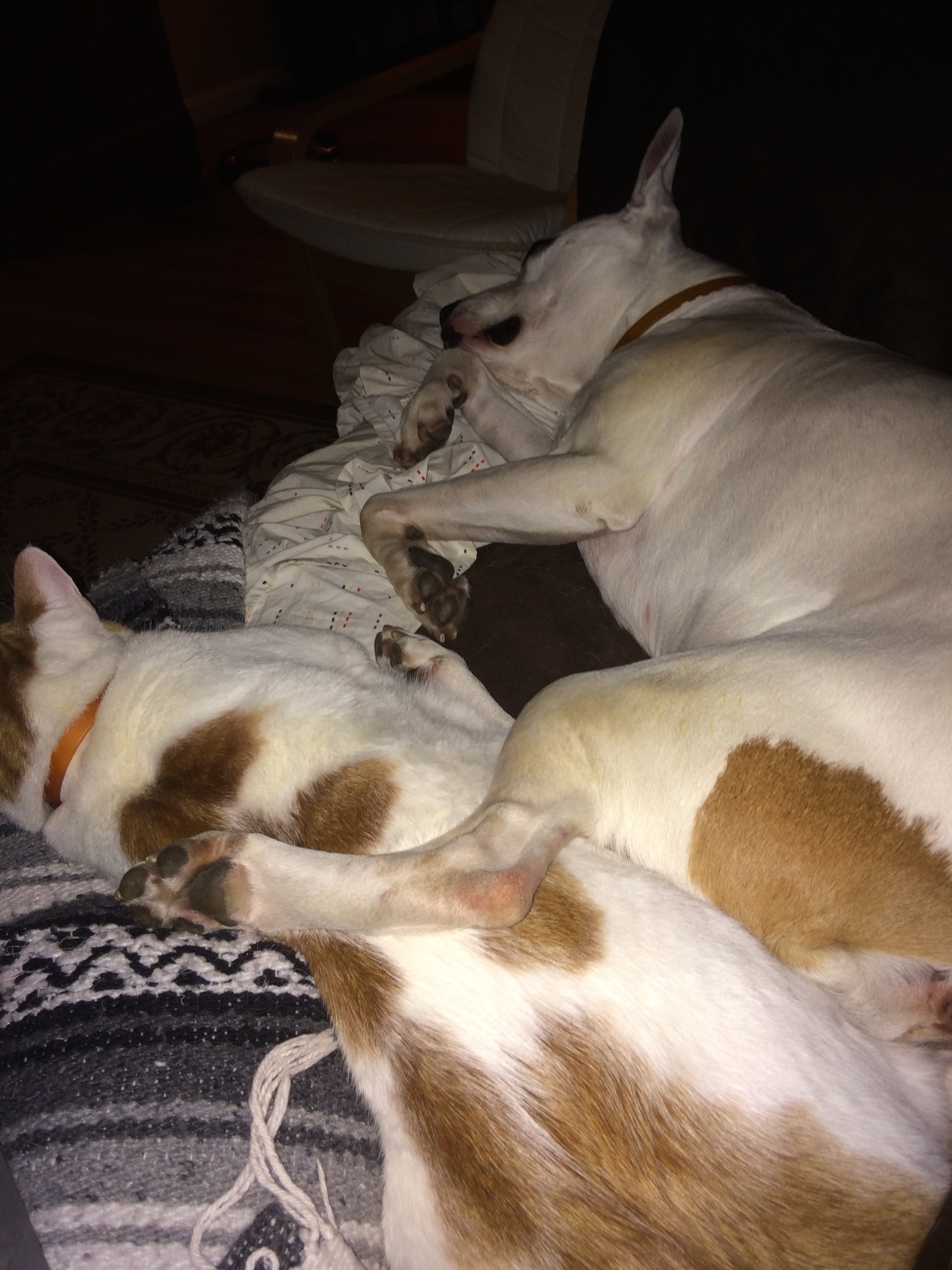
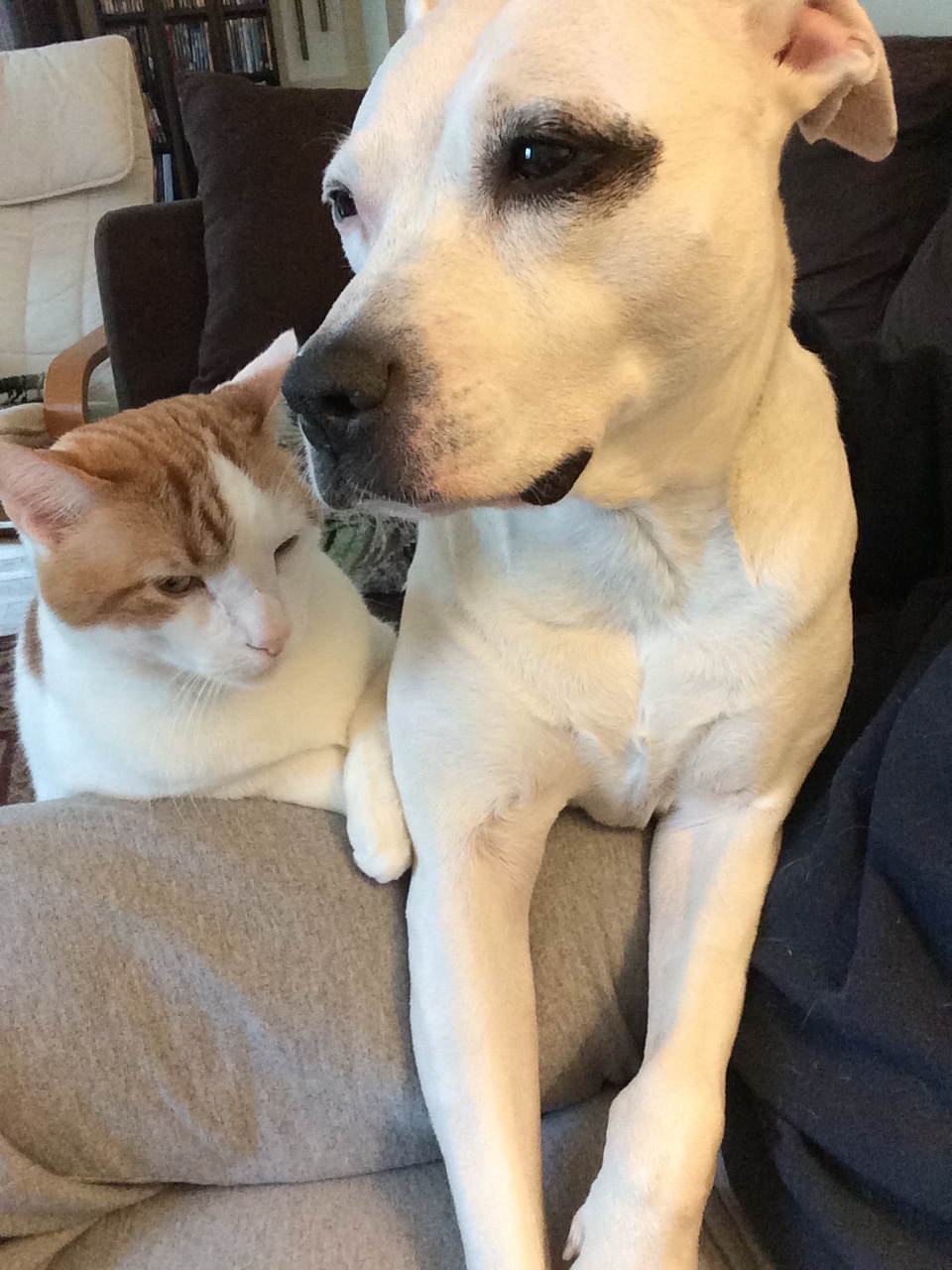
I will be sharing my own experience of integrating my rescued cat, Malcolm, in with my American Pit Bull Terrier, Inara.
Malcolm and Inara
Day 1 – The Grand Arrival
Just like when bringing home a new dog, cats can also benefit from a decompression period. Whether they were a stray, or came from a shelter, or a foster home, or a pet store, or wherever, cats don’t like change. The new cat will really appreciate a chance to settle in with some peace and quiet to learn the smells, sounds, and activities of its new home. I did this by setting up my spare room for Malcolm. He had food, water, a litterbox, and comfy blankets to lie on. I would take a book and just go in and read, sitting on the floor, while he explored his new room and me. When he solicited attention I’d give it to him, but I didn’t push it on him.
It’s important to make sure the bedroom door remains firmly shut though. We want the cat and dog to be able to hear and smell each other without being able to touch.
It is so important give the dog plenty of attention during this period. Sometimes it’s easy to get caught up in the wonders of a new pet and spend all your time with the new arrival. Do spend plenty of time with the new cat, but don’t neglect your other pets.
Baby Gates Are Your New Best Friend
When both the cat and dog seem relaxed with the situation, you can move on to the next step. I cannot emphasize enough that days should be dedicated to these steps, not hours. Going slowly at first, even though it’s hard, will pay off in the end. And if you have any hesitation on whether either animal is ready, don’t move forward. And if at any time either animal is stressed, slow down and back up a step.
Now it’s time to open the door. However, for the safety of both cat and dog, you want a barrier. I chose to use a tall metal baby gate to provide separation. If I’d had any doubts that Inara might go over it, I would have stacked two gates. Then alternate sitting on each side of the baby gate, doling out yummy treats to both cat and dog for appropriate, non-confrontational behavior.
Here are two videos from when I was at this step with Malcolm and Inara. Neither are exciting at all – this is what you want though! Boring is good. In the first video, Mal isn’t quite up to going over to the baby gate, but that was okay. The second video is long, but I didn’t cut it because it shows what a slow, steady process this is. In that video, they do have their first official greeting.
The Raising Of The Gates
This is a big step, but if you have done your homework and not rushed things, it should go very smoothly and without fanfare. At this point, dog and cat are relaxed while sniffing each other through the gate and there has been no barking, growling, hissing, spitting, or swatting. So once again, it is time to arm yourself with something comfortable to sit on, a book, and yummy treats (for the animals, not you). Then raise the baby gate up about a foot. You want the cat to be able to easily come and go underneath it, but you don’t want it high enough that the dog can get under it. Quietly sit and read and whenever the cat is brave enough to come out and explore a little, dole out treats. Whenever the dog is being gentle in her behaviors towards the cat, dole out treats.
Final Steps
Once this major milestone has been reached without difficulty, it should be smooth sailing. Before letting the two have free roam of the house together, put the dog in her crate or in a bedroom and let the cat explore the house. We want him comfortable in his full surroundings before he is expected to happily deal with a dog AND new surroundings. If you are comfortable that the dog will not bust her crate to get to the cat, you can leave the cat out while you’re at work and dog is crated (or in a bedroom).
Eventually you can give them both free reign in the house together. It’s so important to ensure that the cat always has escape routes from rooms and high places to flee to if necessary. I kept the baby gate up but raised for quite a while, just so Malcolm always had his safe place.
Even though there is peace in the household, I am a firm proponent of “better safe than sorry.” Keep cat and dog separated at meal times and separated when you are not at home. All it takes is one incident and you have a seriously injured or dead cat or dog. A little management goes a long way to maintaining a happy household.
Malcolm’s foster home had dogs, and Inara grew up with a cat, so you’ll see by the Youtube dates that within a few days these two were fully integrated. I do NOT encourage this speed and would have gone infinitely slower if they both weren’t already familiar with the other species.
Good friends
What other tips do you have for integrating dogs and cats?
Get Dog Training Business Tips!
Receive valuable dog training business tips and resources every week! Subscribe to The Modern Dog Trainer now by submitting your name and email below.
It’s a life saving behavior and one that needs to be taught like any other behavior. It is one of the most difficult behaviors to get reliably but it shouldn’t have to be. With practice, patience, and consistency anyone can achieve a reliable recall. There are many different ways to teach “Come” and below we’ll examine 5 of them.
“How to Train a Whistle Recall” by Pamela Dennison
Pamela starts with the first steps of teaching the whistle recall. It begins with charging the whistle. With every blow of the whistle she delivers high value treats. She puts a lot of emphasis on the use of the high value treat versus commercial treats. She gives a timeline of how long your should work on charging the whistle and the importance of not rushing the first steps of any recall. This video does not cover it but with the following videos you will see how to gradually add distraction to begin proofing the recall.
“How to train “Come!”” by Emily Larlham – Kikopup
Emily teaches the first steps of “Come” with the dog on leash. She begins by just simply backing up, clicking & treating when the dog moves with her. Once this becomes reliable she adds the recall cue. Once the dog is reliably coming, Emily then works on adding distractions while the dog is on leash. The art of teaching come on leash first is to set the dog up for success so that it never learns that not responding to the cue has any value.
“How To Train Your Dog to Come” by Training Positive
In this video, the fundamentals are brought into training the recall. The focus is on rewarding your dog for checking in while in a distracting environment and utilizing a “watch me” cue. These behaviors are a precursor to letting your dog off leash so that your dog remembers that you exist while in a stimulating situation and increases the likelihood that they will continue to check in with you. The other aspect of teaching come that Training Positive uses is once you have your dog come to you engaging them with other behaviors or tricks.
Zak George begins teaching the recall by making it a fun game for you and the dog. Making it fun will get a faster recall. In his video, Zak uses a footage from training a puppy recall for the first time which is useful because you are able to see when real life issues arise and how to troubleshoot them when they happen.
In Ian’s short video, he starts with luring the dog backwards to follow him, then into a sit and as he delivers the treat he is touching the dog’s collar. Ian explains the importance of touching the collar as part of the recall because if you need your dog to come to you it will do you no good if you can’t actually catch your dog. As in other videos he keeps the distance short and the distraction low while practicing the sequence of events.
While all these videos are similar, they offer different perspectives on teaching the recall. The one thing that is consistent within these videos is that you can’t rush this behavior. If you want to get a reliable recall you have to practice and build the behavior by starting with low distractions and always proofing.
What ways have you found most effective to teach a dog to come?
Get Dog Training Business Tips!
Receive valuable dog training business tips and resources every week! Subscribe to The Modern Dog Trainer now by submitting your name and email below.
Teaching a dog to walk on leash seems to be one of the most difficult behavior for owners to accomplish with their dogs and it shouldn’t have to be. When it comes to walking the dog, the emphasis is on rewarding the dog for walking on a loose leash. This leaves a lot of wiggle room for where the reinforcement should be. Is it when the dog is in front, behind, or next to you? Perhaps it’s when the dog is crossing behind or in front of you? If we teach the owner how to train a heel we are conditioning them to look for a specific position which can help them be better with their timing and reinforcement.
3 Options To Teach Your Dog How To Heel
Utilize Your Surroundings To Limit The Dog’s Choices
Training Positive utilizes a wall and a chair to help position the dog into a heel. The heel in this instance is on the right but ultimately the heel is more of the dog’s position in relation to you, so it can be on the right or the left. You can teach your dog to heel for the left side and label the right side something different so that you have a dog that can walk on either side of you. Training Positive shows the small steps and the patience it takes to use the lure, to just the hand signal, and fading out the hand signal to just a verbal cue.
Start With A No-Motion Heel Position
K9-1 starts out by beginning with a stationary work luring the dog back into position while giving the heel command. Once the dog is reliably targeting the general location just behind your left leg K9-1 trainer starts adding only 1 step to the process, keep it short and sweet. Gradually she begins to increase her movement and as that improves also starts to reward in intervals. K9-1 discusses how to troubleshoot if your dog falls out of the heel, how to get them back into it, and then also the importance of having a release cue to allow your dog to exit the heel position which is very important.
Teaching Heel With Platforms
With the use of 4 square mats with the handler standing in the middle of them, this trainer, Stonnie Dennis, utilizing targeting of mats to teach his dogs what position he wants them in. He uses positive reinforcement and emphasizes the importance of if the dog does his part then we need to be certain to do ours and reward the dog using food or toys. Stonnie also puts emphasis on repetition and putting in the work to achieve the proper heel position. For the handler that wanders too much when teaching the heel, you utilize the mat for them, to ground them to one spot, and have the dog rotate around them.
Have you used other tricks to teach your dog to heel?
Get Dog Training Business Tips!
Receive valuable dog training business tips and resources every week! Subscribe to The Modern Dog Trainer now by submitting your name and email below.
[mc4wp_form]
Other articles you might find useful when teaching a dog to walk on leash.
As you become a better trainer and further your knowledge and chops in the training world you may want to start seeing behavioral cases. The one thing I learned to do very early on is to rule out anything medical first. There are so many illnesses that can masquerade as behavioral issues.
Take a moment and think about how you behave when you’re under the weather, have an ache, or pain in a bad knee. Are you fun to be around when you’re experiencing pain of any kind?
Photo by Erin Bessey
Medical Causes For Aggression In Dogs
Our dogs and our clients dogs can be incredibly stoic and muscle through certain aches and pains and feelings of malaise. But there are occasions when unwanted behavior appears because of not feeling well.
Thyroid Abnormality Based Aggression
Part of the endocrine system, the thyroid is a butterfly shaped gland located in the neck, just below the larynx and partially wrapped around the trachea. It secretes two major hormones, thyroxine (T4) and, to a lesser degree, triiodothyronine (T3). These hormones play an important role in controlling metabolism, affect the heart, regulate cholesterol synthesis and degradation, and stimulate the development of red blood cells (erythropoiesis). Thyroid hormones are also essential for the normal growth and development of neurologic and skeletal systems, in addition to other roles.
Most dogs that suffer from hypothyroidism have what’s called autoimmune thyroiditis which can be hereditary. Sometimes the hypothyroid patients will have increased cortisol levels which can chemically mimic a constant state of stress. In this case, no amount of training will help! Typically, thyroid issues will fall into one of the following categories, aggression, extreme shyness, and seizure like activity.
Arthritis and Joint Pain & Aggression
We forget how quickly our beloved pups age and as the age they can develop aches and pains and arthritis, it’s important to get a proper arthritis diagnosis.
How does this present? A lot of times our dogs and client dogs will show disinterest in activities they used to enjoy such as running and jumping. Some dogs may start nipping or behaving more grumpy when touched or pet. Thank goodness that here are a lot of wonderful treatments available to provide relief to dogs. But stay informed and ask about the long-term and side effects of certain pain and anti-inflammatory medicines. The medicines available can provide great long-term comfort so they can get back into the swing of things.
Ear Infections & Aggression
Certain breeds have a predisposition but any dog can get an ear infection. This is generally painful for the pup when the infection gets out of hand, starting by a lot of itching and followed closely by inflammation and swelling. Some tell signs that your dealing with an ear infection can be head and face rubbing on walls and carpets and a “funky” yeasty smell coming from the ears.
Eliminate Medical Issues Before Treating The Dog’s Behavior
These are just a few of the many illnesses that can masquerade as a behavioral issue, by ruling out anything medical you can then formulate a behavior program for your clients dog.
For all of these “behavioral” issues a vet is needed. I will always offer to continue to work with the family to counter condition the pup to handling. Teaching families to do the handling and practice with mock vet visits will make vet visits more tolerable for the family and their dog.
I would love to hear of your experiences ruling out medical issues for behavior problems! What are some medical issues that you have found can trigger aggression in dogs?
Get Dog Training Business Tips!
Receive valuable dog training business tips and resources every week! Subscribe to The Modern Dog Trainer now by submitting your name and email below.

 With Pocketsuite, you can schedule a lesson or package of lessons with a client and rest assured they will receive a reminder notification at a set time before their lesson(s). Never worry about forgetting their lesson, forgetting to send a reminder, or purchasing a separate reminder service for your business.
 PocketSuite integrates very simply with any website. Through the app, sign up for the widget and it will send you instructions on how to set up online registrations on your website. You can adjust your availability within the app – on the go – and it will seamlessly update with your online widget to prevent double booking.