![The Humane Hierarchy Of Behavior Modification Explained]()
by Ines | Nov 12, 2014 | Training Methods
The Humane Hierarchy is a model in which training methods are ranked from leash invasive to most invasive. Dr. Susan Friedman, a well-respected and knowledgeable behavior analyst, coined this term and model. This model has been adapted by the Certification Council of Professional Dog Trainers as the guide for their trainers to use when working with dogs.
The model is broken down into 6 levels. Trainers should thoroughly explore the options at every level before escalating their training method to more intrusive choices.
Health, Nutrition, and Physical Setting
Health and nutrition affect a dog’s body chemistry and, thus, its behavior. Failing to address the dog’s medical issues will likely reduce the effectiveness of any training. For example, consider a dog that is acting aggressively when a child pets the dog on the head. If the dog is experiencing pain due to an ear infection, the dog is only reacting due to the pain the petting causes the dog. Behavior modification will be ineffective to change this dog’s reaction. A professional dog trainer should understand some key signals that pain or medical issues could be the route of a problem so they can refer to a veterinarian when appropriate. Many trainers choose to have clients take their dogs to the vet for a wellness exam before any training begins.
Antecedent Arrangement
Much problematic behavior is a response to an environmental trigger. A dog’s behavior is influenced by the environment. Manipulating the environment so that the dog does not experience the trigger can eliminate the entire problem. Without thoroughly completing this step before moving on with more intrusive training, the antecedent to the dog’s behavior may continue to trigger the same response. For example, if a dog barks when he sees other dogs through a window, applying a frosted window film at the dog’s eye level will eliminate the problem without further intervention. Without this step, training will not progress as smoothly as it could.
Positive Reinforcement
Once a dog’s health has been examined and the antecedents to the behavior have been eliminated or changed, positive reinforcement is the least intrusive way to modify behavior. Positive reinforcement is the addition of something the dog desires in order to increase the frequency of the behavior in the future. Ultimately, dogs repeat behaviors that create desirable consequences. Setting up the environment to help the dog make the right choices and then using positive reinforcement to reward those choices is the most humane behavior modification method if it can be applied safely.
Differential Reinforcement of Alternative Behaviors
Differential reinforcement involves strongly reinforcing certain alternative behaviors to the problem behavior. It also includes removing the reinforcer for the problem behavior.
Negative Reinforcement, Negative Punishment, & Extinction
Notice the yield sign before this option in the chart. These behavior modification methods can increase stress and anxiety in the dog. The emotional ramifications on a dog should be considered before utilizing these. Much of the stress can come from the dog’s lack of understanding of what it is supposed to do instead of the problem behavior. Once the problem behavior stops producing the dog’s expected consequence, the dog can experience frustration and anxiety. The dog may not have a clear understanding of what will work instead.
Positive Punishment
The stop sign before this option in the chart reflects the fact that this is a last resort. The CCPDT suggests that trainers consult with one another to find alternative solutions to positive punishment. Positive punishment is the addition of something the dog deems undesirable and works to avoid in order to decrease the frequency of the problem behavior in the future. Most likely, all the other options have not been exhausted if a trainer chooses to use positive punishment as a means to train a dog. Environmental management, health, and less invasive techniques should be thoroughly implemented before utilizing positive punishment. Lack of creativity and problem solving skills can often lead trainers to use this method too soon.
Do you consider yourself a Humane Hierarchy modern dog trainer?
![5 Reasons To Encourage Crate Training With Clients]()
by Liz Wyant | Nov 7, 2014 | Training Methods
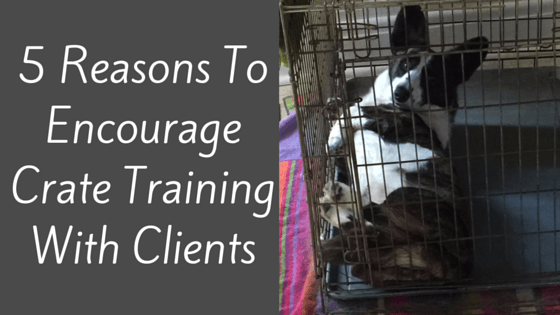
Crate Training Can Seem Peculiar To Clients
For those unfamiliar with crate training, it can seem cruel, almost as if the dogs are being caged like zoo animals. However, as a savvy trainer, it is important to be able to explain to your clients a few reasons they should strongly consider crate training.
Know Where The Dog Is
Explain to your clients the great peace of mind that can come from knowing exactly what scene they will be walking into upon their arrival home – their dogs, happily wagging, safely contained in a crate, nothing in their home destroyed. Day after day, consistently.
Home Security Systems
Many people these days have home security systems. Remind your clients that if their alarm system goes off and the police are notified, the police WILL enter their home, with or without them present. Wouldn’t your clients rather know their dog is safely out of harm’s way due to being happily crate trained?
Windows = Automatic Dog Trainers
When dogs have access to windows during the day because they are free roaming, they can learn some valuable lessons. Valuable to them, at least. These include: barking scares the mail carrier away; barking scares pedestrians away; barking scares passing dogs away; barking scares delivery people away. That means your client’s dog has learned that barking excessively makes things go away. This is not really a lesson most people want their dogs to possess! Crate training keeps the dogs away from windows, preventing them from getting over-aroused multiple times throughout each day.
Learn To Relax
Dogs that are permitted to roam around the house, pestering the cats, barking out the windows, and finding other ways of entertaining themselves have a high probability of getting into trouble. Crate training teaches dogs to relax and enjoy downtime, especially when left with a lovely chew toy or work-to-eat toy in their crate.
No Issues With Other Household Animals
Many of your clients will be multi-pet owners. Whether those pets are all dogs, dogs and cats, dogs and birds, or some other combination, crate training ensures the safety of all animals in the household. Encouraging your clients to crate train means they will not ever have to be concerned about coming home to an injured or dead pet due to a fight that may have started over something as insubstantial (to people) as a tissue on the floor or play that escalated without supervision. Clients enjoy knowing that all of their beloved pets are safe and happy and will remain so.
Many clients may balk at the idea of crate training. Being able to calmly explain different benefits of it will enable them to start working through their antipathy towards the idea.
What are some other reasons you can think of to encourage crate training?
Recommended Links
![5 Reasons To Use Rally Obedience Signs In Your Basic Level Training Classes]()
by Laurie Schlossnagle | Nov 6, 2014 | Training Methods

Rally Obedience Signs Can Be Valuable In Any Dog Training Class
No need to reinvent the wheel…there is probably a rally sign for it! Rally obedience signs are not just for Rally-O training and competitions. Rally is a sport designed for handlers and dogs at all stages of training. Utilizing the signs not only works in a basic level class, but also makes sense and has a variety of benefits.
1. Accommodate Visual Learners
Visual learners can SEE what you are asking them to do and may process information better and more efficiently. Addressing and accommodating learning styles in both the handler and the dog will be a benefit to both you and your students. It will make your classes unique and effective.
2. Students Don’t Have To Wait For Further Instructions
It allows for teams to work individually while you are assisting other teams. Setting up signs in your training space with numbers or symbols for your students to follow independently gives you more time to help other teams one-on-one.
3. Choose From A Variety Of Venues
There are several venues of rally obedience; allowing for a visual variety of the same exercise. Check with local competitors and/or clubs to find out what venues of rally obedience are popular in your area. Using several of the locally popular venues gives you and your students variety in class and exposure to dog sports. Below are to signs from five different organizations that offer rally obedience competition:
4. Custom Training In A Group Setting
When teaching rolling enrollment classes, the signs can help you address the different levels of your students. For Fido’s first class, using the “sit” sign gets Fido up and moving and involved right away; for Fido’s next class, using the “sit-walk around (stay)” sign begins the 3-D instruction/training (duration, distance, distraction). While Fido is working on his “sit” and “sit-walk around (stay),” Spot is working on “sit” and “down” and Rover is working on polite leash walking using the pace change signs (“slow,” “fast,” and “normal”). The rally obedience signs are a great way to adjust to each dog’s skill level.
5. Easy Introduction To Students’ Next Possible Class
It may get your students interested in doing something beyond your basic level training class (increasing retention and income). Many students are interested in doing more with their dogs beyond the basic levels, but are not sure how to proceed. Having already seen the rally signs in class will encourage and empower students to continue with their training and strive to do more with their dogs.
Do you use rally obedience signs in your classes?
Recommended Articles:
![3 Ways to Use Active Listening with Clients]()
by Katya Rowny | Nov 3, 2014 | Training Methods
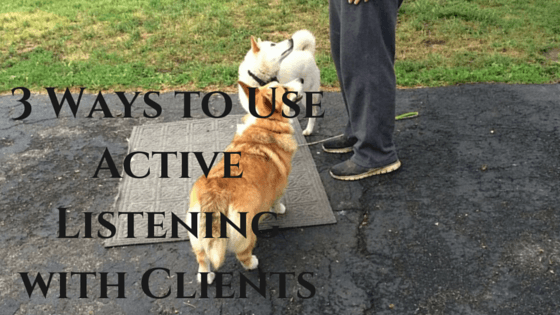
Active Listening With Clients Can Help Your Clients Go From Confused To Cooperative
Being a dog trainer involves more than having a background in dog knowledge, it requires us to utilize our people skills. As much as we’d love to say “it’s all about the dogs”, in reality a majority of our interactions are with their humans. People skills are an important tool of the trade and can go a long way in strengthening our relationships with our clients.
Active listening with clients is a key aspect of our jobs and a skill we have to work on so we can be more effective in our work.
1. Give Your Full Attention
No texting or multi-tasking when speaking with a client. Just as your time is valuable, their time is, too. Make eye contact, and periodically give feedback that you are engaged by saying things like “yes” and “uhuh”, because this encourages the speaker to continue. Make sure your body language is open and inviting, as well as your facial expressions – smile!
2. Provide Feedback
Sometimes it’s hard to put into words what we want or need. The same goes for frustrated dog owners. When you’re providing feedback, acknowledge what was just said to you such as “It sounds like you are saying…” or “I hear you saying this …, is that correct?” This helps to re-focus the conversation on the client and to let them know you’re on the same page.
3. Defer Judgment
As dog trainers, we pride ourselves on our wealth of knowledge in the field. When speaking with a client, don’t interrupt with counter arguments. We have all been in positions where we’ve been embarrassed by our dog’s behaviors. By actively listening, you are reassuring the client that they aren’t alone during the training process.
As much as dog training has to do with dogs, it has even more to do with their humans. Being a good listener will help the owner achieve their training goals. Training is an ongoing process with ebbs and flows and if we can be a source of reassurance and guidance for our clients, we are doing our jobs successfully.
Recommend Articles
![Do Bad Dogs Exist? Helping Your Clients Look At Their Dog Objectively]()
by Erin Bessey | Nov 3, 2014 | Training Methods
In group training classes it is common to touch base with the students on how their week went. Without missing a beat they will inform you of everything that went wrong. The dog stole the cat food, they chased the cat across the yard, or wouldn’t leave the turkey poop in the field. It is so easy to get stuck on the negative that it’s time to shift the focus and start asking “What went well?” encouraging owners to focus on the positive.

Image via Erin Bessey
There Are No Bad Dogs, Some Just Need Extra Guidance and Training
Encourage owners to look at the dog’s behavior objectively. Help them realize that the dog has been set up to act that way. They have been influenced by the environment, genetics, or information they have received from the handler. When observing the dog, help them ask “Why is my dog doing this?”
Reinforce the Behaviors You Want to See Again Rather Than Reinforcing the Dog
Don’t punish the dog for acting like a dog. Barking, chewing, pulling on the leash, not coming when called, pottying inside and so on are all normal doggie behaviors that most people don’t like. Owners usually view behaviors as bad, good, abnormal, or normal but it really boils down to desirable and undesirable behaviors which should be established by the owner.
Time to Rephrase
To replace the “bad” behavior, train an alternative “good” behavior while managing the environment to prevent the “bad” behavior from occurring. Reinforce the absence of the undesirable behavior or interrupt it with a trained behavior before it is reinforced. What speaking with clients avoid saying, “We don’t like when the dog…” and consider saying “We want the dog to …” or “We need to work on….” For example, instead of saying “We don’t want the dog to jump on visitors when they come over,” we could say, “We want the dog to lie down on his mat when visitors come over” or “We need to work on polite greetings with the dog.” It gives the owner a picture of what they do want and set an obtainable goal.
Once the goal has been set, make it a habit to check in each week with them and ask “What went well?” It will keep the client on track to reach their goal and remind them to focus on the positive which, as we know, with practice will get easier.
What other questions could you ask clients to help them think positive and gain information about their progress?
![5 Ways To Reduce A Dog’s Stress In Class]()
by Liz Wyant | Oct 25, 2014 | Training Methods
As a modern dog trainer, you’ve studied canine body language. You are confident in your ability to identify when a dog is experiencing stress. But now that you’ve identified that dog, how do you help it?
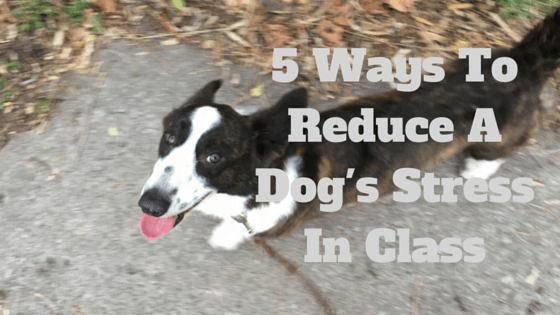
Increase Distance From Dog’s Stressors
If space permits, this can often be the easiest way to help a dog. If the dog is experiencing stress due to proximity to other dogs, move him away. Getting him away from his stressors can allow him to relax enough to benefit from counter-conditioning and desensitization and learn the material you are covering in class.
Put Up A Visual Barrier
Sometimes your space is limited and you can’t move the dog away from her stressors. At this time, consider a visual barrier. Even something as simple as a ring gate with a sheet tossed over it can help the dog relax. This can be especially beneficial if the dog is experiencing stress due to other dogs looking at her. Blocking eye contact is quick way to reduce stress in class.
Increase Rate Of Reinforcement
If the dog in your class is still eating but perhaps getting a bit “sharky,” there is a good possibility the dog is experiencing stress. These dogs might be looking around at their environment while doing the bare minimum required to get a treat from their owner. Encourage the owner to start rapid-firing treats, rewarding for each task. This can help dogs focus on the training instead of their environment.
Do Simple Tasks At Which The Dog Is Proficient
So often when dogs get to higher levels of obedience/skill, owners don’t reward the little things as much. However, when a dog is experiencing stress, it can be beneficial to have owners drop back to beginner-level skills and reward for those to help build the dog’s confidence up. Those behaviors have a strong history of reinforcement so the dog will be able to successfully complete those tasks and get heavily praised. Training should not always get increasingly difficult because that can be very discouraging for a dog.
Massage
Some dogs are very tactile-oriented and want to be by their owners when experiencing stress. If you have a dog like this in your class, encourage your clients to do some slow, steady massage on their dog. You might find that all the dogs in your classes benefit from short breaks from training with massage and perhaps relaxing music playing (check out “Through A Dog’s Ear”).
Being able to identify stressed dogs is just the first step. You need to have the skills to successfully help the clients ease their dog through the stressful event. Having many options in your toolbox can be of great benefit to both your clients and their dogs.
What is your recommendation for reducing a dog’s stress in class?
Recommended Articles