![Lessons From A Weekend With Ken Ramirez]()
by Liz Wyant | Dec 4, 2014 | Events, Training Methods

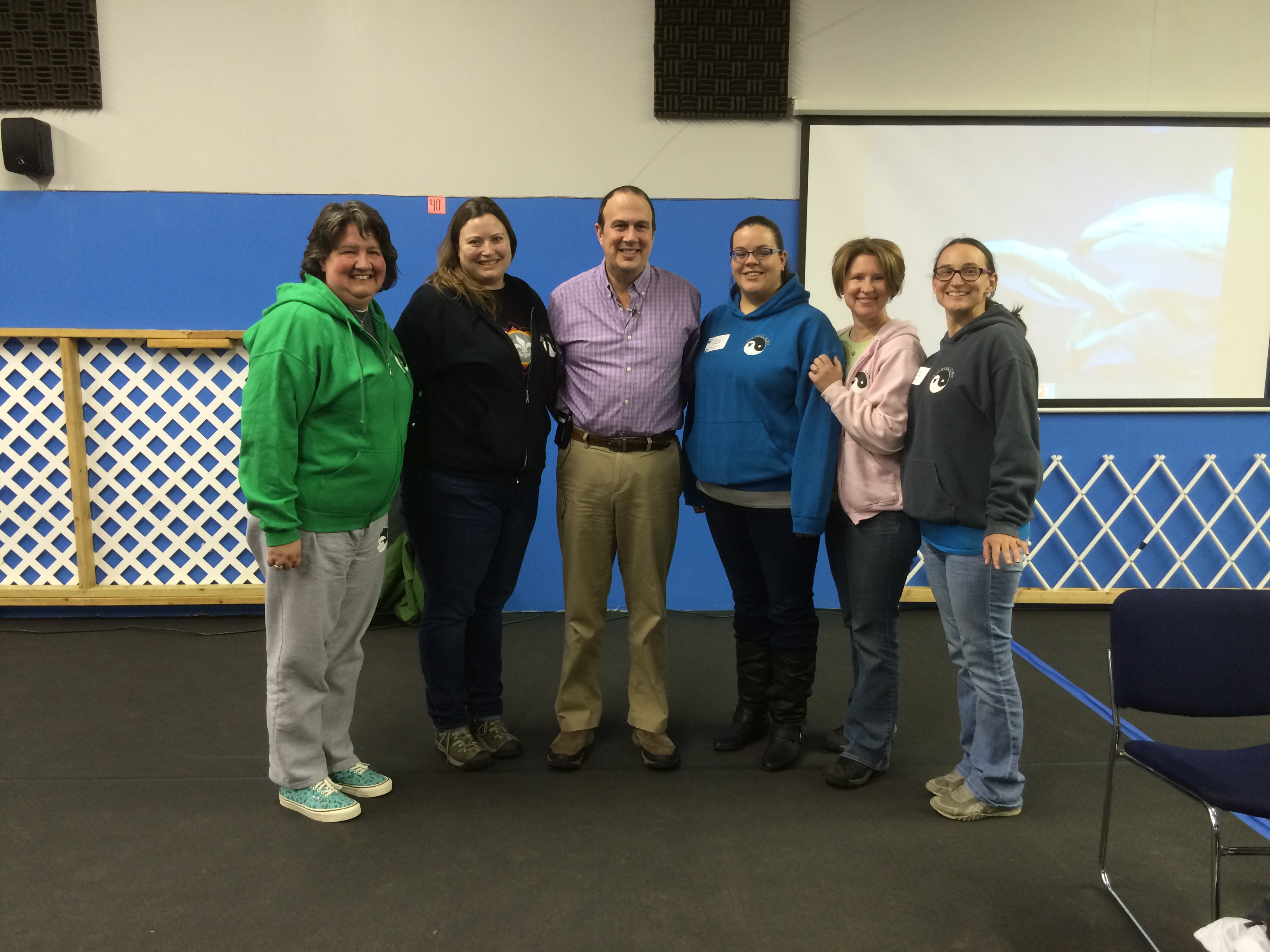
Ken Ramirez, Liz Wyant (the author of this article), and some of her friends at his Cleveland seminar.
A Weekend With Internationally Recognized Animal Trainer, Ken Ramirez
Ken Ramirez has been in the animal training/behavior world for over 35 years. He has worked with guide dogs, law enforcement K-9s, zoo animals, and marine animals. He has worked at Chicago’s Shedd Aquarium for 26 years, most recently as the training advisor. In October of 2014, he started a new role as the Executive Vice-President and Chief Training Officer of Karen Pryor Click Training. Ken is an avid proponent of force-free animal training.
In November, Ken presented a two-day seminar we were able to attend. 26 pages of notes later, here are some of the concepts we felt were most important.
Training 101
Ken describes training as teaching an animal what the rules for living in a particular space are. He emphasizes that it should be a shared process; the animal should WANT to be with that person and should WANT to train.
Ken feels the cornerstones of animal care are:
- Health Care
- Nutrition
- Environment
- Behavior Management – As Ken says repeatedly, “training is not a luxury.”
That last point is what struck me the most – training is not a luxury. So often our clients factor in costs of health care, food, and grooming, but not training. Training is only used when something goes bad, not to provide the mental stimulation that dogs need to have a basic, happy and healthy life.
Least Reinforcing Scenario/Stimulus (LRS)
Ken explained the LRS as the most positive approach to dealing with unwanted behavior. It was developed in the zoological training community as a way to operationalize the mantra of “ignore the unwanted behavior.” Though very basic, it can be a powerful tool. The Least Reinforcing Scenario is simply a 2-3 second neutral response after an animal gives an unwanted behavior, followed immediately by another opportunity to earn reinforcement. For example, you cue a dog to sit and it lies down instead. Immediately when the dog lies down instead of sits, give a neutral response for 2-3 seconds and then cue the dog to do a different cue that you are positive they can successfully complete.
So what is a neutral response? There is no straight answer to this. It is not a freeze, it is just a continuance of what you are doing – if you are looking at the dog, keep looking at the dog. If you were in the process of scratching an itch, keep scratching the itch. The key is to just maintain the environment so the dog is neither punished nor rewarded. This is only effective for a dog that is accustomed to working in a positive reinforcement environment. When you reward, reward, reward and then don’t, the dog will notice the lack of rewarding. There’s no need to extend the time or get emotional – just 2-3 seconds of a neutral response is enough feedback.
Alternative Reinforcers
Alternative reinforcers are learned reinforcers. They can be anything – clapping, toys, touch, play, words, or anything else the animal values. They give you a chance to provide some variety in your reinforcers to keep the dog excited about working with you. Alternative reinforcers need to be trained as behaviors so the dog understands what they mean. This means it needs to be paired with food and marker signals and practiced for weeks. Once the dog begins to value the alternative rewards, you should still use treat rewards 80% of the time during training sessions.
For alternative reinforcers to be effective, the trainer and animal must already have a predictable and solidly established relationship. It is incredibly important to constantly maintain the strength of the alternative reinforcer by keeping it paired with food. Also, be mindful that if a dog’s behaviors deteriorate after using the alternative reinforcer, the alternative reinforcer is NOT a reinforcer at all!
These are just a few of the topics that Ken discussed. He kept everybody captivated for two full days and we left feeling invigorated about training and ready to try his ideas. Should you get the opportunity to see him, we couldn’t recommend him highly enough!
Have you tried using LRS’s or alternative reinforcers? Tell us in the comments!
Get Dog Training Business Tips!
Receive valuable dog training business tips and resources every week! Subscribe to The Modern Dog Trainer now by submitting your name and email below.
[mc4wp_form]
![3 Ways To Reduce A Dog’s Stress During Training]()
by Monica Callahan | Dec 3, 2014 | Training Methods
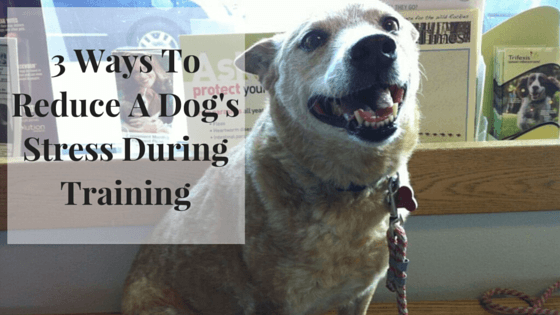
Reducing Stress In Dog Training
The very nature of training can be stressful to a dog. Not all stress is bad. However, when a dog has many different stress-inducing factors piled on top of each other, this can become overwhelming and cause the dog to act out or shut down. When a dog is too stressed out, learning does not occur. For this very reason, we must try to minimize the amounts of environmental stress our dogs experience during training. Here are three ways you can reduce stress in dog training.
1. Clean Clicker Mechanics
If a teacher were asking you questions in class and then having to look up every answer you gave them to make sure they were right, you’d become incredibly frustrated after a while. The same thing can happen with our dogs. If our marker words or clicks are too slow, our treat delivery sloppy, or our attention is not completely on our training session, the dog is likely to get frustrated and may stop trying. Making sure your mechanics are clean and on time will do a lot for a dog’s confidence and stress level. It’s also our job, as the trainer, to make sure our client’s mechanics are clean. Playing some clicker mechanic games before introducing your client’s newly acquired training skills to their dog can go a long way for the stress level of their dog. You can find more about clicker mechanics here.
2. Appropriate Distraction Levels
When a dog is worked in an area where there are too many distractions for their level of training, they can become incredibly stressed for a few different reasons. If the dog is prone to being anxious, too many distractions can cause them to go through information overload and they can become stressed out. When a dog is stressed, they cannot provide their owners with the attention their owners want. When the owners see their dog’s attention elsewhere, the owner can become stressed with the training process. Feeding off the owner, the dog becomes even more stressed. It is a stressful cycle to get in. To make both the dog and owner successful, lowering the distractions around the session to a level the dog can be successful is key.
3. Small Steps
When we are working with clients and their dogs, we are generally helping them build behaviors for their dogs. We have to take small steps towards the big picture goal. When we expect dogs to take leaps in training, they can become lost and get stressed when they don’t know what we are asking for. Training will go quicker when we ask for smaller steps that they can build on quickly. Taking larger steps may slow us down as the dog has to guess and interpret what we are asking for.
Some level of frustration will always be present in training, however, we should always do our best to make sure the least amount of frustration is present when training. Showing our clients how to use a clicker and how to build behaviors appropriately is our duty as a trainer. When our dogs are happy, we will get cleaner, quicker, and better behaviors.
What other ways can we lower our dog’s stress during a training session?
Get Dog Training Business Tips!
Receive valuable dog training business tips and resources every week! Subscribe to The Modern Dog Trainer now by submitting your name and email below.
[mc4wp_form]
![Preventing Bribery: How To Get Treats Out Of Your Client’s Hands]()
by Monica Callahan | Dec 1, 2014 | Training Methods
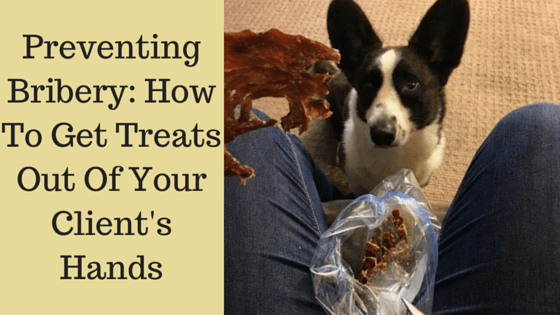
How To Prevent Bribery In Dog Training
In the dog training world, there seems to be two big groups of clients. On one side, there are clients who are incredibly stingy and hoard treats like they are gold, and on the other side, there are clients who never let a treat leave their hand or in front of their dog’s noses. For those clients who find it hard to put down the treats, we have to get creative and find ways to get those treats out of their hands. Here are some tips on how to prevent bribery in dog training.
Treat Bags
If clients are working away from their ziplock bag of treats, it is likely that they will take handfuls so they don’t have to keep going back to the bag every click. A treat bag on their waist or a treat vest will keep their treats accessible so they do not have to load up a handful before a training session.
Let Me Help You
As a teacher, we are there to monitor our students. If we hold the treats for our clients, then we can monitor when they go for the treats. This can make our clients more aware of their clicker and treats, and prevent them from grabbing a treat before they click. This technique does require you to accompany the client as they work so their treats are accessible. An approach like this may not be appropriate for everyone or every dog. Assess your situation before utilizing this approach.
Positions
If your client consistently grabs for a treat before the click, try finding a ‘home’ station. Collaborate with your client and find a position that their hands can go back to every time after clicking and treating. Once they use the position enough, it will become second nature and will get rid of the premature grabbing of the treats. This technique can also be used with the previous suggestion.
TAG Teaching
TAG teaching is the human equivalent of clicker training. You, the trainer, will come up with a TAG point for your client. A TAG point is the criteria of what you want. An example could be, “The TAG point is hand on thigh.” It would be your client’s job to return their hand to their thigh after every click/treat. When your client does place their hand on their thigh, you would click your own unique clicker just for your client. In this case, the click is reinforcement to your client for a job well done. TAG teaching makes your client aware of what is expected of them and makes them more aware of what they are doing. After enough times, it becomes routine for your clients to keep placing their hand on their thigh. To learn more about TAG teaching, visit their website here.
Being a trainer means that we must be good teachers to our clients. When our clients have good clicker mechanics, they can achieve anything they want. Sometimes we have to use our creativity to help our clients become proficient at training.
What other creative ways have you used to get treats out of your client’s hands?
Get Dog Training Business Tips!
Receive valuable dog training business tips and resources every week! Subscribe to The Modern Dog Trainer now by submitting your name and email below.
[mc4wp_form]
![10 Ways To Use A Mat In Training]()
by Laurie Schlossnagle | Nov 24, 2014 | Training Methods

Excellent Reasons to Use a Mat in Dog Training
A mat, or a defined place for a dog to “go to,” is a versatile and useful behavior to teach a dog. A mat can be many things: a dog bed, a dog mat, a bath mat, a towel, a blanket, a pillow — whatever makes the most sense for the dog and the handler.
1. As A “Place” For The Dog
Useful in emergencies, when clients can’t put their dog in a crate, when they have dropped something, or when they need to vacuum. This gets the dog out of danger quickly without a hassle.
2. Inviting Guests
A doorbell or knock can be the cue for a dog to go to his mat and wait while the client answers the door. This helps to prevent door dashing and impolite greetings.
3. Out From Underfoot In The Kitchen
Instead of being underfoot, the dog is waiting patiently on her mat for the client to finish preparing her meal and/or her medications.
4. Keep Visitors Happy
Some people are not terribly fond of dogs and some dogs are not terribly fond of visitors in their home. When a dog is comfortable on his mat, it makes social gatherings so much easier on everyone! The dog can be a part of the party, but at a safe distance for everyone.
5. Teaching Stay
Having a defined space helps some dogs better understand the concept of stay. The mat is a physical cue for them to lie down and be still.
6. Teaching Tricks
A very cute trick where the dog lies down on a blanket or mat, then grabs the corner of it and rolls herself up in the blanket or mat can be taught by starting with a go to the mat exercise.
7. Home Away From Home
While traveling, it is nice for a dog to have a familiar spot to lie down, to sleep, to hang out. A mat can be a great safety blanket for a dog.
8. Therapy Dog Work
There are many times in therapy dog work where dogs need to simply hang out. Using a mat defines this idea for the dogs and gives them a familiar space. Reading programs are a time/place where using a mat is very helpful and comforting to the dog, the handler, and the reader.
9. Working Outside
If the dog participates in outdoor activities in all kinds of weather, a mat will be helpful in giving the dog a clean, dry space to be. The mat also helps to protect the dog from hot or cold surface temperatures.
10. Defined Space
In a multiple dog house, or in a class situation, having a defined space a dog can call his own, without worrying about other dogs infringing on that space, can help the dog to feel more comfortable and more focused.
Get Dog Training Business Tips!
Receive valuable dog training business tips and resources every week! Subscribe to The Modern Dog Trainer now by submitting your name and email below.
[mc4wp_form]
![Ways Owners Might Be Punishing Their Dogs Without Knowing It And How To Address It]()
by Erin Bessey | Nov 18, 2014 | Training Methods
Owners and trainers have come a long way from the punitive methods of training. While it is no secret some still use punishment, many have converted their methods to the more humane, scientifically proven uses of positive reinforcement. Even with the best intentions and use of rewards there are ways that Owners and trainers may unintentionally still be punishing their dogs.

Image via Erin Bessey
It’s Not Always Prong, Shock, or Choke Collars
It is basic knowledge among dog trainers that behaviors that are rewarded will be repeated. It is on that premise that clients are taught how to train their dogs basic behaviors or modify the problem ones. When the word punishment is tossed around most people imagine choke, prong, or shock collars, hitting, slapping, or even kicking the dog. However, there are subtle ways owners might be punishing their dogs and ruining their trained behaviors.
Owners come to class with their dog wearing a standard flat collar, occasionally a harness or gentle leader. A choice made with the best intentions. An owner can still unintentionally be a compulsion trainer when their dog is wearing a flat collar. Imagine the dog who excitedly lunges to the end of his leash and is spun around because he reaches the end with such force. He is receiving a correction. The intensity of the correction may be less than a choke or prong collar because a flat collar does not offer the choking sensation. If it were a leave-it exercise the dog may only respond to leave-it on leash because if he makes an attempt to indulge in the forbidden item he will be jolted backwards. If you find clients manipulating their dog with the leash encourage them to come to class with their dog on a harness to reduce the accidental use of punishment.
Reinforcement Has To Be Rewarding in the Dog’s Eyes
Calming signals are a foreign matter to many dog owners. They don’t recognize their intentions as being intrusive or unpleasant for the dog. A perfectly good recall can be quickly ruined by unintentional punishment. Owners like to pet their dogs as means of encouragement or reinforcement but some dogs don’t enjoy this. A dog that is sensitive to touch may not like the pat on the head after coming back to the owner resulting in a slower recall. Emphasize that to reinforce the behavior it has to be rewarding in the dog’s eye. For a dog to leave the yard (which he finds highly rewarding) to come for his recall treat, to then be locked in the house all day will turn into the dog that takes his sweet time getting back to the house. Encourage owners to pair the giving of any treats with petting to create petting as a secondary reinforcer. When a dog is brought inside after playing, reward with the recall treat but then provide him with something fun and enriching to do for 5-10 minutes.
Listen to how owners are describing the behavior and see if there is an area that can be identified as unpleasant for the dog. Observe the interactions between owner and dog to see if the dog is loving it as much as the owner. It might also be very beneficial to teach owners about calming signals so they can learn to determine these things on their own.
Recommended Articles by The Modern Dog Trainer
![Private Sessions Or Group Classes?]()
by Liz Wyant | Nov 13, 2014 | Business, Training Methods

When new clients contact you, generally the first thing you will be asked about is classes you offer. Most people don’t even think about private training. Knowing whether to guide your clients in the direction of classes or private sessions will help your clients get the most bang for their buck.
Reactive/Fearful Dog
Though there are some incredibly well-run “Reactive Rover” type classes out there, for dogs that cannot be in the same building/vicinity of other dogs or people, classes can just be too much and there will be little to no benefit. Help the client get a solid foundation on the dog through private sessions. If the dog and owner have zero foundation skills, they will struggle in a group class setting.
Young And/Or Untrained Dog
Beginner Obedience classes are probably the most utilized class out there, but are they always the best option? So often, the massive distraction of other dogs and people all combined make it difficult for a young or untrained dog to focus on their owner. Doing even one or two private sessions before putting a dog into a class can make a monumental difference in their ability to focus and benefit from the class.
Owner Needs Special Attention
There are some clients that, for a myriad of reasons, would benefit from one-on-one instruction. Putting an owner like this into a group class just wouldn’t be fair or beneficial to them. This type of owner craves your full attention which cannot be provided in a group class setting. Spend some time with them in private sessions so they can be confident in their abilities before you transition them into a group class.
Specific Training Issue
If you have a client that has attended group classes and continues to have problems getting his/her dog to do a certain behavior, a private session may be in order. This will enable you to focus all of your attention on them and see what the problem may be so you can help them fix it.
Household Issues
Housetraining, intra-household dog aggression, cat/dog issues – many of these are problems that can’t always be solved in a group class. These often require you to go to a client’s home and help them enact feasible management while they work on behavior modification.
What other times do you recommend private sessions versus group classes to your clients?