![End Of Year Review]()
by Kat Camplin | Nov 3, 2015 | Business
As we hit the beginning of November it’s time to start planning for the usual annual holiday downtime. Other than much needed days off, how should we prioritize annual administration tasks? What gets us the most bang for the time spent?

Get holiday/thank you cards and gifts ordered
Even if you’re not comfortable sending out cards wishing clients a happy holiday, you can still send out thank you cards. “Thank you for making this year so special.” Why send out cards? Those clients you worked with back in March may be having new problems or may have neighbors who are getting a new puppy. Getting your name in front of them again encourages referrals. Watch for deals on printing websites such as VistaPrint and FedEx/Kinkos.
Send thank you gifts to clients and veterinarians with the largest referrals. A gift basket with healthy snacks that can be shared by the veterinarian team or family can be cheap and easy to make. Delivering gifts in person allows you to see if referrers need more cards, brochures, or are planning any events that you might be able to participate in.
Review accounting software and systems to prepare for tax time
Tax time is typically a busy time for dog trainers since it follows on the heels of holiday puppy season. Taking the time to review your system, whether it’s working, and whether there is a better alternative can save you hours in the next year. How are you tracking your income each day? How are you tracking income and expenses? How are you tracking client packages, discounts, and referral bonuses? If you have a sliding scale of rates, which one did you charge most this year? Are you decreasing your income more than you think? Are items you supply such as treats really eating into your bottom line?
The best accounting system to use is the one you’ll actually use. If you find yourself trying to recreate income and enter receipts weeks after you’ve earned or spent the money, your system isn’t working. If your system requires hours of work each week, it may be time to spend some money on an automated or semi-automated system such as Wave, Xero, QuickBooks or Godaddy Bookkeeping.
Are you saving for retirement or emergencies? This is an area most dog trainers neglect. Just do it. Even $10 a month in a savings account is better than nothing.
Review time-tracking, scheduling, and client management systems.
Are you spending hours each week sending reminders or calling clients to remind them of appointments? Are you entering appointments in multiple places? Have you missed multiple appointments this year? How do you track client applications and waivers?
There are as many systems as there are dog trainers. The one to use is the one that saves you the most time and gets you where you’re supposed to be at the right time. Online forms built into your website can save you some typing, and most forms can forward to a newsletter email list through Zapier.
There are numerous CRM’s (Customer Relationship Management systems) out there. Some are as simple as a spreadsheet, and some have the ability to send reminders, schedule appointments, and store homework. Popular paid solutions include Evernote, Nimble, DogBizPro, SuperSaas, Google for Work, Highrise, and PocketSuite.
How much time are you spending doing individual homework instructions for each client? Should you spend some time building your own library so you can just copy/paste/individualize for new clients?
Review website design, keywords, and search engine optimization.
If you haven’t done it already, first on your list is to set up a Google Search Console account. Formerly known as Webmaster Tools, this service will tell you how Google sees your website, from the density of important keywords like, “dog training,” to which page people leave your website from. The last page they see is important. For example, if visitors are getting to your Contact page and then bailing, your form may be too long.
Is information easy to find? How far into your website does a visitor need to go to find scheduling times, group class start dates, registration, and pricing information? Is your location and phone number on every page? Does your layout and content look professional?
Google yourself. What page of Google does your business appear on? Who are your biggest competitors and how do they rank higher? Check out their keywords, descriptions that appear on the Google search results, page titles, etc. They’re doing it right. Take notes and see how to incorporate some of those ideas into your own website.
Make plans and goals for the new year.
Will you be giving yourself a raise? If so, is it in-line with your competition? Will you announce it on your website or just charge new clients the new amount and old clients the old amount? While it may seem nicer to grandfather in existing clients, the more charging tiers you have the more difficult it is to track exactly how much you’re making each week.
Are you planning a certification or organization membership or do you really want to go to a conference? Work on your budget now so you have the money to do it. Conference registration costs are about $40 a month without airfare and hotel. Can you set aside $5 per client hour for ongoing education and certification costs? How will you remember to do it and put those funds in a safe place?
Are you low on veterinarian referrals? How can you make yourself more desirable and promote yourself to that group of people? Spend some time setting up a plan and the materials you’ll need to introduce yourself.
Can you pivot by adding a new service? Could you be making some money on retail sales? If you’re always sending links to online sources for treats, harnesses, interactive toys, treat bags, etc., does it make sense to do a minimum wholesale order and charge retail prices at the client’s session? The client gets the item right away, and you get a little extra money. Warning, this will usually require a wholesaler’s license and more accounting due to taxes. It may not be worth the headache, but it’s something you should review.
Catch up on learning. Are you behind in some of the newest techniques and training protocols? You might consider signing up with Tawzer Dog DVD Rentals for a few months to catch up. You can also read some of those books you purchased through the year and incorporate them into new training plans for next year.
What items are on your “to do” list for the end of the year?
Dog Training Business Tips
Receive valuable dog training business tips and resources right in your inbox!</strong> Subscribe to The Modern Dog Trainer now by submitting your name and email below. Don’t forget to let us know what you want to learn more about!
[mc4wp_form]
by Liz Wyant | Nov 2, 2015 | Business
There are many professional organizations out there for dog trainers to join. How do you possibly decide which one(s) to give your money to? I recently joined the International Association of Animal Behavior Consultants (IAABC) as a basic supporting member, and could not be happier with my decision. Following are the top 10 reasons to consider joining the IAABC:
- Free videos for CEU’s – Once you join the IAABC, even if you are joining at the basic supporting membership level, you have immediate access to free lectures and webinars. These are changed/added to on a regular basis. But not only are they free; you can actually earn CEU’s for watching them and answering a few quick questions!
- Conference registration discounts – I was given the honor of attending the IAABC’s dog behavior conference in Chicago earlier this year, and I can honestly say it was one of the most educational and beneficial conferences I’ve ever attended. As a member of the IAABC, you get discounted ticket prices to their conferences. They already have their dog and cat conference scheduled for 2016, and for 2017 they are hoping to add horse and parrot conferences as well.
- Member discounts – Enjoy discounts to Dogwise, Tawzer Dog, The Clicker Company, Behavior Works, E-Training for Dogs, and Dogsafe.
- IAABC Animal Behavior Consulting courses – As part of their education initiative, you can take online courses that are interactive and educational. The first one they are offering is “Conducting Remote Feline Behavior Consultations.” IAABC members get a 15% discount on the course, but they also offered a code to audit it for free. They are soon going to be collaborating with the Karen Pryor Academy to offer discounts on coursework.
- Discussions – The IAABC offers many different ways to converse/consult with fellow members. You can talk to people via their very active Facebook member group, LinkedIn, and Yahoo groups. There is a general members Yahoo group along with species-specific groups. As a member, you are welcome to join any/all of the species-specific groups to benefit from the shared knowledge.
- Appropriate for all skill levels – There is no need for advanced degrees and decades of training experience to join the IAABC. Trainers of all skill levels will benefit from the offered courses, conferences, and discussions with other members.
- Inclusive of all science-based trainers – Here at The Modern Dog Trainer, we endorse force-free training methods. The IAABC follows the LIMA principle – Least Invasive, Minimally Aversive. That means there may be some people you interact with that use training methods/tools you might not agree with. However, so much can be gained when people are able to have honest, level-headed, thoughtful discussions with those from different backgrounds/philosophies.
- Multi-species – When you sign up with the IAABC, you choose a “division” – dog, cat, parrot, horse, or working animal. That being said, you are permitted to join the other divisions’ discussion lists and watch any of the videos. Even if you never plan on training anything but dogs, there is always something to be learned from watching other species get trained.
- Upcoming Principles & Practice course – Launching in 2016, this will be a multi-week, multi-module, multi-speaker self-study course. This course will provide an overview of the many facets of animal behavior consulting for all species, from domestic animals to exotics, appropriate for experienced animal behavior consultants and practitioners as well as those newer to the field.
- Committed to higher standards – The IAABC heavily promotes continued learning and has an extensive Code of Ethics that members must follow. The IAABC is constantly evolving and adding new educational opportunities and programs for members.
Are you a member of the IAABC or other professional organization? Tell us about it!
Dog Training Business Tips
Receive valuable dog training business tips and resources right in your inbox!</strong> Subscribe to The Modern Dog Trainer now by submitting your name and email below. Don’t forget to let us know what you want to learn more about!
[mc4wp_form]
![Tips for Becoming a Full-time Dog Trainer]()
by Ines | Oct 31, 2015 | Business
This article was provided by the Certification Council of Professional Dog Trainers to accompany our brand new podcast! Learn from professional dog trainers who have made the transition into full-time business owners before. We’re sharing our tips for those who are just starting out. Don’t forget to listen to the first episode of The Modern Dog Trainer Podcast!

So You Want to be a Dog Trainer?
- Love for dogs? Check!
- Want to make your own schedule and work autonomously? Check!
- Desire to make money doing something fulfilling? Check!
Sounds like you want to be a dog trainer! The good news is that dog training can be a lucrative and fulfilling career if you can make it! The bad news is, there are some barriers to entry with choosing a career as a dog trainer.
Becoming a Full-time Dog Trainer
If you’re still reading, it sounds like you’re ready to take the plunge. And as a board member of the leading independent certifying agency for dog training professionals, I believe that you can do it. But before you begin, you should start thinking about some of the things you need to do to be successful. And while you’ve likely thought about stocking up on treats, leashes, and training collars; you have likely not thought about some of the intangibles that are worth your consideration before making the jump into full-time dog training. Things like:
- Your schedule will be all over the place. As a dog trainer, you are in the service industry. People in the service industry work when their clientele do not. For a dog trainer, that means nights and weekends. Think about your current schedule, and think about how that may change when you become a dog trainer. If you have loads of commitments, hobbies, and engagements that happen during night and weekend hours; are you willing to give up that life?
- A good support system. Maybe it is a spouse who is willing to support you as you leave to teach that 7:30pm class or book your Saturday full of clients. Or a healthy savings account that you can dip into in the months before you make it big time. Either way, you need something to fall back on as this can be an emotionally and financially draining profession.
Dog training is very often a second career for people. And many are disappointed to find that after 20 years of building a livable salary for themselves working at their first career, they struggle to make ends meet as a dog trainer. But think about it this way: you may have had a successful career in one field, but entering the dog training field, you are starting back at entry level. That may mean taking jobs that are not your dream job just to work with dogs. . . and doing it at an entry level salary. If you persist, it gets better. . . we promise. But you’ve got to make a name for yourself before you start making big bucks! Oh, and those big bucks we’re talking about. . . probably just a mid-range salary for someone coming out of the business world.
- A love for people. Here’s a biggie. Dog trainers never get into this field thinking about how much they love working with people. They want to help dogs. But here’s the truth. . . dog’s don’t pay your salary, their owners do! So, in order to be a successful dog trainer, you have to be good with dogs and GREAT with people. And many times you may feel like you are in sales, you’re selling yourself and dog training more than you are just training a dog. So brush up on that etiquette, you’ve got people to meet!
So after all of this do you still want to be a dog trainer? Well, here’s the good news: it’s a fun job for the right individual. And very fulfilling. If becoming a dog training professional intrigues you, we encourage you to check out our website at www.ccpdt.org for more information.
Dog Training Business Tips
Receive valuable dog training business tips and resources right in your inbox! Subscribe to The Modern Dog Trainer now by submitting your name and email below. Don’t forget to let us know what you want to learn more about!
[mc4wp_form]
![A Dog Training Client’s Journey]()
by Ines | Oct 10, 2015 | Business, Communication
When a prospective client calls you, it is unlikely that they know exactly what to expect. Usually, all they know is that they are in over their heads and they need professional help. Here we discuss the process a successful dog training guides their client through to create a satisfying customer journey.
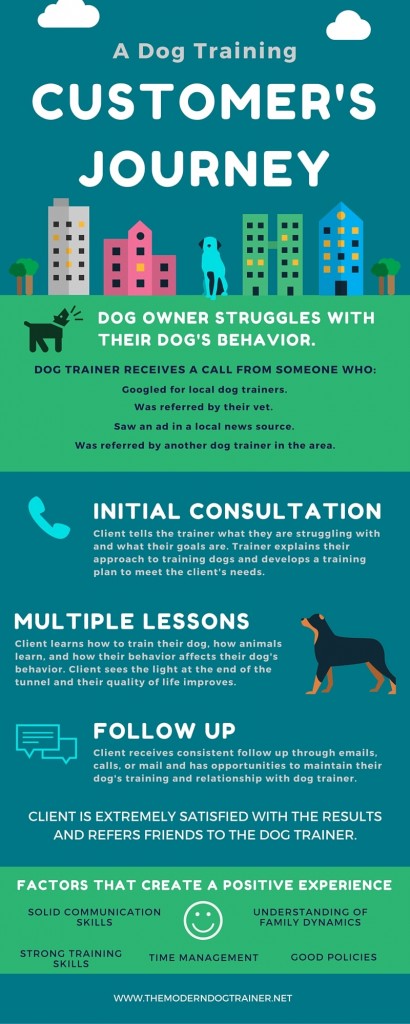
Acquiring a Dog Training Client
Clients usually get your contact information through four main sources.
- Search Google for local dog trainers
- Their vet refers them to you after you’ve created a strong relationship with the vet.
- Advertising you have paid for in local news sources.
- Another trainer refers them to you if they are unqualified or don’t have time.
Initial Dog Training Consult
The client then goes through an initial consultation either on the phone or in person. This is where you gather as much information about their case as you can. During this consultation, you can develop a training plan that will suite the needs of the dog as well as the family’s situation. This takes a deep understanding of animal behavior training and setting realistic goals for this particular dog and family. Each family will require different environmental setups and each dog will learn in their own way. The more families you work with, the more you will expand your tools in your toolbox.
Several Lessons to Follow-Up
Several lessons are usually needed to make progress in any case. Rarely will one lesson solve an issue. Several lessons allow you to address other issues that may pop up and will allow you to make sure clients are implementing training techniques correctly. Client’s quality of life should improve quickly and they should start to see the “light at the end of the tunnel.”
Follow-Up After Dog Training Lessons
Most new trainers fail when it comes to this part of the client’s journey. (It is something I have done in the past due to lack of experience and understanding.) It is easy to complete lessons and then never initiate conversations with the client again once their problems are “fixed.” However, this is a huge missed opportunity! Maintaining a relationship with the client means you can offer them more services (and continue your income). They will maintain their dog’s training better in the long run. And, ultimately, you’ll stay fresh in their mind so when their friends complain about their dog’s behavior, they can quickly recommend you!
Many factors play a role in satisfying clients. Dog training is a challenging service because much of what contributes to the success of the dog’s training is out of your hands. You can make recommendations, but there is no way to quickly “fix” the dog without complete cooperation from the owner. Even then, many other factors contribute that are out of your control – genetics, history, environment, etc.
Factors that you CAN control include:
- Good communication & social skills
- Strong training skills/knowledge
- Understanding of family dynamics
- Good policies, time management, upholding your promises/appointments
- Follow up with client after lessons are complete
- Provide additional services for maintaining training for dog & relationship with owner
Being a successful dog trainer means being an ever-learning business owner so you can provide the ultimate experience for your customers. In the end, the most successful businesses have a lot of word of mouth referrals. What part of the dog training client’s journey do you need to improve? Share your thoughts in the comments below!
Get Dog Training Business Tips!
Receive valuable dog training business tips and resources every week! Subscribe to The Modern Dog Trainer now by submitting your name and email below.
[mc4wp_form]
![Teaming Up With A Rescue]()
by Liz Wyant | Sep 9, 2015 | Business

At some point in a dog trainer’s career, they are going to get approached by a rescue asking to work with them for a discount. How do you decide if this is a wise decision?
Are You Willing?
This is the often the hardest decision. Are you willing to discount your prices, possibly drastically, to assist a rescue with their fosters and adopters? This is a personal decision that nobody can make for you. Is it going to impact the time you can spend with full-cost clients? Are you going to offer to help a limited number of hours/fosters a week? Are you going to offer a discounted rate not only to current fosters that the rescue is paying for, but also adopters from that rescue?
Is It A Reputable Rescue?
There are dozens, if not hundreds, of rescues in every big city. How do you determine which ones you are willing to attach your name to? As a modern dog trainer, you are probably passionate about using only force-free methods. Does your potential rescue affiliate feel the same way, or will they be alternating between you and a more aversive trainer? That can be confusing for both the dogs and the fosters trying to work with them, so you need to decide if it’s worth laying out restrictions that dogs you work with can ONLY work with you. Or decide if you want to skip that rescue entirely if they are not willing to commit to force-free training.
Are You Confident Referring To Other Trainers?
There are a great many dogs out there with serious issues – aggression to dogs/people/small furry animals, resource guarding, separation anxiety, etc. If you do not have enough experience to safely and effectively work with these animals, are you confident in admitting that? And do you have the trainer connections to be able to refer the rescue to another trainer that can work with those issues?
Can You Handle The Emotional Baggage?
Rescues have limited resources. Because of this, they may not have the money or dedicated fosters required to work through some longer-term issues like reactivity or separation anxiety. This means the dogs may get shuffled to another rescue (and possibly a harsher trainer), or they may get euthanized. Are you going to be able to handle knowing that a dog you worked with got euthanized because you couldn’t “fix” it in the allotted time frame?
Choosing to work with a rescue is a big commitment. However, if you can find a good rescue, you may find that your clientele increases, offsetting your reduced rate, because they recommend you to their adopters. You’ll have the pleasure of watching foster homes learn how to train humanely, and see dogs with less than perfect prior lives come out of their shells or learn to stay home alone or walk nicely on leash. You’ll have great satisfaction when you see one of the dogs you worked with get into an amazing home, and you know that you helped with that. It’s not a decision to be made lightly, but it can be immensely fulfilling.
What tips do you have for working with rescues?
![5 Must Have WordPress Plugins for Dog Trainers Websites]()
by Kat Camplin | Sep 5, 2015 | Business

You’ve got your WordPress website set up and now you want to add some bells and whistles. Here are the 5 Must Have plugins to get you – and keep you – up and running.
Useful WordPress Plugins for Dog Trainers Websites
Security
You many not think your little local dog training website could be a victim of hacking and viruses, but think again. Hacking and viruses can take many forms and can effect your Google rankings. Google can blacklist your site for security reasons, or a virus can redirect all your links to spam topics and degrade your page rank. Yikes!
iThemes Security is a free plugin with some really nice security features that’s easy to use. Just head on over to the Dashboard and let iThemes Security guide you through all the settings. Fix High Priority settings first, then move down to Medium and Low.
There are a number of Brute Force Attack security items that are really helpful. A Brute Force Attack is a computer attempting to log into the Admin area of your website in order to take it over. First, you can set the plugin to lockout anyone after 3 login attempts. Note that if you do this you may lock yourself out, so be sure to keep your login information up to date.
You can also hide the login page (wp-login.php, wp-admin, admin, and login) altogether, making it harder to find by automated attacks and making it easier for users unfamiliar with the WordPress platform to remember. Try /abracadabra or /click-and-treat to personalize the url you go to to login.
Although iThemes Security is very user friendly, you can get some support on the official WordPress Plugin forum.
Search Engine Optimization – SEO
Setting up your website correctly and using your target keywords in the content is the only way to get on the first page of Google search results. The old days of listing a ton of Metatag keywords are over. Content is king and Google is very good at determining what is useful.
Yoast SEO is a hardcore helper in helping you get higher search rankings. Take the Introductory Tour after installing the plugin to get an idea of your options. You can automatically change blog titles, enter Webmaster Tools verification codes, and create XML maps to enter into Google Webmaster Tools so your website is indexed correctly.
On each page or post you can enter Focus Keywords in an analysis window and the plugin will determine your keyword density for that page. You can change page titles and enter Meta descriptions for specific SEO purposes right on each post. If you’re sharing blog posts, you can dictate how they appear on individual social media platforms by clicking on the Social tab. If you want a specific photo, description, or title to appear on Facebook posts versus Twitter posts, you can do that!
Although Yoast SEO is very user friendly, you can get some support on the official WordPress Plugin forum.
“What Did I Just Do?”
One of the problems dog trainers have with maintaining their own websites is having the time. During slow periods you can get a lot done, but it may be two or three months before you get back to it again.
When you have the time you may spend a few hours trying to tweak something specific. You’ve posted in a support forum, done a search on Google and found a bit of code. You follow the instructions and “Oh my gosh! It works! Hurray!” A few months later when you want to change something else you have no idea what you changed, where you found whatever you changed, or even how to undo it to make your new idea work. What do you do?
Keep program and change notes in the WP Admin Microblog. The Microblog is a backend blog that is hidden from visitors to your website. It works just like a mini-blog with post titles and the ability to attach media files and search previous entries. You can use it to paste little bits of code you get from support sources, then enter a description of what it does, hit “save” and you have a record in case you need to undo something later. Do you need a place to put design ideas or links to things you find on other sites that you like? Just create a blog post with the link and you can refer back to it when you get more time.
Although the WP Admin Microblog is very user friendly, you can get some support on the official WordPress Plugin forum.
Mobile Versions
One of the biggest changes to Google search result rankings is the penalty for not having a Mobile friendly version of your website. You must have a mobile version. Period.
While some Templates are responsive, the design may not be exactly as you would like. A smaller version of your main website is groovy, but what if you could really tweak it so Mobile users can find what they need more quickly?
Enter the WPtouch Mobile Plugin. You change the title, set a Mobile specific landing page, tweak menu items, show comments in popup bubbles, and add sharing links for your pages and posts.
Although the WPtouch Mobile Plugin is very user friendly, you can get some support on the official WordPress Plugin forum.
Widgets for Newsletters
Allowing visitors to sign up for your newsletter with no fuss or time requirement is a great way to target new clients. Most newsletter services have plugins to help you out. Each plugin has a shortcode for putting a sign up field on a page or post, as well as a widget to go in a sidebar or on the front page.
MailChimp for WP allows you to link to a specific mailing list so you can capture visitor emails separately from your existing list. As an example, if you want to do a discount for signing up for your newsletter you’ll know who gets the discount and who doesn’t. Support is available on the official WordPress Plugin forum.
Constant Contact for WP allows you to link to a specific mailing list, operate registration for an event, track Analytics, and design your own form. Support is available on the official WordPress Plugin forum.
Related Article: Our Favorite WordPress Themes for Dog Trainers
Did we miss one of your favorite plugins? Leave us a note in the comments below!