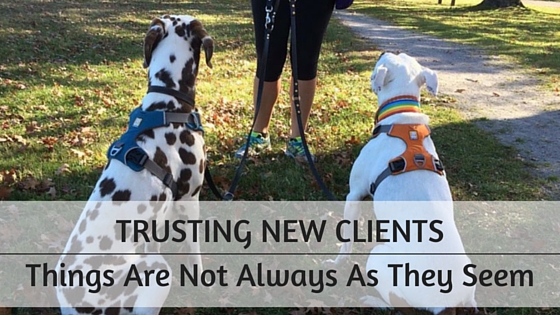
It is a story often told among dog trainers. It goes something like this:
A prospective client calls and says that another dog trainer – sometimes multiple dog trainers – could not help their dog or said their dog was beyond help. We take the case and find that the dog is indeed help-able. In fact, we do wonders with the dog in a short period of time, and we are perplexed and discouraged that the other trainer (or trainers) almost destroyed the client’s hope for their pet, when in fact the case really was not that difficult.
When we take such cases and succeed in helping a dog, there is a part of us that feels superior – that other trainers in our area are not as capable as we are. Frankly, it feels kind of good, and we can’t wait to herald the news to our other colleagues so that they can be wary of the incompetent, unhelpful trainers who nearly destroyed some pup’s life.
All is well that ends well, right? The dog received the help it needed. The client is happy. We feel more confident than ever. But there often is another side to such stories.
Taking Client’s Comments With A Grain Of Salt
Perhaps the client was indeed telling the truth about the other trainer(s). But stories about multiple trainers failing cause me to be suspicious of the client – especially if my impression is that the dog’s problems are easily remedied.
We need to consider that clients may not always be truthful. They are human (like us), and sometimes they are not above behaving in a way that gets them what they want or makes them feel good (like their dogs).
A case in point: I recently was approached by a prospective client who told me that one of my most trusted colleagues and referral partners had recommended my board-and-train program. According to this client, my colleague thought it would be a better option for this particular dog than her own group class.
When I called my colleague to thank her, I learned the prospective client was lying. In fact, my colleague had this client on the roster for an upcoming, limited-size group class and had no idea the client was still shopping around for trainers.
When questioned about the situation, the prospective client began back-pedaling and telling me more lies to extricate herself from the first one. I decided not to accept this person as a client. If she was willing to blatantly lie to me (she could have just said they would rather do a board-and-train program), then what would she have been capable of unjustly saying about ME? It just didn’t seem worth the risk.
Digging For The Truth
As a rule, when a potential client tells me they have worked with one or more trainers, I require them to tell me who the trainers were, what steps were taken to solve a dog’s behavior issues, and how the dog responded to those steps. (And if I personally know one or more of the trainers mentioned, I might call them to better understand their experience with the client and dog.) If the prospective client is not willing to be forthcoming with such information – or if the information they provide throws up red flags about their own credibility or willingness to follow through with a trainer’s advice – I am better off without them.
Give Colleagues The Benefit Of The Doubt
Professionally speaking, I think it is a bad idea to give credence to unverified testimony against colleagues. Doing so risks us forming (or worse, spreading) false conclusions about them, and it potentially burdens us with deceitful or non-compliant clients. There are two sides to every story, and if we are to make a judgement about the credibility of a prospective client or the professionalism of a colleague, it is only right to get all the pertinent details and understand both sides of the story.
My mission as a professional dog trainer is helping dogs, but sometimes owners need help too. And sometimes helping an owner is showing them that some behaviors are rewarding, whereas others are not.
Have you ever had a similar experience?
Dog Training Business Tips
Receive valuable dog training business tips and resources right in your inbox! Subscribe to The Modern Dog Trainer now by submitting your name and email below. Don’t forget to let us know what you want to learn more about!
Welcome 2016! Traditionally people begin thinking of their New Year’s Resolutions shortly after the start of the new year, maybe a week or two before. While there are the common, personal New Year’s Resolutions – eat healthy, exercise more – what about your resolutions as a dog trainer? What have you resolved to do? How are you going to better yourself and your business this year? We are already half way through January and if you haven’t come up with any resolutions we’ve got you covered.
Image via Erin Bessey – Bessey’s Positive Paws
10 New Year’s Resolutions
Increase Clientele
Review your clientele numbers for the last year or two. Then figure out how much you would like to grow this year and set a goal to increase those numbers for 2016.
Network More
Maybe you are just starting out in your business, perhaps you are well established, whichever you are make a point to reach out to others. We can fall into patterns easily and get comfortable there. You won’t be able to grow if you don’t push those comfort levels. Reach out to other trainers, veterinarians, groomers, boarding and daycare facilities. Those are the traditional places to network. What about thinking outside the box? Look to speaking with schools or children’s daycare. While this may seem odd, these places have great, continuous interactions with families. Families who like to share stories about their kids and the family pet. Maybe the daycare is run in a home and has a dog that is present. Putting your name out there and talking to some office people is all it would take. Your name could spread like wildfire because who else would think to make themselves known at a non dog-related business?
If it has been a number of years and you are still maintaining the initial starting rate it might be time to increase. The business is growing and it is important to stay competitive with the surrounding areas while being paid your worth.
Train Your Own Dog
As a trainer we get very fixated on our work. Why wouldn’t we? We love what we do, but because we are busy helping others train their dogs our personal pets often fall to the way side. Make one of your new year’s resolutions to teach your dog a new trick or activity.
Teach A New Class
If you haven’t given your classes a face lift in a while make it happen this year. Have you just updated the current class curriculum? Why not look into offering a new class.
Learn A New Skill
The dog training world is exploding with all kinds of training. If you are used to teaching basic behavior classes take the time, reach outside of your comfort zone and learn something new. If you have never done agility, find a class and try it out with your own dog or better yet, build your own equipment. Interested in doing a trick class? Teach your dog the trick first before offering it to others. You would accomplish two resolutions on your list doing it this way! Try any one of the following: Treiball, heel work, Rally-o, agility, dog sports, trick training, nose work, and the list goes on!
Read More Books
In order to learn a new skill it may require you to read a new book to accomplish that. Challenge yourself and read a book that you don’t necessarily agree with as far as training techniques. Exercise your mind and form opinions and arguments and be sure to be able to back up your position. How many dog training books did you read last year? Can you do better?
Set A Schedule
It can be tough setting a schedule and sticking to it. Dog trainers want to help owners and their dogs as much as they can and go to great lengths to do this. Making time when we wouldn’t otherwise be scheduling due to fear of losing a potential client isn’t always best. Being too flexible could indicate to clients business is slow. Avoid answering e-mails and phone calls at all hours. Instead have a shut off time where you are done work for the day. Set a schedule if you don’t have one and stick to it.
Make Time To Play
Make time for yourself! To avoid burn out you need to be sure to leave time for yourself to play. This is where setting a schedule as one of the new year’s resolutions will be helpful. Play might be considered learning a new skill or working with your own dog but be sure to leave time to do something for you. It’s okay to do that!
What new year’s resolutions have you made? Comment below and let us know.
Sign up below to stay up to date with modern dog training business practices and dog training methods!
Dog Training Business Tips
Receive valuable dog training business tips and resources right in your inbox! Subscribe to The Modern Dog Trainer now by submitting your name and email below. Don’t forget to let us know what you want to learn more about!
In a quick, unscientific poll of a small number of colleagues and clients, the overwhelming results were that clients appreciate knowing their trainers are participating in hands-on continuing education. To be among the best of the best in the dog training field, it is important to also be a student. Some certifications for dog trainers require continuing education to maintain certification; some dog trainers choose to participate in continuing education.
Continuing education can take on many forms. It can be a book that is read, a dvd that is watched, a seminar that is observed, a local workshop that is hands-on, a national conference that is all of the above with the added bonus of networking with colleagues. While a list of books read and dvds watched can be impressive, spending time and funds on a seminar, workshop, and/or conference shows clients a different level of commitment to continuing education – a level of investment both of time and funds to seek out knowledge and information.
Why Is Continuing Education Important For Dog Trainers?
Accountability – seeking out and participating in continuing education puts a trainer into the position of being a student and demonstrating results.
Commitment – commitment to our profession, commitment to our clients, commitment to our dogs. Attending workshops, seminars, classes, etc. sparks a renewed commitment to spend time doing what we love.
Maintenance of/increasing knowledge and skill – use it or lose it! Teaching helps us to maintain our knowledge and skill but continuing education helps us to increase that knowledge and skill. Learning about new thought processes and methods expands our range of who we can help and how we can help them.
Staying on the cutting edge – there is constantly new science about dogs, about learning, about humans, about the dog/human interaction, etc. Participating in continuing education keeps trainers up to date on the latest and greatest science and how it can be useful in dog training.
Sign up below to stay up to date with modern dog training business practices and dog training methods!
Dog Training Business Tips
Receive valuable dog training business tips and resources right in your inbox! Subscribe to The Modern Dog Trainer now by submitting your name and email below. Don’t forget to let us know what you want to learn more about!
2015 has been an eventful year. In celebration, we’ve put together the top 10 most popular dog training business articles from this year. We are so thankful to have such a supportive readership and appreciate all the kind words you’ve shared with us this year.
We strongly believe that by sharing our knowledge of dog training business ownership we will help more positive reinforcement based trainers grow their businesses and reach more dog owners. All of the following articles received over 2,000 unique views and we’re extremely excited to see where the next year takes us!
I, as founder of The Modern Dog Trainer blog, would personally like to thank all of the blog contributors who share their knowledge, skills, and experiences with us all every month. The Modern Dog Trainer blog & podcast would not be where it is without their generosity and expertise!
Sign up below to stay up to date with modern dog training business practices and dog training methods!
Dog Training Business Tips
Receive valuable dog training business tips and resources right in your inbox! Subscribe to The Modern Dog Trainer now by submitting your name and email below. Don’t forget to let us know what you want to learn more about!
Most likely, you became a dog trainer to help dogs. However, it is difficult to help dogs if your phone isn’t ringing and you’re not getting new clients month to month. In this introduction to marketing for dog trainers, I’m going to discuss 5 strategies you can implement this week to get more clients in the coming months.
Marketing for Dog Trainers
When most people think of advertising, marketing, or sales, they usually get a knot in their stomach. They have become “dirty” words that identify slimy sales people who only care about getting your money. Fortunately, times are changing and I couldn’t be more excited about it!
Advertising is mostly about interrupting someone’s online experience with undesired ads, pop ups, or auto-play videos. And I’m willing to bet that this kind of advertising doesn’t bug anyone more than me! Fortunately, modern marketing is starting to take a different path.
The approach behind marketing these days is to meet people where they want to be reached. Go where they are looking for help and provide something that they find valuable. For example, if a potential client is searching “how to train my dog” on Google, a modern dog trainer would have an article that shows up on the first page of the search results with tips on “how to train your dog.” This approach offers something of value to a potential customer and will build trust, start a relationship, and drive a desire for more from that resource. Hmm… sounds a little familiar to modern dog training? Essentially, you’re starting to build a positive association for yourself in the eyes of potential customers.
“The Google”
Where do you go to learn more about a certain subject? For most people, that’s a search on Google. Google has positioned itself as THE search engine people use to learn about a problem they’re experiencing. With dog training, problems could include chewing, barking, pulling, digging, etc. Understanding how Google works is important, if not the MOST important, marketing strategy a dog trainer could use. I have personal experience with this.
Late last year my husband and I decided to move from Texas to New York for a variety of reasons. Scary! I knew I had to master Google so that my business would show up in my new service area. Five months before the move I implemented several tactics to demonstrate to the search engine that my business was moving. The techniques I put into place meant I had clients calling me from my new service area within my first month of living there. In fact, I had a client booked before I even had time to file for my new LLC!
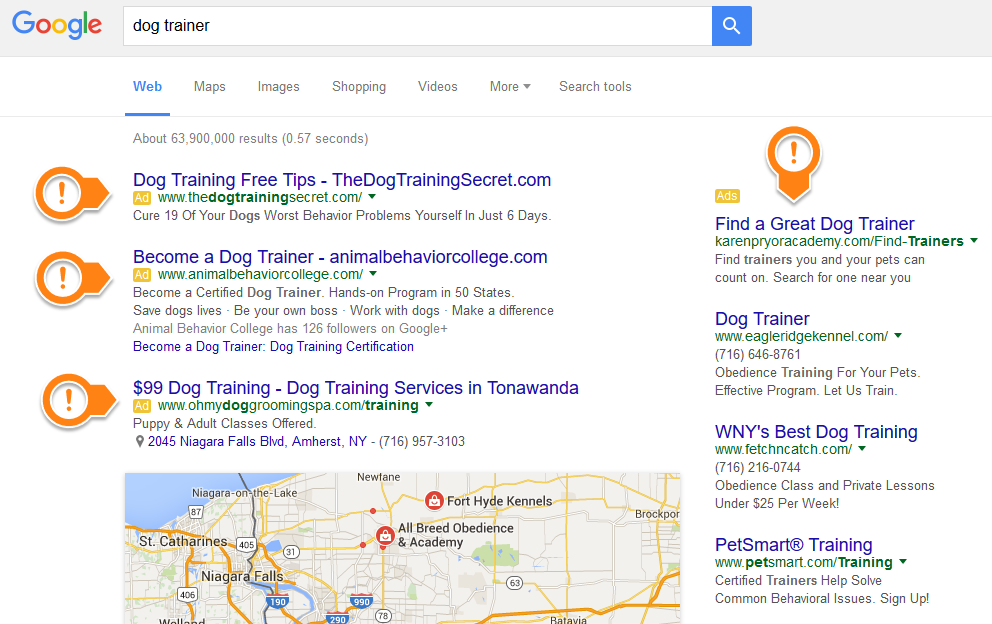
The benefits of mastering search engine optimization (SEO) are undeniable. SEO can help every dog training company stay ahead of their competition – new or old. Most of your future clients will find you through Google search results or paid Google Adwords campaigns.
Social Media
Social media can monopolize your time if you’re not careful. Most potential clients will look you up on social media before they give you a ring so you can’t ignore it. A strategic approach is key to not wasting time on social media. Tools like Buffer or Hootsuite can help you mass-schedule posts on multiple platforms at once – time and life saver!
Social media is also picking up speed when it comes to searches. There are millions of searches performed on Facebook, Twitter, YouTube, and more every single day. Sites like Facebook will recommend friends of friends to like pages. Social media plays a crucial role in building trust in potential customers and most potential customers check out you social media to make sure your company is still active. Take some time every week to set up a schedule of posts to share on you social media accounts.
Blogging (and Vlogging)
Blogging has evolved into something more than an online diary of one’s personal stories. Blogging is now used by some of the most well-known brands like Evernote, SalesForce, and Etsy. A company blog helps you build rapport with current and future customers. A blog page is one of the most visited pages on a website as people research their potential purchase. This is one of the best places to share your company’s story, share success stories, and make announcements. Like social media, an inactive blog can signal to potential customers that you’re not available so come up with a strategy to maintain your blog if you start one.
Getting New Leads
PPC advertising or “Pay Per Click” advertising is intimidating. Many inexperienced small business owners over spend very quickly which leads to a traumatic one-event learning experience. It can be hard to come back from (I should know, it’s happened to me), but PPC advertising with Google Adwords can be one of the fastest ways to get new leads. At first glance, Google Adwords can seem easy, but there are many detailed options you should know about to control your spending. Mastering Google Adwords can easily be the quickest way to grow your business so it is worth a second look.
Digital Marketing for Dog Trainers
Digital marketing is something that modern dog trainers need to learn about right now. Times are changing and business that don’t change won’t make it. Fewer people are relying on word of mouth and are turning toward Google and social media to find the help they need. Make sure you’re there when they’re looking for you!
I’m working on a new book on digital marketing for dog trainers. If you’re interested in growing your dog training business to the next level, going from part-time to full-time, or simply want to start getting more consistent client flow each month,you’re going to want to read this book. Sign up below to receive a notification when it is released and an exclusive discount for subscribers only.
“Digital Marketing for Dog Trainers” will teach you how to:
Show up on the first page of Google to get more clients
Get leads immediately with Google Adwords campaigns
Get more people to call once they land on your website
Create a blog that makes you unique & valuable to clients (and isn’t a waste of time)
Manage and automate your social media like a pro
Start an email subscription list customers will love
Track and measure your efforts to stop wasting time
And more because I keep adding to the list every day!
Let’s see how we can grow your dog training business to the next level. Whether you’re going from part-time to full-time or simply want to get new clients more consistently each month, you can benefit from a course I’m working on.
Coming up with names for any business can be rather fun. For dog trainers, we tend to think of cute names that may draw clients into training that sounds happy and joyful. Fun aside, naming your business has important difficulties as well as benefits if you plan ahead.
The big problem with business names.
The biggest problem you’re going to have in naming your business is finding one that isn’t already taken. The second biggest problem is going to be finding a name that is available as a web address for your website as well as any social channels you want to use to market and promote your business.
Twitter sets a 15 character limit on usernames, or the @ name. If your business name is Dogs Rock Awesome Dog Training, you’re going to have some problems getting that down to a memorable 15 character name. While Facebook’s limit is 70 characters for Page names, people are using mobile apps more often, so the longer name may prevent them from searching for you.
In a perfect world your business name will be available as a web address domain, Facebook Page, and usernames on Twitter, Youtube, and Instagram at the least. Branding across platforms is important. While we can provide links from the domain to Youtube or from Youtube to Twitter, people need to find you first to click the link. You want to be findable without people having to visit one of your channels first.
Do you really need a business name?
Technically, you already have a business name. Your personal name is your business until you register a Doing Business As (DBA) with your county licensing office as a front for your personal name. Is there anything wrong with John Smith Dog Training? Absolutely not. You are the face for your brand. You’re doing the training. You might as well be transparent about it and use your name.
Pros:
The web address is probably available for either just your name or with the service: JohnSmith.com or JohnSmithDogTraining.com.
Once people meet you your name is easy to remember.
Your name travels with you, so should you move you won’t have to rebrand.
Your name can change services, so if you add boarding services later you don’t have to worry about changing the web address to reflect that.
Cons:
No one knows who you are, so marketing can be difficult.
JohnSmith.com could be any service. Without keywords in the domain name you have to really use your web content to get on the front page of Google searches.
If you grow to the point you hire employees clients may be confused when John Smith doesn’t show up at their door to train their dog.
Location as your business name.
When people go searching the internet for a dog trainer the most common search is My City Dog Training. While using your city and Dog Training sounds boring, it really will move you to the front page of Google pretty quickly. If your goal is to get up and running quickly and you don’t care about creative names, this is the fastest route.
Pros:
More likely to get on the front page of Google.
You can hire any employees without creating confusion.
Social channels will probably be available if the domain is available.
Cons:
If you live in a common city name like Springfield, your name may already be taken by a busniess in another state.
Moving becomes a problem. While you can forward MyCityDogTraining.com to MyNewCityDogTraining.com, you’re still basically starting over with a brand new business.
Creating a name.
When I was thinking of business names I spent a lot of time searching the internet for naming “rules.” One of the most helpful pieces of advice I found was to create a name that didn’t require you to spell it when said out loud. The concept is, if you’re at a networking event, noisy conference, or hanging out in a bar, you should be able to say your business name and have it understood.
The out loud rule is very difficult for dog trainers. Domain names may be available using “K9” instead of “canine,” or “dawg,” instead of “dog,” but those names will require a whole lot of explanation and spelling if you’re passing your name verbally. Is it possible to market and succeed with words shortened and misspelled? Yes, but it will probably take more time and you’d need to make sure you have business cards on you at all times.
Ebay and Google are names that had no meaning before they started. You can let your creative juices flow and just create a name. OgDay? Doggle? Making up words can be fun, just remember that marketing and focused keywords on your website are going to be very important. Also, watch out for bad words or alternative meanings in the middle of made up words. Sinep might sound snappy, but read it backwards.
Putting two or more words together to make one shorter word can help with the character limits on social media channels. An example might be taking the first few letters of Reward Based Training, and creating RewBa Train. Rewba.com and RewBaTrain.com are available, and social channels probably would be. While marketing and branding will still be important, if you do it right this kind of name can be memorable more quickly than a completely new made up word.
If you keep entering domains into a domain search and they’re taken, it may be time to get some help. There are hundreds of business name generators online that can spark ideas and will check domain availability at the same time.
NameMesh will take your keywords and make new words, find synonyms, and give you “new” domain options. New domain options have different endings to .com and are geared toward defining your business. For instance, you can now get .training or .photography. Some fun options might be dog.ninja or canine.guide. Existing domains have first option for the new domain, so if you own dogtraining.com you have the first option to buy dog.training. Competition is still high for the new domains as people buy them for investments instead of use, but using them allows you more options.
Panabee is another name generator that merges words and concepts pretty effectively. Enter a few words and you’ll get quite a few options. Panabee doesn’t include the new domain endings, so use this if you want to stick with a .com, .net, and .org.
If your all time perfect domain name is taken, visit the site and see what’s there. If you see a splash page from a host like GoDaddy, at the top you will see, “Welcome to: (domain name,) This Web page is parked for FREE, courtesy of GoDaddy.com. This usually means someone is sitting on the domain as an investment. Domain name buying for resale to someone who really wants it isn’t as popular as it once was, but it’s still done. If you really, really want it, go to the webhost (GoDaddy in the example above,) and put in the domain name in the domain search. You will get a result page that says the domain is taken, but in tiny text next to that is, “ Still want it? Here’s what to do.” Follow the link and you’ll get a page offering to contact the owner for you to see if they’ll sell. Expect to pay big. Premium domains run between $500 and $2500 on average.
Due diligence.
While it may not be that big of a deal for your business name to be close to another business in another state, you want to be sure you’re not stepping on any toes in your home market. Search for your city and “dog training,” for your area and see what businesses are on the first three pages of Google. It’s also a good time to see who your main competition is and how they’re using they’re keywords and name and branding. If your main competition uses K9, you might want to stay away from any name using that shortcut.
Just because a domain is available does not mean it’s not trademarked. You can do a quick trademark search at the U.S. Patent Office’s Trademark Electronic Search System. The last thing you want is to spend money and time on building brand name recognition only to receive a cease and desist letter.
Did we miss an idea? How did you come up with your business name? Leave us a comment!
Dog Training Business Tips
Receive valuable dog training business tips and resources right in your inbox! Subscribe to The Modern Dog Trainer now by submitting your name and email below. Don’t forget to let us know what you want to learn more about!
[mc4wp_form]





 Advertising is mostly about interrupting someone’s online experience with undesired ads, pop ups, or auto-play videos. And I’m willing to bet that this kind of advertising doesn’t bug anyone more than me! Fortunately, modern marketing is starting to take a different path.

 Blogging has evolved into something more than an online diary of one’s personal stories. Blogging is now used by some of the most well-known brands like Evernote, SalesForce, and Etsy. A company blog helps you build rapport with current and future customers. A blog page is one of the most visited pages on a website as people research their potential purchase. This is one of the best places to share your company’s story, share success stories, and make announcements. Like social media, an inactive blog can signal to potential customers that you’re not available so come up with a strategy to maintain your blog if you start one.