![Should You Start Your Own Company Or Join Someone Else’s?]()
by Ines | Nov 25, 2014 | Business
How To Choose Between Starting Your Own Business Or Becoming Someone’s Employee
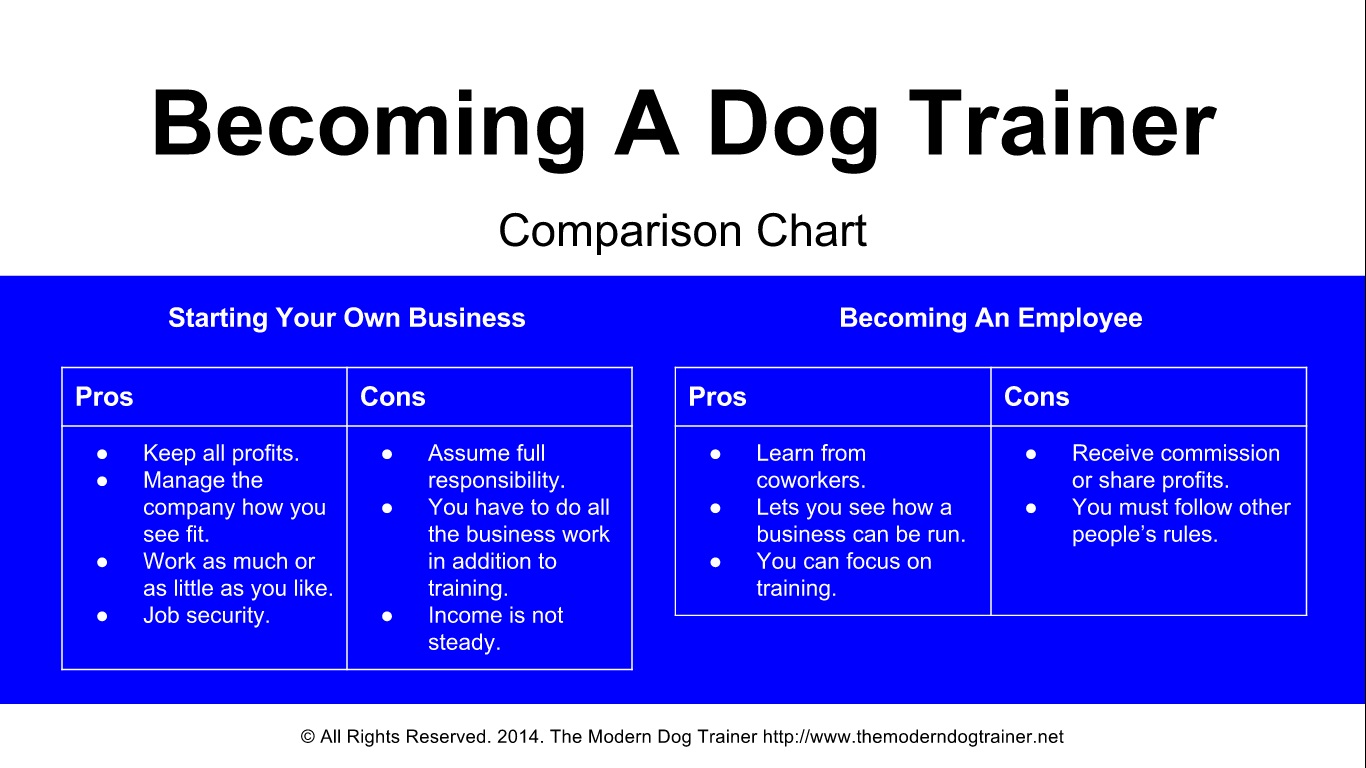
When you are first starting out, it can be difficult to choose between starting your own dog training business or joining someone else’s. Ultimately, there are benefits to both.
Start Your Own Business
Many dog trainers choose to start their own business. Having your own business increases your revenue and lets you run the business how you see fit. However, having your own business also comes with more responsibility. You’ll need to purchase insurance, get the appropriate business licences, and maybe even start an LLC. The income isn’t always steady and you don’t have anyone to share the work load with. Fortunately, the job security is great because you are your own boss.
Starting your own business is the best way to make a decent wage as a trainer. It is more of a career path than an hourly or commission based job. However, there are some advantages to starting out with a regular job under someone else’s direction.
Get a Job
If you don’t know how to run a business, but are eager to get started training, getting a job is a great option. While working for someone else, you’ll be able to learn about how the administrative end of running a business looks like and you’ll be able to learn from the other trainers in the company. The down side is that you have less freedoms when it comes to working and you will have to survive off of commissions or hourly based pay. Many of the jobs that you will find are entry-level positions such as dog caretaker, kennel tech, or dog walker. Management level positions are quite rare. Getting a job is a great way to get a lot of experience under your belt. We’d like to encourage you to research companies that are willing to reimburse or fund continuing education or certifications.
If you are considering getting started as a dog trainer, check out DogTec’s free download, “Going to the Dogs?” There is some great information about what it takes to become a dog trainer.
Would you prefer to start your own business or join someone else’s company?
Recommended Article by The Modern Dog Trainer
![The Humane Hierarchy Of Behavior Modification Explained]()
by Ines | Nov 12, 2014 | Training Methods
The Humane Hierarchy is a model in which training methods are ranked from leash invasive to most invasive. Dr. Susan Friedman, a well-respected and knowledgeable behavior analyst, coined this term and model. This model has been adapted by the Certification Council of Professional Dog Trainers as the guide for their trainers to use when working with dogs.
The model is broken down into 6 levels. Trainers should thoroughly explore the options at every level before escalating their training method to more intrusive choices.
Health, Nutrition, and Physical Setting
Health and nutrition affect a dog’s body chemistry and, thus, its behavior. Failing to address the dog’s medical issues will likely reduce the effectiveness of any training. For example, consider a dog that is acting aggressively when a child pets the dog on the head. If the dog is experiencing pain due to an ear infection, the dog is only reacting due to the pain the petting causes the dog. Behavior modification will be ineffective to change this dog’s reaction. A professional dog trainer should understand some key signals that pain or medical issues could be the route of a problem so they can refer to a veterinarian when appropriate. Many trainers choose to have clients take their dogs to the vet for a wellness exam before any training begins.
Antecedent Arrangement
Much problematic behavior is a response to an environmental trigger. A dog’s behavior is influenced by the environment. Manipulating the environment so that the dog does not experience the trigger can eliminate the entire problem. Without thoroughly completing this step before moving on with more intrusive training, the antecedent to the dog’s behavior may continue to trigger the same response. For example, if a dog barks when he sees other dogs through a window, applying a frosted window film at the dog’s eye level will eliminate the problem without further intervention. Without this step, training will not progress as smoothly as it could.
Positive Reinforcement
Once a dog’s health has been examined and the antecedents to the behavior have been eliminated or changed, positive reinforcement is the least intrusive way to modify behavior. Positive reinforcement is the addition of something the dog desires in order to increase the frequency of the behavior in the future. Ultimately, dogs repeat behaviors that create desirable consequences. Setting up the environment to help the dog make the right choices and then using positive reinforcement to reward those choices is the most humane behavior modification method if it can be applied safely.
Differential Reinforcement of Alternative Behaviors
Differential reinforcement involves strongly reinforcing certain alternative behaviors to the problem behavior. It also includes removing the reinforcer for the problem behavior.
Negative Reinforcement, Negative Punishment, & Extinction
Notice the yield sign before this option in the chart. These behavior modification methods can increase stress and anxiety in the dog. The emotional ramifications on a dog should be considered before utilizing these. Much of the stress can come from the dog’s lack of understanding of what it is supposed to do instead of the problem behavior. Once the problem behavior stops producing the dog’s expected consequence, the dog can experience frustration and anxiety. The dog may not have a clear understanding of what will work instead.
Positive Punishment
The stop sign before this option in the chart reflects the fact that this is a last resort. The CCPDT suggests that trainers consult with one another to find alternative solutions to positive punishment. Positive punishment is the addition of something the dog deems undesirable and works to avoid in order to decrease the frequency of the problem behavior in the future. Most likely, all the other options have not been exhausted if a trainer chooses to use positive punishment as a means to train a dog. Environmental management, health, and less invasive techniques should be thoroughly implemented before utilizing positive punishment. Lack of creativity and problem solving skills can often lead trainers to use this method too soon.
Do you consider yourself a Humane Hierarchy modern dog trainer?
![Preventing Play Induced Aggression At Dog Parks]()
by Ines | Nov 5, 2014 | Research
Research Team
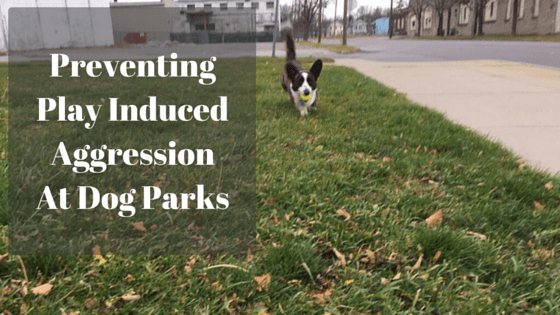
Dog parks are a touchy subject for many dog trainers. While the concept of dog parks is wonderful, the implementation and reality of dog parks are challenging. Dog parks, in theory, are a great way to socialize your dog around other dogs and people off leash. For city dwellers, they may be the only time a dog is able to be off leash outdoors. However, the many stories of bullying and aggression displayed at dog parks are not to be ignored. Fortunately, a research team lead by Lindsay R. Mehrkam, M.Sc. at the University of Florida performed a study to understand what happens when play turns into aggression.
Factors That Contribute To Aggression at Dog Parks
Context is an important factor in understanding dog-dog interactions. The researchers were aware of this and took context into considerations. The team only took into account play that turned aggressive in order to remain objective. They also ended the video recordings at the very first sign of aggression in order to stay objective and prevent their personal biases from intervening in their observations. The size of the dog park was important. Larger dog parks had fewer cases of aggression than smaller ones. The size of the confined area affected how the dogs behaved with one another. They also observed high contact play usually occurred between dogs that were already quite familiar with each other.
Precursors To Aggression
The teams research discovered some simple and consistent predictors to aggression at dog parks. While these are not 100% guaranteed to lead to aggression, they are common precursors to it. Behaviors such as vocalizations and hackles near the tail were found to be common in play that lead to aggression. Additionally, dogs who tucked their tails at any point had a 58% higher likelihood of becoming aggressive. These specific behaviors can be observed fairly easily by anyone who knows what to look for.
Current Research Conclusions
The researchers concluded that aggression occurs in about 1 in 10 play interactions at dog parks. They discovered that owners did not intervene enough – only in about 5% of play encounters. They want to make it clear that there isn’t a single behavior that will lead to aggression 100% of the time so that should be taken into consideration. Context is extremely important in understanding dog-dog interactions. They concluded that the best thing to do is to be an advocate for the dog you are responsible for. Train them before entering the dog park so that you can safely leave challenging or uneasy situations.
Do you recommend your clients take their dogs to the dog park? Do you recommend they avoid dog parks?
Recommended Articles
![Things To Consider When Determining Your Prices]()
by Ines | Oct 27, 2014 | Business

Pricing services can be difficult since there are so many factors included in dog training. These factors include: customer interactions, communication skills, location and travel, education, experience, perceived value, and amount of competition in the area.
Cost Of Operation
Before you can determine a good price point for your services, you’ll want to make sure that the prices will make a net profit after costs are deducted from your profit. If your costs end up being more than profit, you won’t be in business very long. The basic principle of starting a business is to make a living from it.
Target Audience
While it is noble to donate your time to rescues and those that cannot afford to pay you for your services, pricing yourself lower so that more people can afford you is a recipe for burn out. You have to make each client worth your time and energy which means you need to be charging for the value you provide to your customers. Your prices should reflect the audience you want to reach.
Market Research
Location plays a huge role in determining your prices. It would be quite difficult to begin a business if you were the most expensive in the area. Also, it is not to your advantage to be the least expensive in your area because many customers understand that they will get what they will pay for. Being the least expensive tells the community that you do not think highly of your skills. Make sure your prices are competitive, but also exude confidence about your training skills.
Pricing Models
Hourly
Many trainers start off using an hourly fee to price their services. This is a great way to get started. However, as your business grows you’ll discover that you only have so many hours in a day and, thus, can only make so much money each day. Once you start running out of hours in the day, or maybe even sooner, consider changing your pricing model to the following.
Flat Fee
A flat fee pricing model is commonly used for board and train programs because it is more than an hourly commitment. This kind of service can provide a lot of value to clients who can afford it. A flat fee pricing strategy can allow you to make customized training packages for each family you work with and provide them a variety of services to increase their chance of success. For example, you can create a package that includes day training and private lessons for a flat fee based on that family’s needs.
Understand Perceived Value
As dog trainers, we provide incredible value to families everywhere – we give them peace in their lives again. Perceived value is about what the customer thinks they are gaining by hiring you. When clients look for trainers, they aren’t really looking to hire a dog trainer, they are looking to get balance, peace, and control back in their lives again. Understanding perceived value for the customer will help you determine the right pricing for your services.
Pricing can be very difficult for new trainers to understand and implement. Consider reaching out to your mentor and ask them how they first determined their pricing strategy. Most importantly, when customers call, make sure you can articulate how and why your services are worth their prices.
Recommended Articles
![Becoming The Best Teacher You Can Be]()
by Ines | Oct 24, 2014 | Communication, Events
At the APDT Conference last week we had the pleasure of listening to Sumac Grant-Johnson‘s speech called Build A Better Trainer. Sumac is a wonderful dog and people trainer. She engaged the audience like few speakers were able to. Everyone was laughing and enjoying themselves during her speech. Here are some of the highlights of her presentation.

Teaching Skills For Dog Trainers
Many trainers get into dog training for the dogs. However, you have to work with people to make a living so having some people skills are important to being a successful dog trainer.
Sumac has broken down the steps every teacher should take when instructing a class or lesson into an easy-to-remember acronym: OIA. OIA stands for Observe, Interpret, and Act. She encourages all trainers to learn as much about human body language as they do about dog body language. This will increase your ability to understand clients who might be struggling. She stated that if there is a failure rate of more than 25% in a class after instructions are given then the issue lies with the instructions given, not the students.
Observations
As a teacher, you must be able to observe your student’s actions. Look at what they do correctly and incorrectly. See what might be inhibiting them from achieving the goal behavior.
Interpret
Once you’ve made accurate observations, you can then interpret what you’ve observed. Bring into consideration environmental factors such as space, distractions, fears, and noise. She mentioned that you can let clients know what they can do if they cannot hear you appropriately.
Learning Styles
A good instructor understands how to utilize different approaches so that all learning styles are incorporated into their teaching. Learning styles can be broken down into visual, auditory, and kinesthetic. Make sure you’ve researched these styles so that you can identify the learning style of each client.
Knowledge Base
Every client will have a different history and knowledge base. Sumac recommended we read the book
How Doctors Think by Jerome Groopman. You never know right off the bat what kind of training knowledge, behavior knowledge, or experience a client may have. What they know can hold them back in some cases due to prejudices or biases.
One of the most important parts of her presentation was the recommendation to never express differing or conflicting opinions right off the bat or they’ll put up barriers.
Act
After observing and interpreting your client’s behavior, you’ll want to act accordingly. Consider adjusting the environment, avoiding putting people on the spot, and mark and reinforce correct behavior. Sumac recommended the use of words like good, nice, or great as marker words before explaining what they did correctly. Make sure you give your students achievable steps towards the goal behavior just like you would when working with their dogs.
In the end, she states that as dog trainers, we all of ONE job. That is to help people meet THEIR goals. This presentation was one of our favorites out of the whole APDT Conference in Hartford. She is an excellent presenter and intelligent people-person. She claims she used to be extremely shy as a child, but we find that extremely hard to believe! Thank you
Sumac Grant-Johnson for sharing your knowledge with us.
![Things You Should Know Before Taking On Aggression Cases]()
by Ines | Oct 23, 2014 | Events, Training Methods

There is no doubt that dog training is dangerous, but you’d be surprised by how many dog trainers are not taking the right precautions when they work with aggression cases. Michael Shikashio, President of the IAABC and outstanding certified dog trainer, hit the nail on the head with his speech at the APDT Conference in Hartford last week. His talk, Staying Safe in Aggression Cases, discussed the following points:
Be Aware Of The Responsibilities Of Aggression Cases
When you take on an aggression case, you’re taking on a lot of responsibilities whether or not you’re aware of them. Consider the liability of handling an aggressive dog. What will your procedure be if the dog bites a family member, another dog, a stranger, or yourself? What are the legal ramifications of such an incident? If you are bitten, you could suffer from physical and psychological injuries as well as a damaged reputation. What will happen to the dog if he bites someone? Are you mentally prepared to handle such a case? Ignoring the possibilities does not make them less likely to occur. You must be prepared for the worst even if you’re expecting the best.
Gather As Much Information As You Can
Michael discussed the usefulness of paper or online questionnaires, but stated that ultimately those cannot compete with an in-person discussion session with the owner. There are non-verbal cues that you can pick up on in person. Speaking with a client in their home makes them more comfortable and you can examine the environment for lesson set ups in the future. Gathering a detailed bite history in person can help you get more information about each incident.
Setting Yourself Up For Success
Michael discussed that there are some simple steps you can take to protect yourself during the first meeting with the dog. Clear written and verbal instructions are a must. Even then, he encourages you to call the owner when you arrive and before you get out of the car to make sure all instructions have been followed. You must assume that the dog will bite if given the opportunity so wear appropriate clothing to the meeting.
Discuss management techniques the owner can put into place such as using two leash attachment points (collar and harness), a waist leash, muzzles, gates, and barriers. He encourages you to demonstrate the proper fitting of all harnesses or collars with the owner on a stuffed animal before the first meeting with the dog.
Back Up Protection
Unfortunately, we know we cannot trust owners to follow instructions 100% of the time or 100% correctly. Accidents happen so have your own personal shield against attacking dogs. Wear secure shoes, avoid loose clothing, and make sure your treat pouch is secure. Bring items like a spray shield for a last resort reaction if you’re attacked. Make sure to remove hats, sunglasses, and scarves before the meeting.
Defensive Handling
One of the most common mistakes trainers make is assuming the dog is alright with them and letting their guard down. Dogs can easily push past their thresholds in order to gain access to treats or food. Luring dogs into your space that aren’t ready to be that close can set yourself up for a bite. Using the treat and retreat game is important, but make sure you toss treats at a good distance behind the dog to keep a safe distance. Also, avoid sudden movements during this game.
Defensive handling is best learned by shadowing an experience trainer, states Michael. Things like leaning away from the dog while training, knowing strong leash grip techniques, and knowing how to use your center of gravity should be practiced well before your first aggression case.
Know Your Options
Ultimately, if you are bitten, you had better know where the nearest emergency room is. Knowing this information before the lesson will make an accident less stressful. You won’t be left wondering where to go or asking your client to look it up for you. It is also not a bad idea to keep a first aid kit in your car for emergencies.
We’d like to give a big THANK YOU to Michael Shikashio for presenting this very important information to trainers at the APDT Conference this year. You can contact Michael for more information at Complete Canines.
Have you started taking on aggression cases? What precautions do you have in place to protect yourself?
Recommended Articles