![5 Reasons Why Dogs Should Attend Doggy Day Care]()
by Erin Bessey | Dec 8, 2014 | Business

Why Doggy Day Care Is A Good Idea
It seems like a great solution to many trainers to recommend doggy day care to the average client. Many dogs lack stimulation, sufficient outlets for their energy, or opportunities to socialize with other dogs. Here are five reasons why you might consider sending a dog to doggy day care – or starting a doggy day care yourself.
1. Exercise & Socialization
Daycare provides the dog with play times throughout the day to express normal doggy behavior. They have the opportunity to meet and play with new dogs and learn how to properly socialize and interact with other dogs. Naturally, day cares run differently. Some provide dogs access to each other all day long for endless play while others have set play times and playgroups for the dogs.
2. Human Contact
During the day while the owner is away at work, the dog doesn’t have to stay home alone. The staff members of the day care interact with the dogs regularly. They are there to interact during play if the dog desires, treats during quiet times, or a good ol’ scratch behind the ear and cuddles.
3. Expert-Supervised Playtime
Often owners themselves are not comfortable monitoring play between dogs. They aren’t familiar with what is appropriate and what is dangerous. A proper daycare has experienced staff that have had training to interpret dog body language so they can ensure all the dogs are comfortable.
4. Relief From Boredom
Crates get a bad reputation sometimes from pet owners. They don’t want to leave their dog crated while they work or when they aren’t home. Not utilizing a crate and establishing good house habits can potentially set the dog up for destructive behaviors when alone. To compromise, owners can send the dog to daycare where they will have plenty of stimulation and opportunities to prevent any boredom.
5. A Good Solution For Busy Owners
Some owners feel guilty for working more than 8 hours and leaving their dog at home. Day care will allow the dog multiple opportunities to potty and be entertained while the owner is away.
It is essential to take the dog’s personality and temperament in to consideration when deciding if doggy day care is right for the dog. The five reasons above list some benefits to day care but day care isn’t for all dogs. Robin Bennett is an outstanding resource for dog-dog interactions and an expert in running great doggy day cares. Check out her articles on doggy day cares here.
Stay tuned for a follow-up article on reasons why some dogs shouldn’t attend doggy day care.
Get Dog Training Business Tips!
Receive valuable dog training business tips and resources every week! Subscribe to The Modern Dog Trainer now by submitting your name and email below.
[mc4wp_form]
![Writing A Dog Training Book With Sue Brown]()
by Thomas Aaron | Dec 5, 2014 | Business
Copyright The Light Of Dog LLC. All Worldwide Rights Reserved.
An Interview With Sue Brown On Writing A Dog Training Book
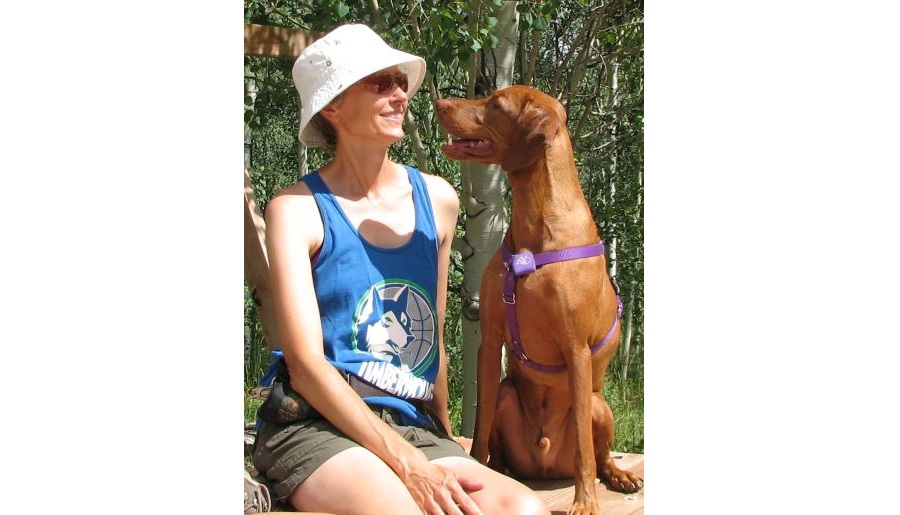
Writing a book about dog training can help you to establish yourself as an industry authority in your community and beyond. But what does it take to write a book? We asked Sue Brown, an accomplished dog trainer and author of Juvenile Delinquent Dogs: The Complete Guide to Saving Your Sanity and Successfully Living with Your Adolescent Dog and Ask the Trainer to talk to us about her own experience as an author.
When it comes to dog training in Denver, Colorado, Sue Brown sets a standard of professionalism that serves as a model for the up-and-coming trainers in her community and makes her a trusted colleague of the more experienced trainers. She holds certifications through the International Association of Animal Behavior Consultants and the Certification Council for Professional Dog Trainers. She also is a Canine Good Citizen (CGC) evaluator, and is the co-founder of the Colorado Dog Trainers Network, a networking and training organization for Colorado dog trainers.

Copyright The Light Of Dog LLC. All Worldwide Rights Reserved.
The Modern Dog Trainer: You have written two books, Juvenile Delinquent Dogs and Ask the Trainer. Why did you decide to write these books?
Sue Brown: I wanted to find a way to share my knowledge and experience with a wider audience. In addition, I had known I wanted to write a book for a long time. I enjoy writing and I wanted to do something more in-depth than you can do with a blog. The only thing holding me back was determining the right topics. Once I had an idea I was passionate about, I got started!
TMDT: Why did you choose those particular topics?
SB: I wanted to write a book that had not already been done several times over. As I scoured through the available books, I noticed there were tons of books about puppies and about dogs in general but none about adolescent dogs. And most books are written from the perspective of a “textbook” sort of approach. I wanted something different. My training clients have always appreciated the personal stories I shared about my own dogs, so I wanted to take on a new topic from the perspective of going through the process with my own dog. So I wrote Juvenile Delinquent Dogs as I was raising my Vizsla, Romeo. He gave me plenty of stories to share! As for Ask the Trainer, it was a way for me to compile and share the articles I had been writing for several years that cover a wide variety of topics.
TMDT: How long did it take you to write each of your books?

Copyright The Light Of Dog LLC. All Worldwide Rights Reserved.
SB: The initial draft of Juvenile Delinquent Dogs took one-and-a-half to two years. That was due in part to the fact I was writing it as I was raising Romeo and I wanted to cover that entire process as it was fresh in my mind. In addition, my clients knew I was writing the book, so they kept giving me more ideas to add. The edits and re-writes added another several months.
Ask the Trainer was a compilation of articles I had written over time for a rescue group newsletter, so that was written in stages over several years.
TBDT: What was the most fulfilling thing about writing your books?
SB: I have always loved to read. As a child, I could sit and spend an entire afternoon reading a book from start to finish. So it was very fulfilling to see an actual book that I had written myself!
TBDT: What was the most difficult thing about writing your books?
SB: I had intended Juvenile Delinquent Dogs to be around 150-200 pages, but it ended up being much longer because there was so much I wanted to share. Even as a student, I always had trouble keeping my written essays short! The hardest part was deciding when to stop. I still think of things I wish I had been able to include. I am happy with the length of it, as it is intended to be a reference book for those living with dogs. I don’t expect people to read it cover to cover in one sitting. It’s meant to be kept handy so it can be referred to over and over again.
TBDT: How do you use your books to augment the dog training you do in your community?
SB: Some people who contact me cannot afford the training that would be most beneficial, so the books are a chance to gain a lot of information and have the ability to go back to it over and over again. Other people will participate in group classes or private training and buy the book to supplement our training together so that they can go back and take time to absorb what we have covered in person. Studies show that people will forget 90% of what they have heard within a week. The books are a way to have that information handy and be able to go back to it at any time.
TBDT: Why did you choose self-publication over traditional publication with a company like Dogwise?
SB: I love to learn, and being able to self-publish and handle that entire process myself was a great learning experience. I certainly made mistakes and would do some things differently next time around. But I am also a Type-A personality, and I knew I wanted control over the entire process. This was my “baby” and I wanted it to be exactly what I wanted!
TBDT: Your first book, Juvenile Delinquent Dogs is available in hard copy and e-book formats, and your second book, Ask the Trainer, is available only in e-book format. What were your reasons for those format selections?
SB: E-books are very popular now, and there are many benefits to them. But I still love being able to hold a book in my hands and carry it with me. So Juvenile Delinquent Dogs was always intended to have a print and e-book version to satisfy both types of people – those who still prefer to hold a book in their hands and those who prefer the economy and convenience of an e-book. For Ask the Trainer, I had seen everything it takes to produce a print version – and the expenses that go with it – and decided to stick with an e-book format for this book. This also gives me the option of easily revising it and adding new articles – which I have done several times already.
TBDT: What advice would you give to those who aspire to write their own books?
SB: My first piece of advice would be to choose a topic about which you are passionate. The process can be long and frustrating at times, so your passion will help you stick with it.
Next would be to talk to others who have done it so that you can avoid some of their mistakes. Also, be honest about how much time and effort you have to put into it. While I am glad I self-published, I honestly do not know if I would do that again. It took a long time and a ton of work, and I don’t know that I could put that much time into another book.
Finally, do not let doubts or anything else hold you back. If you’re passionate about it, go for it!
TMDT: You obviously have worked very hard on your professional certifications. Do you believe it is important for up-and-coming writers to hold dog training certifications?
SB: Our profession is unregulated, so it is very much a buyer-beware market. I believe independent certifications from reputable organizations are a way for us to begin setting standards, minimum qualifications and a set of ethics by which we all strive to abide. Many clients do not know to ask about qualifications, but I am seeing more and more who do. As it pertains to writers, I believe legitimate certifications help lend credibility and demonstrate a degree of expertise, especially for those whose names are not well-known.
TBDT: Can you give us a concise summary of your book-writing process?
SB: Yes, I do it like this:
- Outline your book. Consider what you will cover and how it will be laid out.
- Write it. Review it. Make revisions. Review it again. Make more revisions.
- Have a few people review it. I had 3-4 people review it for me and give feedback. Make revisions.
- Send it to an editor/proofreader. Make more revisions. Send back for re-review. Make more revisions.
- Send to a professional for layout and formatting.
- Determine your final title and design your book cover. Or work with someone to design it for you.
- Review it — and review it again — to ensure everything is perfect.
- Send it to printer.
- Don’t forget to work on your marketing during all of this as well!
- Figure out pricing. It will depend upon how much of this you do yourself and how much you pay others to do. If you are self-publishing, it is a lot more expensive because you are covering ALL of the costs, but you keep more of the profits as well. If you are working with a publisher, you share some costs, and you also receive a smaller percentage of sales.
TMDT: What is next in your book-writing career?
SB: I hope to get started on another book in 2015. You will have to wait to find out the topic!
If any of you have more questions for author Sue Brown, please let us know in the comments, and we will try to get them answered for you. We’d like to extend a BIG thank you to Sue for taking the time to answer our questions. Be sure to check out her books and ebooks!
Get Dog Training Business Tips!
Receive valuable dog training business tips and resources every week! Subscribe to The Modern Dog Trainer now by submitting your name and email below.
[mc4wp_form]
![Should You Start Your Own Company Or Join Someone Else’s?]()
by Ines | Nov 25, 2014 | Business
How To Choose Between Starting Your Own Business Or Becoming Someone’s Employee
When you are first starting out, it can be difficult to choose between starting your own dog training business or joining someone else’s. Ultimately, there are benefits to both.
Start Your Own Business
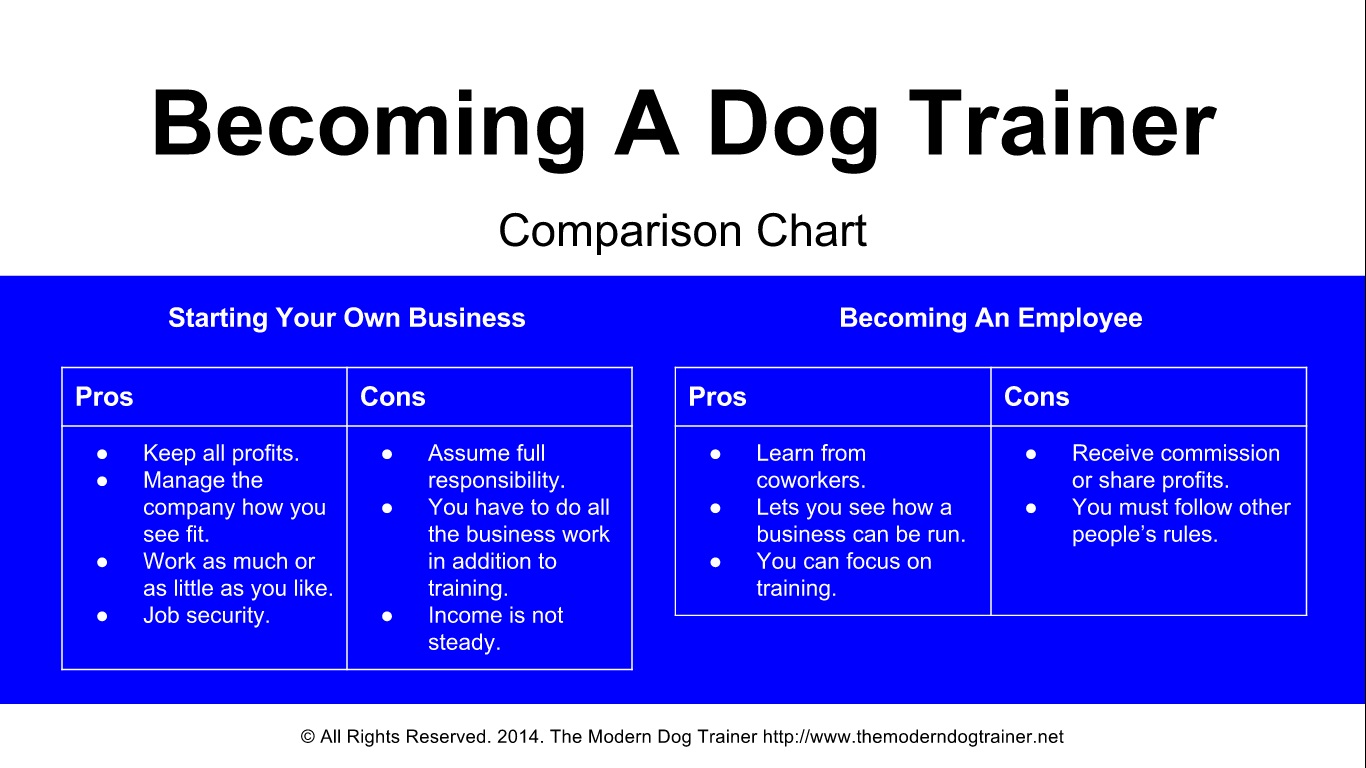
Many dog trainers choose to start their own business. Having your own business increases your revenue and lets you run the business how you see fit. However, having your own business also comes with more responsibility. You’ll need to purchase insurance, get the appropriate business licences, and maybe even start an LLC. The income isn’t always steady and you don’t have anyone to share the work load with. Fortunately, the job security is great because you are your own boss.
Starting your own business is the best way to make a decent wage as a trainer. It is more of a career path than an hourly or commission based job. However, there are some advantages to starting out with a regular job under someone else’s direction.
Get a Job
If you don’t know how to run a business, but are eager to get started training, getting a job is a great option. While working for someone else, you’ll be able to learn about how the administrative end of running a business looks like and you’ll be able to learn from the other trainers in the company. The down side is that you have less freedoms when it comes to working and you will have to survive off of commissions or hourly based pay. Many of the jobs that you will find are entry-level positions such as dog caretaker, kennel tech, or dog walker. Management level positions are quite rare. Getting a job is a great way to get a lot of experience under your belt. We’d like to encourage you to research companies that are willing to reimburse or fund continuing education or certifications.
If you are considering getting started as a dog trainer, check out DogTec’s free download, “Going to the Dogs?” There is some great information about what it takes to become a dog trainer.
Would you prefer to start your own business or join someone else’s company?
Recommended Article by The Modern Dog Trainer
![Three Services You Can Offer that You Haven’t Thought Of]()
by Thomas Aaron | Nov 17, 2014 | Business
Side Services Dog Trainers Can Offer To Boost Profits
If you are looking for a way to earn some extra income, adding some new services to your current offerings can increase your clientele, increase your profitability and ward off monotony. These are three potential side services dog trainers can offer and some suggestions about how you might market them. Each of these ideas easily deserves its own article — or even its own book — but the following information will help you see some of the possibilities available to you.
Lectures & Workshops
If you’ve been training dogs for a while, you probably have developed your own way of talking about various issues. Perhaps you have come up with unique analogies to describe dog training tasks or developed effective methods for solving tricky problems. Not only is your wisdom useful to the average dog owner, but even seasoned trainers can benefit from fresh perspectives on old problems. Alternatively, if you are shy about sharing your own wisdom, you can host a speaker from elsewhere to provide knowledge to your community. Either way, you position yourself as someone striving towards the cutting edge of dog training – and you can earn some extra money, too.

Michael Shikashio presenting at the 2014 APDT Conference.
There are some easy ways to advertise local lectures and workshops. Your own social network can be very useful for posting announcements (the more locally you can filter your announcement, the better). If you are already advertising your website, your advertising dollars will be more useful if your website has some interesting lectures listed on it. Also, local bulletin boards – particularly if they are in pet-industry establishments – can be a great way to make your community aware of your offerings.
Since lectures and workshops are meant for multiple attendees, it is a good idea to keep the price affordable for individuals and derive your profit from drawing a large audience. To provide some extra information on how a lecture could be set up, here is how one company describes its lectures to augment its dog training in Denver.
Dog Selection Assistance
Potential clients sometimes call to scope out dog training services before ever purchasing or adopting a dog. As a dog trainer, you already have a good feel for the factors that influence compatibility between dogs and families. Instead of just competing for their dog training business, become their advocate and help them find the right dog. This is a great way to earn extra money while practically guaranteeing yourself their dog training business once they finally acquire their new dog.
Of course, calls like those mentioned above are good opportunities, but there are other ways to make your community aware of your dog-matching service. In addition to making services known on your website and in your social networks (see above), you can capitalize on relationships you have with animal rescues and shelters. They typically are interested in placing animals in compatible homes and may be willing to let you offer your services through them. Additionally, well-networked dog trainers often receive news of available litters of puppies through breeders in their communities. Serious breeders are always concerned about their pups ending up in the right home, and they may be interested in using you to match up prospective owners with suitable puppies.
Pet Photography
If you are a good photographer and have access to a good camera, you can use your own skills and equipment to augment your income. After all, everyone loves a creative picture or an action shot of their dog. But if you don’t have the skills or equipment to close the deal, you can always partner with someone who does. Many up and coming photographers can be found on Craigslist and through local photography programs. They are often happy for an opportunity to build their portfolio and make a few bucks in the process.
Pet photography can be a great up-sell opportunity for your current and past clients, and great photos can end up in great referrals to your clients’ friends and family. In addition to offering it for the dogs you are currently training, consider scheduling a photo shoot at a local park through your social network and newsletter to bring in some extra money.
Another fantastic way to generate money through pet photography is by attending dog-related events with your camera. Make sure you have the technological capability and know-how to shoot great action shots if you attend agility, hunting, or other sporting events. You may have to peddle your pictures at these events when you first get started, but once your work becomes known, you can gain invitations to these events as their official photographer. This will generate great word of mouth advertising among the participants and increase your sales.
Photography prices vary wildly and they can get too expensive for your clientele pretty easily. Consider taking your – or your photography partner’s – skill level into account, along with the disposable income of the demographic you serve.
Hopefully these ideas will help you improve your offerings, your bottom line, and keep business exciting for you. At a minimum, it should provide food for thought and help you consider how you may better serve your own community of clients.
Please tell us what other services you think might be a good augmentation to dog training businesses in the comments below.
![Private Sessions Or Group Classes?]()
by Liz Wyant | Nov 13, 2014 | Business, Training Methods

When new clients contact you, generally the first thing you will be asked about is classes you offer. Most people don’t even think about private training. Knowing whether to guide your clients in the direction of classes or private sessions will help your clients get the most bang for their buck.
Reactive/Fearful Dog
Though there are some incredibly well-run “Reactive Rover” type classes out there, for dogs that cannot be in the same building/vicinity of other dogs or people, classes can just be too much and there will be little to no benefit. Help the client get a solid foundation on the dog through private sessions. If the dog and owner have zero foundation skills, they will struggle in a group class setting.
Young And/Or Untrained Dog
Beginner Obedience classes are probably the most utilized class out there, but are they always the best option? So often, the massive distraction of other dogs and people all combined make it difficult for a young or untrained dog to focus on their owner. Doing even one or two private sessions before putting a dog into a class can make a monumental difference in their ability to focus and benefit from the class.
Owner Needs Special Attention
There are some clients that, for a myriad of reasons, would benefit from one-on-one instruction. Putting an owner like this into a group class just wouldn’t be fair or beneficial to them. This type of owner craves your full attention which cannot be provided in a group class setting. Spend some time with them in private sessions so they can be confident in their abilities before you transition them into a group class.
Specific Training Issue
If you have a client that has attended group classes and continues to have problems getting his/her dog to do a certain behavior, a private session may be in order. This will enable you to focus all of your attention on them and see what the problem may be so you can help them fix it.
Household Issues
Housetraining, intra-household dog aggression, cat/dog issues – many of these are problems that can’t always be solved in a group class. These often require you to go to a client’s home and help them enact feasible management while they work on behavior modification.
What other times do you recommend private sessions versus group classes to your clients?
![5 Places To Hold Group Classes]()
by Liz Wyant | Nov 8, 2014 | Business
If you are a dog trainer without your own private training facility, you can sometimes feel relegated to holding only private in-home sessions. However, with some creativity and planning, you can hold group classes in many different places.
Public Parks
Public parks can often provide you wide open spaces to hold group classes. They enable you to spread dogs out so even space-sensitive dogs can succeed. Holding group classes in parks is often easier if you have somebody to partner with so that one person can teach while the other can run interference with curious bystanders or loose dogs. Be sure to check any city regulations about using parks for personal gain.
Veterinary Offices
Many veterinary offices have spacious lobbies. They often love having a trainer “on staff,” so to speak, so they can refer clients to you. If you can establish a good working relationship with a vet, it can become mutually beneficial with each party referring potential clients to the other. Classes are a great way to keep clients coming back to their office and you’ll be able to make new relationships with clients.
Local Pet Stores
Most of the big box pet stores have their own staff trainers, but many local pet stores have decent open areas and would love to have a trainer hold group classes there to bring customers in their doors. If you promise to promote their products, they may even allow you to use the space for free. Additionally, holding group classes in a pet store provides for GREAT distraction training!
Parking Lots/Garages
Parking lots/parking garages can be fantastic for group classes. Being on concrete allows for distracted dogs to focus a little more easily, yet there is often still grass close by for potty breaks and sniffing rewards. Also, like public parks, they are very large and permit you to spread your clients out so all the dogs have ample space. Just make sure you have permission to be there.
Halls/Basements
Sometimes churches or AmVets type clubs will rent out their halls or basements for a reasonable fee. Be aware that some may require you to be an active member to get this benefit, but it certainly does not hurt to call around and ask.
Remember that when you are out in public or using somebody else’s space, it is important to leave the space as clean as or cleaner than it was when you arrived. Doing so ensures that you and your clients will always be welcome in the future.
What other places do you use for group training?
Recommended Links