![Tips Before You Start Training Dogs On A Deadline]()
by Thomas Aaron | Feb 3, 2015 | Business

Five Things To Consider
There are numerous ways for dog trainers to provide their services, and each has its benefits and drawbacks. In addition to group classes, in home training, and day training services, trainers also can provide board-and-train services.
For clients, having their dogs boarded and trained usually is more expensive than other modes of training, but it is a viable option for those who have hectic schedules and find attending group classes or scheduling private coaching unfeasible. (As trainers, we often become agitated about clients who cannot make time to train their dogs. However, board and train services can lay important groundwork with the dog and can be used in conjunction with in-home training or group classes to help busy clients achieve their training goals more efficiently.)
But before you decide to add board and train services to your repertoire, there are several factors you should consider.
Training Dogs On A Deadline
Board and train usually is faster than group classes or private training, because it pushes the dog towards new training objectives daily rather than weekly. Additionally, the training is being performed by professional trainers, who should have better timing and tactile skills than the average dog owner. For those reasons, some people are willing to pay you a premium to accomplish training goals, but they are not willing to give you their dog indefinitely. They will expect you to complete your training goals on a deadline.
For example, while a Level One Obedience course may take five or six weeks in a group class or in-home training scenario, it usually takes no more than two weeks in a board-and-train environment (for the reasons mentioned above). However, there is a certain stress factor involved in working on a deadline that does not lend itself to successful positive reinforcement training.
It is easy to deal with problems and various training interruptions early in the board-and-train process. But problems are not as easy to handle as the training deadline draws closer. Dogs do not learn faster just because you need them to. Your stress level can complicate their learning ability (as they are emotional creatures). So, trainers who offers board-and-train services must understand how to manage their stress levels and patiently keep the training process moving forward.
Getting Results With Dogs, Not People
If a dog is not making progress in a group class or in-home training environment, there are lots of possible reasons. You could blame the owner for not putting in the effort or not following your advice. You could blame the owner’s children for constantly reinforcing the dog’s bad habits. You could even blame the dog … let’s face it, they are not all easy. However, in a board-and-train environment, all blame rests on the trainer if the job does not get done correctly, and clients will not accept excuses unless they are accompanied by a refund.
Remember, boarding-and-training is about training dogs, not people. It requires a person who can train animals effectively and efficiently, not a personal coach. To be sure, there is an overlap in skill-sets in the two disciplines, but those offering board-and-train services cannot exempt themselves from responsibility if the dog does not get trained well and on-time.
Note: While it is possible to negotiate extending a dog’s training time in your program, you must lay a pretty good argument for it, preferably earlier in the dog’s stay with you rather than later.
Skills Training Versus Behavior Modification
In truth, behavior is behavior. Sitting is a behavior. Coming when called is a behavior. Walking calmly on a leash in the presence of other dogs is a behavior. Exhibiting separation anxiety when the owner leaves the home is a behavior — one we would like to eradicate. However, some behaviors are more feasible to work on in a board-and-train environment than others.
A fundamental rule for boarding-and-training is this: If a behavior is not heavily dependent on the dog’s owner, family or environment (that is, if it is just a skill), it probably can be created or modified effectively in a board-and-train program.
Chasing the cat, house training, leash aggression, resource guarding toys from the children, fighting with the other dog in the family and separation anxiety are all examples of behaviors that are difficult to fix in a board-and-train environment. This is because, in one way or another, they all have specific links to the dog’s environment and family.
Now you could do some groundwork on many of these issues in a board-and-train environment (i.e. some impulse control work, some socialization, some counterconditioning, teaching leash walking), but you most likely will not be able to solve the dog’s problem without some follow-up work with the dog’s family in their home environment.
While there are indeed some trainers who specialize in fixing certain complex behavior issues in a board-and-train environment, skills training is where the average board-and-train program can really shine. Sit, down, stay, come, leave it and leash walking are all examples of simple skills that can easily be taught to an acceptable degree in a short timeframe. Board and train can also be a great way to teach certain work- and game-related skills: retrieving, nose work, protection work, hunting, agility. These are not so dependent on the dog’s family and environment; they are just things the dog can know how to do and enjoy.
Setting Expectations And Offering Handover Sessions
There is what a dog knows, and then there is what a dog does — and the two are not always linked. For example, a dog may know how to come when called, but that doesn’t mean he will be willing to in every circumstance. Also, dogs seem to learn that it is rewarding to listen to some people and not to others. For these reasons, it is important to set expectations correctly with owners. You must tell the owner that you will teach their dogs skills and demonstrate those skills when they come to pick up their dog, but you also must explain that some work with them will also be necessary.
The first formal training the owner gets when they pick up their dog should be a very detailed handover session. You might want to compliment the session with handouts that describe everything their dog was taught, proper cues and related hand positions, important principles to follow, etc.
However, many board-and-train specialists sell their board and train package so that it includes one or (optimally) more in-home sessions to help the owner get the hang of handling their newly trained dog, managing the dog correctly, and reinforcing the dog’s newly trained behaviors.
And The Legalities
Some trainers maintain professional facilities where they provide board-and-train services. Such facilities usually must be regulated by one or more governmental entities. For example, in Colorado a boarding facility must be licensed by the Department of Agriculture and by the city government. It also must be well insured, as a lot can go wrong when dogs and people are involved.
Other trainers like to provide board-and-train services in their home. This option can be particularly attractive to clients, as most people would rather have their dog trained in a cushy home rather than a kennel. For this reason, it also is attractive to trainers (in addition to the fact that a home has much fewer operational expenditures than a facility).
However, there are a few things you should check on before deciding to offer boarding and training at your home. First, you will want to determine the degree to which you must submit to regulatory and licensing authorities. Second, you will want to make sure you are not running amok of your community covenants. And third, you will want to make sure your insurance will cover it.
Clients may not think of these things while times are good. But if something goes wrong (and it probably will, according to Murphy’s Law) and they decide to sue you, you can be sure that all of these things will be brought to light, and your reputation as a professional will rest on how well you have adhered to them.
Do you offer board-and-train options? If so, what other factors do you think are important to consider?
Get Dog Training Business Tips!
Receive valuable dog training business tips and resources every week! Subscribe to The Modern Dog Trainer now by submitting your name and email below.
[mc4wp_form]
![Top 5 Tote Bags For Dog Trainers]()
by Laurie Schlossnagle | Jan 30, 2015 | Business
Dog trainers take a lot with them when they are working. Because of this need for “stuff,” dog trainers are always on a quest for the perfect bag to carry it all.
Tote bags are a great way to get organized and to carry all that stuff to appointments and classes. Following is a list of some favorite tote bags of trainers.
Please note – this is not an inclusive list nor is it necessarily an endorsement; these are some bags I personally use and have heard from other trainers they use and like.
Thirty One Utility Bags

The organizing utility tote from Thirty One is an organized, all-purpose bag with lots of pockets for clickers, receipt books, water bottles, pens, and poop bags. There are two versions of this bag – this one with a zip top and another that is open.

The large utility bag, also from Thirty One, is great for mats, cones, toys, and other big supplies that don’t fit well into other bags. Tops are available for this bag if you prefer a closed bag.
Land Ends Tote Bag

The Lands End bags work well for paperwork – client files, books, contact information, clipboards, etc. They also are good bags for toys. Lands End offers these bags in a variety of sizes, and with or without a zip top.
Products from Thirty One and Lands End are nice because you can get them embroidered with your business name, a monogram, or a paw print. They also come in a variety of colors and prints.
Paw Print Duffle Bag
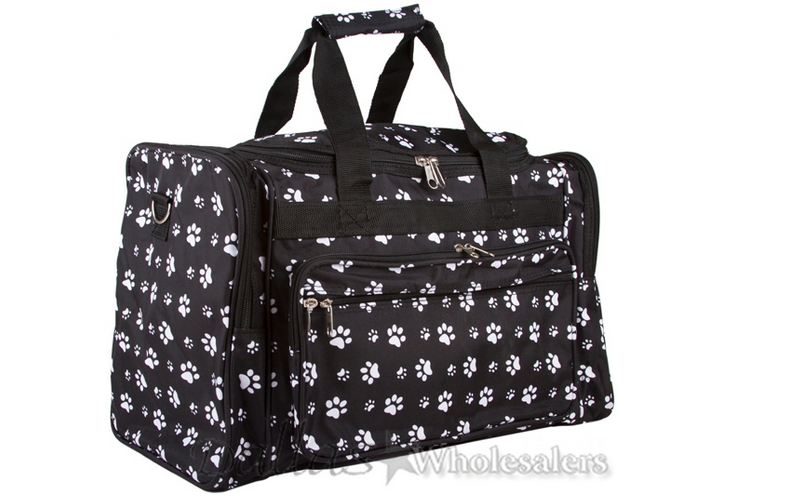
The paw print duffle bag is available from many vendors online. A duffle bag with both handles and a shoulder strap and end pockets and a front pocket is a great bag to have. You can get duffle bags from embroidery businesses with your logo or something dog/business related embroidered on the front pocket. This is can be an all-purpose bag to carry class supplies.
Ruffwear Haul Bag
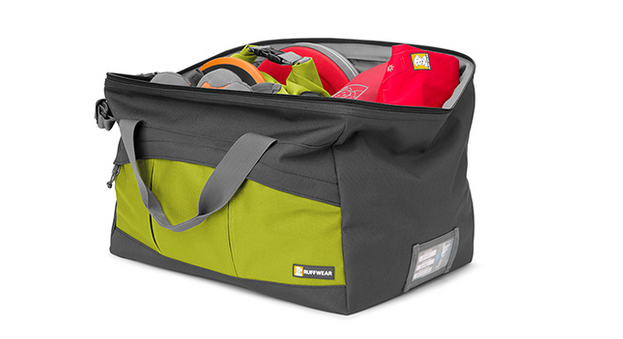
This Ruffwear Haul Bag is brand new, but it is creating quite the buzz among dog trainers. It is from Ruffwear, a company known for its quality dog merchandise. Dog trainers are hoping their new bag is just as wonderful. This bag has a wide-opening gatemouth zip top and is reported to have lots of pockets for all that stuff! It also has both handles and a shoulder strap.
What is your favorite tote bag and what do you use it for?
Get Dog Training Business Tips!
Receive valuable dog training business tips and resources every week! Subscribe to The Modern Dog Trainer now by submitting your name and email below.
[mc4wp_form]
![10 Behaviors All Obedience Classes Should Cover]()
by Erin Bessey | Jan 28, 2015 | Business
Ask anyone and they have their own idea of what a dog should learn. There are the essential behaviors but there are some other behaviors that might not be taken into consideration until there is an issue. It is important to cover these in a class to provide students with a proper foundation for a well-behaved and stable dog.
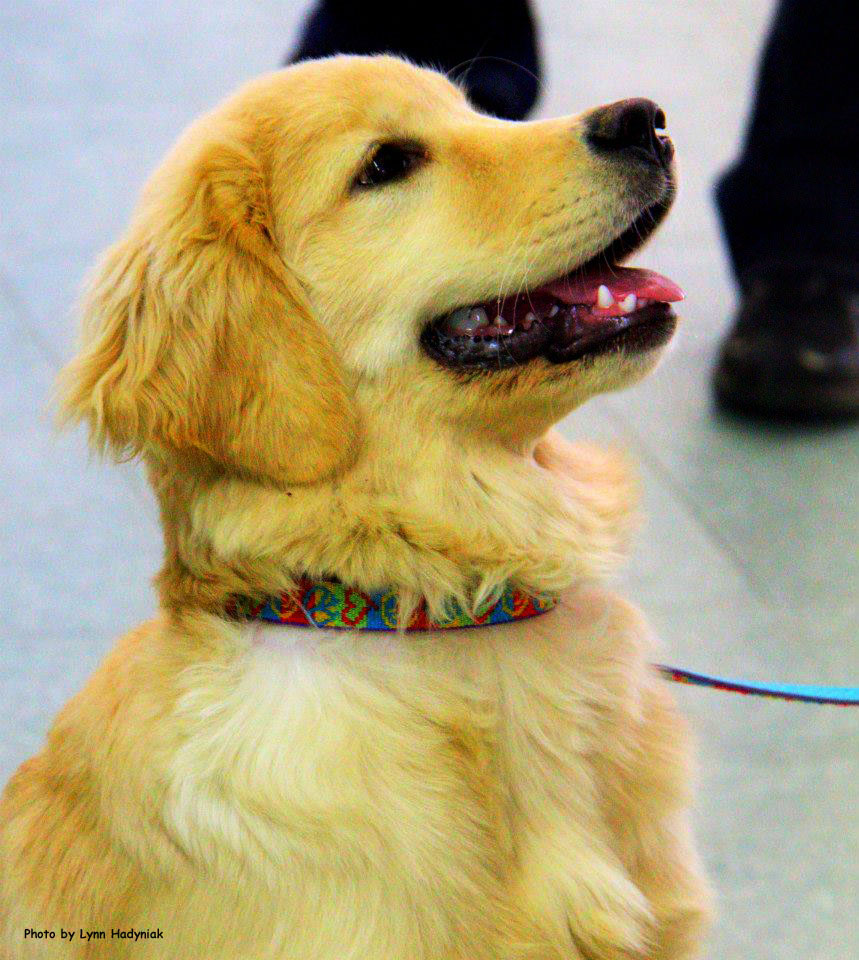
Image via Bessey’s Positive Paws
1. Sit
An essential behavior that most clients have already started with their dog when they come to class but is still just as important to cover. Sit is key to get as a solid behavior because it can be utilized when working on proper greetings or providing a dog with an incompatible behavior to jumping.
2. Down
Another essential behavior that clients like to know how to teach. It works as an incompatible behavior to things like jumping but also is handy when working on teaching place or a settle.
3. Leave-it
A behavior that has endless uses. Not only to teach a dog to leave food or inanimate items but other dogs, cats, people or “yuck”. You can fill in the blank.
Whether a dog is allowed freedom outdoors or not, how to walk on a leash is a behavior to start immediately. There will always be a time when a dog needs to be put on a leash and it is more pleasurable for dog and handler when the leash is loose, let alone safer.
Clients tend to focus their attention on exercising their dog which can lead to an anxious or hyperactive dog that doesn’t know how to chill. Dogs will adapt to the level of exercise they are given. We need to teach them to settle and relax in the face of excitement or boredom.
6. Recall
Also known as “coming when called,” this is a life saving behavior and takes lots of practice to be truly successful. Coming when called is a key behavior to teach early on in lessons. Consider incorporating a hand touch with this behavior to make sure the dog comes within reach in case of an emergency situation.
7. Place
A versatile tool like a mat, towel, dog bed etc. that can be used to have the dog target at a specific location and then to relax and settle. Mats are portable and can be taken to coffee shops or restaurants as well.
8. Focus
Client will repeat cues to a dog when they don’t even have the dogs attention. By teaching the client this tool of gaining their dogs attention will help to eliminate frustration in the face of distractions.
9. Handling
Teaching your clients to teach their dogs to love handling is essential. It helps to create a stable, confident dog. Dogs should allow their owners to comfortably hold their feet (for nail trimming), check their mouth, look in their ears, brush their coats and accept restraint. Having strangers perform these exercises to the dog is a definite bonus to prep for vet visits! (Tip: Have everyone in class switch dogs and practice gentle handling exercises with lots of rewards.)
10. Give
Teaching “give” or a “drop it” helps prevent resource guarding. Instead of forcing something away from the dog we can give the dog the choice to drop the item for something of better value.
The above behaviors are listed in no particular order to importance. Which behavior do you think is the most important?
![10 Qualities Of Great Dog Trainers]()
by Liz Wyant | Jan 15, 2015 | Business
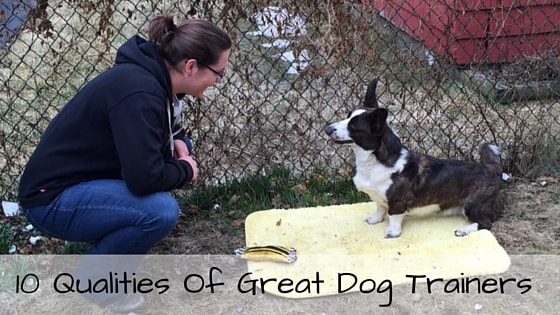
There are many dog trainers in this world. Some are amazing, some are so-so, and let’s be honest, some are downright dodgy. As a modern dog trainer, what are some traits you should possess to be considered a great dog trainer?
1. Patience
Patience is indeed a virtue, is it not? Especially when dealing with clients and their dogs. Maintaining your patience is key to helping clients learn without feeling like you are getting annoyed with them. They didn’t understand your directions the first three times? No problem, you’re willing to explain it again because you are patient and you understand that people and dogs learn at different rates.
2. Sense of Humor
Maybe this should have been number one? On those days where it feels as though everything is going wrong and like the dogs are out to make you feel like a failure of a dog trainer, keep that sense of humor. Learn to keep it light-hearted. If you get frustrated, nobody benefits.
3. Creativity
Dog trainers all have their standard ways of teaching tasks. What happens when the dog or client just isn’t getting it though? You get creative! You use butt scratches (for the dog, not the client!) as rewards. You completely revamp the environment so the dog can succeed. You use interpretive dance to explain a technique to a client. In short, you get creative to get things done!
4. Flexibility
Not necessarily physical flexibility (though let’s be honest, when an untrained mastiff is launching himself cheerfully at your head to say hello, some gymnastic skills can come in handy!), but more mental flexibility. Sometimes you will get a client that just does not want to do something the way you want them to do it. Not out of lack of understanding, but just because they don’t want to. Be flexible. Pick and choose your battles and work around your client’s desires.
5. Confidence
Have some faith in yourself! So often, dog trainers downplay their skills and training. I would bet that your clients think you are fantastic. I would bet that your fellow trainers think you are fantastic. You’ve put a lot of work into your training skills and business, so be confident about talking yourself up.
6. Humility
On the flip side, keep it humble. Don’t be a braggart. But mainly, do not take on clients that are over your head. There is no shame in saying, “you know, I’m not qualified to help you, but let me recommend you contact so and so!” People respect that. And honestly, it will keep you, your clients, and their dogs safer.
7. Open Mind
You can learn a lot from other trainers, even those who do things differently than you do, or even those who use techniques you’d never use (or will no longer use, if you are a crossover trainer). You can learn something from everybody if you just keep an open mind.
8. Diplomacy
Tact can be difficult. But you need to keep that internal filter on your mouth working. Blurting out, “you’re an abusive person for using a collar like that!” will not gain you any clients, nor will it help change any minds. Try instead, “I used to use those collars, too. They certainly do work, but do you know about the potential issues that can arise from their use?” Remain non-judgmental and be careful in your wording. That old adage of catching more flies with honey than vinegar is true.
9. Tolerance for Being Dirty
If you are a neat freak, you may be in the wrong field. Between dirty paws, slobber, dog hair, and residue from stinky treats being wiped on your pants, you don’t have a dream of staying clean!
10. Hoarder of Dog Equipment
Perhaps this is just much-needed justification for never getting rid of anything, but sometimes it can really come in handy! Having equipment on hand (different types of no-pull harnesses, head collars, flat collars, martingales, muzzles, etc) to show as examples to clients can help make things clearer for them. Also, since all dogs are shaped differently, sometimes one type of equipment will fit better than another. One size does NOT fit all when it comes to dog equipment.
So what qualities do you think great dog trainers should possess?
Get Dog Training Business Tips!
Receive valuable dog training business tips and resources every week! Subscribe to The Modern Dog Trainer now by submitting your name and email below.
[mc4wp_form]
![5 Things To Consider Before Renting Space For Dog Training Classes]()
by Kat Camplin | Jan 2, 2015 | Business

Should you make the leap to a permanent facility?
Whether you’re a veteran or just starting out, there’s no doubt you’ve dreamed of having your own dog training facility. You’ve imagined the space, the flooring, and the equipment surrounded by happy, smiling dogs and clients, but should you make the leap? Here’s 5 things to consider before you sign the lease.
Can you afford it?
Your name is on the lease, so you are responsible for the entire amount of the rental costs. If you’re planning on bringing in outside help, rent out a portion, or hold large events, all of that is in the future. Can you afford the rent if those things don’t pan out? Also note, a lot of leases include additional maintenance costs on top of the rent. These can be one annual payment at the end of the year or included in the monthly payments. Ask about additional costs, not just the amount of the rent.
Consider The Equipment
Sure, you can hold basic dog obedience classes on concrete in a barn, but that’s not why you’re getting your own space. The minute you decide to hold any type of sports training classes that include jumping you have to consider anti-fatigue flooring. Sporting equipment, tables and chairs, mats, barriers, and cleaning supplies will be needed before a client ever sets foot in the space. Don’t forget a sign. You’ll need a nice sign out front to let everyone know you’re there! Make a list and add it all up using an average cost from one Google search. Yes, you’ll find discounts and sales on some things, but you don’t want to count on being able to do that for every item.
Insure The Facility
Now that you’ve got the building and all your stuff, you need to insure it all. The building owner will have some requirements for the minimum coverage needed for you to get in the door. If you’re bringing in help or subcontractors you’re going to need liability for those people as well. You’re probably going to purchase your equipment in stages, but what if it all suddenly goes away in a fire? You’re going to need the coverage to get back up and running. The time to find out who pays for fixes from building breakage is before you sign the lease, not after. If a pipe bursts and ruins all your stuff who pays for it? Even if the building owner pays, how long will you be out of business while the repairs are being done? Take a look at insurance that covers loss of income should the unthinkable occur.
Will your city allow you to open?
Cities have zoning regulations so residential areas aren’t built right next to factories. Regulations say where certain businesses can and cannot open. Training businesses often fall between the cracks of zoning codes. You’re not exactly dog boarding and you’re definitely not a groomer, but sometimes cities put you in those zones because there isn’t a place for you. This means buildings you can consider are in a certain district and not necessarily where you want to be. One of your first phone calls should be to the City Planning department to find out where you can go. While you may be able get a conditional use permit for your perfect space, CUP’s require a lot of paperwork, time, and money to get. Plus, you also may be required to do some building upgrades as part of the conditions.
Will clients travel to you?
Sometimes what we can afford and where the city puts us isn’t exactly on Main Street. If you’ve found an old warehouse on the outskirts of town, will people drive to meet you? Sure, existing clients love you and may drive the extra 15 minutes to get to you, but what about people who don’t love you yet? When someone does a map search for your location will they think, “Oh heck no?” Will they drive it in evening traffic? Rain? You need a location people are willing to go to.
Consider these five places to hold group dog training classes before you decide to run your own facility.
Did we miss something? What else should be considered before signing a lease? Tell us in the comments!
Get Dog Training Business Tips!
Receive valuable dog training business tips and resources every month! Subscribe to The Modern Dog Trainer now by submitting your name and email below.
[mc4wp_form]
![5 Reasons Why A Dog Is Not A Good Fit For Doggy Day Care]()
by Erin Bessey | Dec 27, 2014 | Business
Doggy Day Care can be a quick fix for a lot of dogs with energy problems but it isn’t right for all dogs. It is important that a day care properly screen dogs before taking them in for group play. The wrong dog can throw off the whole dynamics of a good play group. Here are 5 reasons that a dog may not be an appropriate candidate for doggy day care.

Image by Erin Bessey
5 Reasons Not to Send A Dog To Doggy Day Care
1. Undersocialized
As Patricia McConnell has said, “dogs have different personalities and have had different experiences while growing up.” Depending on the experiences the dog has had growing up, he may not have had enough positive experiences with other dogs. Because of the lack of socialization many clients want to send their dog to daycare to overcome their fear. A fearful dog, however, forced into a group of dogs could become more reactive. Research shows dogs that tuck their tail are 50% more likely to respond aggressively if they are pushed.
2. Bully On The Playground
Some dogs go to daycare and, while they enjoy it themselves, they are making it a terrible experience for others. The daycare bully tends to overwhelm dogs they are playing with by mowing over them, harassing others that have toys and picking on the shy dog.
3. Dogs That Lack Good Social Skills
This could be the dog that is shy and doesn’t know how to appropriately convey that to other dogs and lashes out aggressively. It could also be the dog that fits #2 that doesn’t know how to properly read another dog’s calming signals and may continue to annoy others with their intensity or energy.
4. Easily Overstimulated
The idea behind daycare is to provide a dog with an outlet for their energy. At the end of the day when you pick up the dog he should be pleasantly exhausted. If a dog is easily stimulated, too many days of daycare might have the opposite effect and keep a dog in “go” mode meaning he is full of adrenaline and come home amped up instead of calm. Sending a dog a couple of times a week instead of all 5 days keep the dog from being over stimulated.
5. Does the Dog Want It or Does The Owner Want It?
Dogs that don’t enjoy the company of other dogs could find the daycare experience very unpleasant and further their dislike for other dogs. It may be clear that a dog does not enjoy the day care experience if he repeatedly exhibits inappropriate, anti-social behaviors towards other dogs.
Dogs at different times may exhibit one of these 5 reasons. When it becomes a problem is when they are repeated. Like people, dogs have bad days, but something will need to change if the behaviors listed above continue to show on a regular basis at day care. It might be as easy as switching up the play groups or reducing the number of days the dog goes to day care. Fortunately an appropriate facility will have good training in reading dog body language and will be able to identify the dog that doesn’t belong. Robin Bennett has some great resources for doggy day care businesses.
Get Dog Training Business Tips!
Receive valuable dog training business tips and resources every week! Subscribe to The Modern Dog Trainer now by submitting your name and email below.
[mc4wp_form]