![Guest Post: Establishing a Working Relationship with a Local Veterinarian or Clinic]()
by Guest Poster | Feb 18, 2015 | Business
Establishing a working relationship with a local veterinarian or clinic can be very lucrative. It can range anywhere from a small percentage of your total monthly or yearly clientele and income to one hundred percent of your entire business. One veterinarian, with whom I worked for many years, when asked what type of person she would look for in a dog trainer, had this to say:
“Someone who is a certified professional and shows me commitment, is experienced, and gentle and patient with animals. I’m more comfortable if I’ve seen them with animals personally. [They should be] willing to travel for in-home visits and handle owners well. You have to learn how to get the owners to be compliant, even if they are know-it-alls or stupid, all of which are very common.”
Before you go out to your local vet’s office and just try to introduce yourself, there are a few things that you should think about…
Write A Concise Introduction Letter
Writing a letter of introduction is probably the most effective way to start a relationship with a veterinarian. Veterinarians are generally very busy people! Visiting them during business hours without an appointment or invitation can be like having an off-leash dog interrupt your training session and start humping your client’s dog. Nobody wants to see that!
Writing a letter is the best opportunity you will have to tell them exactly what you have to offer and why they should choose to send their clients to you for training. Send letters to all the veterinarians in your area, addressed directly to the doctors themselves. Call them back and follow-up. Offer to bring in lunch or refreshments and discuss your services.
You might even offer to pay for an office call in order to compensate them for listening to you.
Know And Embrace Your Limitations!
Be clear and concise about both your strengths and your limitations. Remember, limitations are not shortcomings or weaknesses, but rather the limits within which you are comfortable or qualified to operate. You never want to misrepresent your abilities or qualifications. Being comfortable with your own limitations will help allow you to project a more professional attitude. It also keeps you out of trouble. You never want to accept an aggression case if you are not comfortable or qualified, the same way that you would never diagnosis a medical problem in a client’s dog. Build a strong network of other trainers and behavior consultants and know when to refer up the ladder.
Join Dog Training Trade Organizations
Two of the main organizations that veterinarians search to find dog trainers are The Association of Professional Dog Trainers (APDT) and The Certification Council for Professional Dog Trainers (CCPDT). Both of these organizations have trainer listings and searches that make it easy for you to be found. Other organizations, such as The Pet Professional Guild (PPG) and the International Association of Animal Behavior Consultants (IAABC) have the same types of listings and searches. However, overall recognition of these organizations by veterinarians seems in my experience to be very limited.
Acquire Professional Credentials
You will find that most veterinarians will take you more seriously if you are a certified professional. Achieving certification in dog training shows that you have made a serious commitment to your trade as well as to your own personal growth. The certification that veterinarians are most familiar with is Certified Professional Dog Trainer, either Knowledge Assessed (CPDT-KA) or Knowledge and Skills Assessed (CPDT-KSA). Both of these are available through the CCPDT, the only independent body that exists for certification in dog training.
Become Aware Of The Veterinary Trade Organizations
Spend some time, if you haven’t already, and become aware of some of the different veterinary trade organizations and their missions. The American Veterinary Medical Association (AVMA) and The Animal Hospital Association (AAHA) are two good examples. Membership in these organizations is voluntary and standards and guidelines are above and beyond those set by the rest of the industry. Being aware of which organizations a veterinarian is or is not a member of will help you to tailor your conversation, once you’ve started it.
Now that you know how to establish a relationship with your local veterinarian(s), who are you going to contact first?
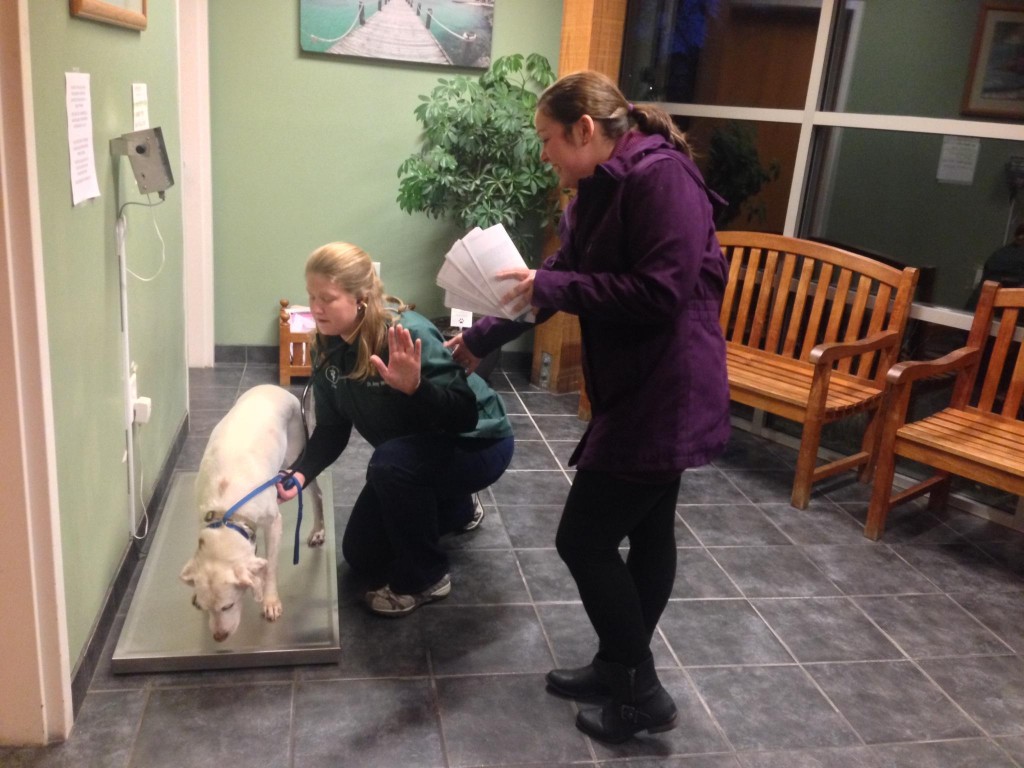
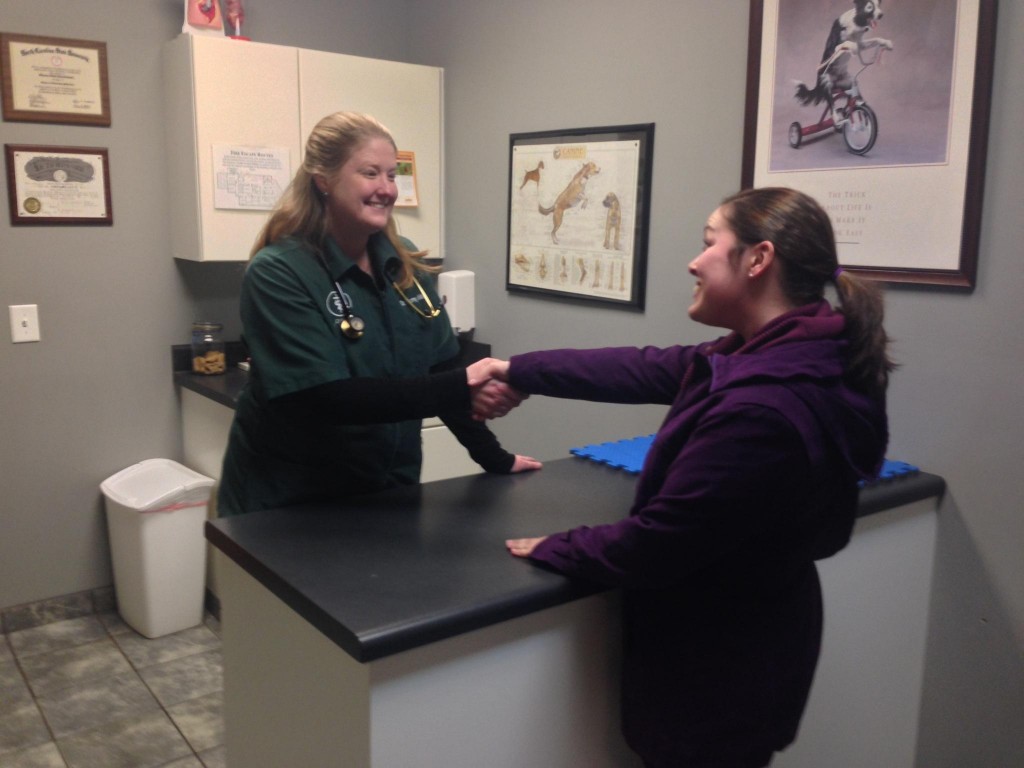
Special thanks to Dr. Rebecca Simmons-Resnick for her input, Dr. Amy White, Ashley Ford, and Poppy for modeling for the photos, and Terri Dickinson for taking them!
About The Author
 John Stawicki is a force-free dog behavior trainer living in Cape Fear, NC, with his lovely wife Paige, and their seven assorted mutts. Together, they contemplate dogdom and their place in the universe. He may be reached at Cape Fear Positive Dog Training.
Get Dog Training Business Tips!
Receive valuable dog training business tips and resources every week! Subscribe to The Modern Dog Trainer now by submitting your name and email below.
[mc4wp_form]
![Guest Post: False Bravado!]()
by Guest Poster | Jan 13, 2015 | Communication
 Dominance
If you work with dog owners or cruise the dog behavior groups on Facebook you will often see dogs that are labeled ‘dominant’. I hear this most often in client homes where they have multiple dogs and have categorized one as the dominant or “alpha” dog because of its interactions with the other dogs.
It is often described as the dog who is stealing all the toys, pushing the others out of the way at the doorways, hoarding all of the chew bones or fighting over them, seeking – if not demanding – the humans’ attention away from the other dogs, guarding the food or water bowls, playing too roughly and ‘enthusiastically’ with the other dogs, or keeping the other dogs off of the comfortable resting areas so they can have them as their own. It appears to be seen even more predominantly within a household where the dogs are of similar age, especially siblings.
 However, if you take the same dogs out of the comfort of their home or familiar territory (such as a well-frequented dog park) or even away from their familiar play mates, you may see a very different dog. One that is much more hesitant around new things, interacts in a shy or reactive way to other dogs and/or people or perhaps they act overly friendly with a lot of jumping around other dogs or people, doing lots of ‘kissing’, lots of soft body curves, mouth licking, submissive grins, lowered head, or even excessive mouthing, all which can become obnoxious submission. So how can it be that this dog that is SO ‘dominant’ in one situation is so different in another?
Remember the bully on the playground in grade school or the class clown in your high school class? There is a similarity between humans and canines in that insecurity and anxiety will be displayed in a variety of ways. The dog that is pushy and easily over aroused and gets into squabbles with the housemates is much like the bully on the playground, whereas the obnoxiously submissive dog that is constantly seeking approval from the other dogs and/or humans is much like the class clown! You may see both behavior displays from the same dog, just in different situations. The fake ‘dominance display’ is often seen at home and in familiar surroundings whereas the submissive display may be seen in a novel environment or circumstance. The latter is usually not of much concern to most dog owners other than it can be a little annoying, but that obnoxious submission can be extremely irritating to some dogs and can actually cause an escalation in communication efforts that may result in aggression. We have an adult Great Pyrenees, Mama Shay, who is excellent at giving and reading canine body language. She can meet and greet almost any dog that is willing to ‘listen’ to her because she is never forward in her approach unless invited by the other dog through appropriate body language. However, young dogs that fall into the category of obnoxiously submissive, really push her buttons. She will give them an appropriate cut off signal with a head turn or eye avert which usually indicates to a dog with good communication skills that a direct approach is not desired. However, if the dog continues to approach in this overly appeasing way, rolling on the ground showing a submissive grin, doing lots of lip licking and eyes blinking like a flickering Christmas tree bulb, she may be pushed to the level of giving a small growl to warn them away. This in turn, makes them seek approval even more intensely and that can often result in a Great Pyrenees who is irritated and would escalate into more aggressive displays if we did not intervene.
 Once a dog like this become familiar with their environment and the other dogs in the play group they often turn to the bullying behavior so often referred to as dominance. By being bouncy, barky, and mouthy during play, or playing in a way that can be over the top with a lot of acrobatic movements, pushing the other dogs out of the way as they go through the doorway, or hogging the human interaction from the other dogs these dogs have gone from what appears to be one extreme to another.
Modern, educated dog trainers know it is always extremely important to identify the behavior and body language of the dogs without labelling it. But pet owners have most likely already done that! When they describe their dog as alpha or dominant it is important to get the actual physical behavior instead of the label. I give them another more accurate characterization of the behavior: “False Bravado”. A dog like this displays an almost over-the-top amount of courage but in reality it is a false show of bravery. As mentioned previously, this behavior is a symptom insecurity or anxiety. The dog is compensating for their lack of confidence and appropriate communication skills by bullying.
Hearing the term ‘dominance or alpha’ can give a trainer a snapshot of what may really be happening in the household and the use of the “False Bravado” term may help us reframe what the pet owner is seeing into a more accurate term.
About The Author
Karen Deeds, CDBC began her career with canines competing in the obedience show ring after being competitive in the horse show ring. Following an incident with her competition dog in 1990 that resulted in an aggression problem, Karen learned the importance of understanding canine behavior and how to manage and modify it.
In 1992, Karen, while working with a local Humane Society, quickly realized the need to educate clients on canine behavior… Far too many dogs were being destroyed because of behavioral problems. She found with education, positive training, & behavior modification, more dogs successfully adapted to a family environment. Canine Connection was founded in 1994 to train owners to connect with their canine partners.
Karen met Bob Deeds in 1998, when she was asked to help his volunteer search and rescue team with a ‘new’ training technique “Clicker Training”. They were married in 2004.
Karen was involved in the Assistance Dog industry for almost 20 years working for 3 different organizations and clients with their service, seizure response, or hearing dogs.
Attending continuing education seminars helps to maintain a high level of knowledge of canine behavior, body language, and proven science based training and behavior modification techniques. Karen was the Tarrant County Veterinary Medical Association’s 2009 Community Service Award winner for her work in the field of canine aggression. In 2010, Karen received the Community Educator of the Year Award from the Association of Pet Dog Trainers (APDT). In 2013 she passed the rigorous criteria to become a Certified Dog Behavior Counselor (CDBC) through the International Association of Animal Behavior Counselors (IAABC).
Both Karen and Bob are active in Dog Scouts of America as instructors at the Texas Mini Camp, teaching a variety of courses. They also continue to assess dogs for working potential in various disciplines such as SAR, narcotics, arson, bedbug, and service work. Bob and Karen currently perform behavioral evaluations and rehabilitation helping the rescue community better place dogs in adoptive homes. They also present numerous seminars for a wide variety of audiences.
Karen’s current canine partner is Cassidy, a golden retriever she adopted from Golden Retriever Rescue of North Texas in April of 2010. They have received their Rally Novice (RN), Rally Advanced (RA), Rally Excellent (RE), Beginner Novice (BN), Novice (CD), and RAE titles and are currently working to compete in AKC Open competition using all force free training.
Get Dog Training Business Tips!
Receive valuable dog training business tips and resources every week! Subscribe to The Modern Dog Trainer now by submitting your name and email below.
[mc4wp_form]