![Trainer Ethics: Calling Your Well Trained Dog A “Service Dog.”]()
by Kat Camplin | Jun 29, 2015 | Business
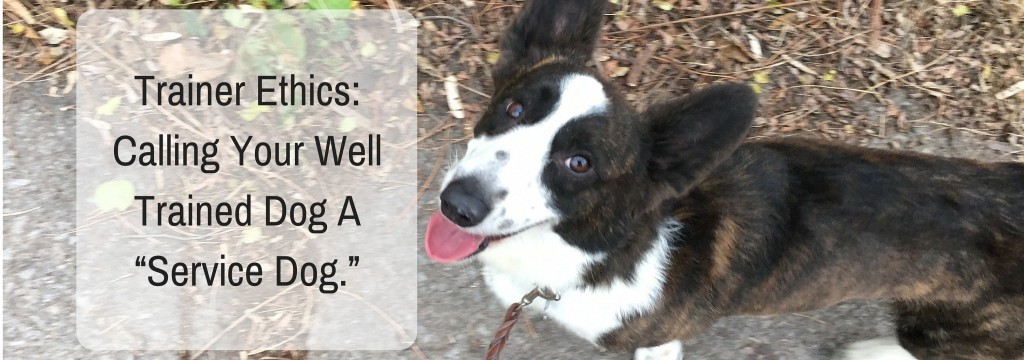
You may have missed the social media explosion resulting from a blog post by a well certified dog trainer admitting she passes off her pet dog as a Service Dog. At first glance this may not seem like a big deal. After all, the dog is well-behaved and giving a good representation of what a “well-trained Service Dog” looks and acts like. That’s not so bad, right? In fact, now that she’s come clean with her fakery, wouldn’t it be a good idea to allow all well-behaved dogs in public places? Should there be limits to where regular pet dogs can go if they’re well-trained? Maybe there should be a Pet Dog Access ID that could be earned that would allow dogs to go places. While the sentiment to allow our dogs in more public spaces is sound, the method she used is incredibly disturbing.
Before we go any further, let’s clarify some of what she admitted to.
- Telling taxi drivers her dog is a Service Dog so they would be allowed in a cab.
- Police were called when a cab driver denied her and her dog a ride.
- Having a friend create a fake Service Dog ID.
- Using the fake Service Dog ID when questioned by shop owners if the dog was a Service Dog.
While most of us can agree that going to such lengths as to call the police to perpetuate a lie is going too far, where do we actually draw the line of pushing our dogs into no-access spaces? As an example, let’s say it’s 105 degrees outside, your perfect dog is in the car, and your father was just rushed to the Emergency Room. Would you claim your dog was a Service Dog to be able to wait in the hospital lobby ? Would you push to be able go into the ER with your dog? Would it actually harm anyone if you did it? Or is harm only done if you get caught?
What is a service dog?
Service animals are defined as dogs that are individually trained to do work or perform tasks for people with disabilities.
What is a disability?
An individual with a disability is defined by the ADA as a person who has a physical or mental impairment that substantially limits one or more major life activities, a person who has a history or record of such an impairment, or a person who is perceived by others as having such an impairment. The ADA does not specifically name all of the impairments that are covered.
Let’s cut to the chase. If you don’t have a disability you do not have a Service Dog. Period. If your dog isn’t trained to do a specific task that mitigates your disability then your dog is not a Service Dog. Period.
To fake a Service Dog is illegal and insulting to people who rely on their dog to get through the day. How many daily conversations do people with disabilities need to have about their Service Dog just to get things done? We see articles all the time about businesses denying access to a person with disabilities with their dog. Just this week we saw a Purple Heart Recipient Denied Access. If you are a fake you are making it harder for people with legitimate need to get access.
In a time when we should be trying to educate businesses about what they can and can’t do, fakery only adds to the idea that everyone is faking it. A friend of mine owns a local deli which is visited by a woman with a completely unruly “Service Dog.” On the surface it would appear the dog is a fake. Aren’t Service Dogs supposed to be well-behaved? No, actually, they only need to be trained for a function. If the dog is unruly a business owner can ask them to leave. When I asked my friend why she didn’t ask her patron to leave she said, “I asked the health inspector since the dog is trying to get behind the deli counter. He said to just endure it. If I remove the woman and her dog there would be a huge backlash and I’d lose business.” Having businesses as allies is important. Why make this harder? If a business owner thinks they have no recourse if a Service Dog destroys something they’re not going to be accommodating. Trainers should be advocating for well-behaved Service Dogs and getting businesses on board, not trying to fool them.
One of the more interesting topics to come out of this social storm is what, if anything, the certifying bodies should do when one of their members makes an admission of guilt. Is a blog post enough to remove their certification? Is there a mechanism for a reprimand or probation or temporary removal of a certification? Or is it all or nothing? If we are positive reinforcement trainers advocating an ethical hierarchy to teach behavior in animals, aren’t humans animals? Do we have to go directly to +P? What is an appropriate response?
On the flip side, most of us have no idea how ethics investigations work with the certifying bodies we belong to. At least if you break a law you have some idea of the consequences. It would be beneficial to have an idea of the process of an investigation and the possible consequences, both as members and as witnesses to possible violations of standards.
As professionals, when you see another trainer presented with overwhelming evidence that they should reconsider their actions, what would you expect their reaction to be? This particular storm grew quickly because of the trainer’s gloating, defensiveness, attacking her critics, and further justifying her actions. She then took the offending blog post down and posted on her business page, “I am too busy training to argue with faceless people on the Internet.” An important lesson from this event: Once it’s on the internet you can’t get it back. Google cached it, people printed it, took screenshots of it, etc. It’s still out there. Her business page was barraged with comments. She simply could not remove them fast enough. As one popped up people replied and added more. It was The Perfect Weekend Social Storm.
Lesson: If you’re in over your head and taking attacks from all sides, step away from the computer and make a plan. As we all know, reactivity gets you into trouble every time.
For those of us who share this trainer’s certifications, we feel guilty by association. Is this what following a code of ethics looks like? Not to many of her fellow professional trainers. In this case a sincere public apology would be appropriate, both for the benefit of the profession as well as a demonstration to the Service Dog community that she understands how hurtful her actions were.
Since the blog post and firestorm happened on a weekend I’m sure there will be more to come from this story. We will post an update if more information becomes available.
![SPARCS 2015: What the New Science of Human-Animal Interactions Reveals About Our Relationships With Dogs with Hal Herzog, PhD]()
by Kat Camplin | Jun 21, 2015 | Events, SPARCS
Review of Anthrozoology with Hal Herzog.
Anthrozoology (also known as human–non-human-animal studies, or HAS) is the study of interaction between humans and other animals.
The types of questions Anthrozoology asks are:
Why do humans keep pets?
Are there gender differences in how we think about pets?
What are the physiological effects on humans from interacting with animals?
Statistics:
“90% of owners think of pets as family members.”
“40% of married women say they get more emotional satisfaction from their dog than from significant other.”
40% of owners would save their dog over a stranger if they had to choose between the two.” Read more about the Trolley Problem.
The Humanization of Pets
The “humanization of pets” includes dressing pets up in costumes, throwing them birthday parties and weddings, as well as breeding or selecting for childlike features.
“Humanization” comes with moral consequences.
“Humanization” shifts dog breeds from having a function to being fashionable.
Different cultures around the world view animals differently. There is a cultural difference between “having a dog” and “having a pet.” “Having a pet,” did not come as a cultural shift in the United States until after WWII.
Dog Popularity
“Having a purebred dog,” peaked in 1987 and has been in decline ever since. This shift can be linked to the cultural view that “having a rescue dog,” makes people “good,” and “moral.”
There are more than 400 breeds of dogs worldwide, but most breeds are less than 200 years old.
What decides one breed becomes popular over another is based on chance. Those breeds that gain popularity very quickly also decline very quickly. Having a specific breed becomes fashionable.
Owner reported behavior issues have no impact on whether a dog remains popular or declines.
Dogs appearing in movies increase in popularity based on first week ticket sales, with AKC registrations for that breed peaking 10 years after the opening weekend. On average a breed being in a hit movie results in 800,000 additional registrations than there were prior to the movie’s release.
The Pet Industrial Complex
There is a cultural shift with the Pet Industrial Complex, which promotes healthier living through pet ownership, morality through pet ownership, and creates dividing lines between “good” people and “bad” people.
There is no evidence that pet owners live longer, no matter what news organizations promote.
The promotion of morality of what makes someone a good person is how they treat their pets. Even if they are bad people who treat animals well, they are viewed as having some morality.
The Takeaway
When we study our relationships with animals what we really do is learn about ourselves.
![SPARCS 2015: The Laws of Connection with Peter Killeen, PhD]()
by Kat Camplin | Jun 19, 2015 | Events, SPARCS
A Review Of The Laws of Connection
The “glue” for each Law of Connection, ie, what holds the behavior together.
David Hume: A Treatise of Human Nature – Contiguity, Similarity, Causality
Ivan Pavlov: Classical Conditioning – Temporal contiguity
Edward Thorndike: Law of effect – Satisfaction
B.F. Skinner: The Behavior of Organisms – Reinforcement
R.J. Herrnstein: The matching law – Relative Reinforcement
David Premack: Premack’s principle – Transition to a more probable response
Peter Killeen, PhD Presentation Quotes.
On the matching law: “The greater the satisfaction, the greater the strengthening. The greater the dissatisfaction, the greater the decreasing.”
On Premack’s principle: “Reinforcers are responses, not stimuli.”
On the role of affect: “No matter how we think about stimuli and their settings, we must also know how to feel about them. Affect tells us which action modes to engage.”
On the role of emotions: “Emotions tell us what to do.”
Read more on the role of affect.
![Time Tracking Software Reviews]()
by Kat Camplin | Jun 9, 2015 | Business

Image via Kat Camplin
For months I’ve been on a mission to find the perfect tool to track my time and my client’s time. Specifically, tracking prepaid package time for each client. On my list is a way to view package time use, alerts when payments are due, tracking prepaid money as credits, and easy invoicing. It should also be cost effective. $90 a month is out of the question. Most of my clients pay by check, so online payments aren’t a priority, but two of these systems support that function.
All of these services use a Client / Project format. The top-level is the Client and time tracking is at the Project level. This can take some getting used to if you’re not used to dealing with Projects. As an example, if you’re working for a rescue group tracking individual dogs as Projects is very handy. Each of the systems below has its pros and cons. Take a look!
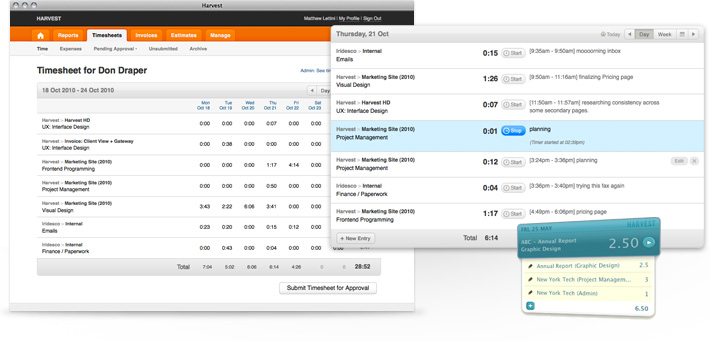
Image via Harvest
Website: https://www.getharvest.com/
Cost: 1 user – $12/mo. $10 for each additional user.
Free Trial?: Yes
With unlimited clients and projects for just $12 a month, Harvest tops the list for the solo trainer. Projects can be tracked via time or money, and the Project landing page has pretty blue sliders that show how much each Project has used and has left. You can set Project alerts based on percentage used, so you can remind your clients when there is only 1 or 2 sessions left early enough to tweak goals or talk about another package. If you charge for equipment or consumables you can add those in too.
The time tracking interface is friendly, giving you either a day view or week view to enter time against a Project. Click the day, choose the client and project, enter an hour amount and save. For the week view you can add lines for all your weekly clients and just tab across the days of the week entering your time. Putting this into your daily workflow will make this go even faster. Log your hours from the day before and stay ahead of the game. There is also an iPhone and Android app so you can log time on the go.
Invoicing is simple and you have a few choices. You can either base the invoice on previously logged hours, which pulls all your visits into single lines on the invoice, or you can do a free form invoice and fill in lines however you like. If you’re doing prepaid packages the free form invoice is a lifesaver. You fill in the cost per hour, number of hours and bam, invoice is done. Save the invoice and then you can immediately record a payment, which turns invoices into a nice receipt for your clients. You can either send clients a link to the invoice, download it as a pdf and send in an email, or print it out and send it snail mail.
You can accept online payments through Paypal Standard/Business or Stripe.
Harvest integrates with other online services on its own and through Zapier and IFTTT. If you use Quickbooks the integration is easy. To check out all integrations visit Harvest’s Integration page.
Website: http://www.freshbooks.com/
Cost: 5 clients – $10/mo. 25 clients – $20/mo. Unlimited – $30/mo.
Free Trial?: Yes
Freshbooks bases it’s cost on clients, not users. On the plus side if you’re doing a lot of rescue group work and need to track individual dogs as projects, the rescue group only counts as one client. However, if you have a large and revolving client base, archiving and un-archiving clients will be a pain. That said, I really like the idea of archiving inactive clients so you don’t have to scroll through people you don’t work with any more.
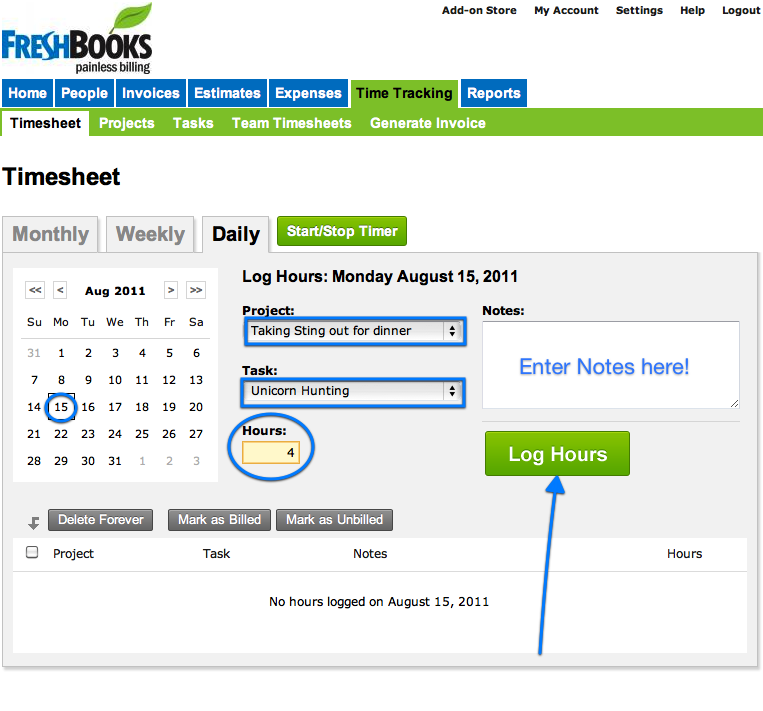
Time tracking is similar to Harvest, except you have the added option of a month view to enter time. You have the option to set hours as billed or unbilled as you log.
Freshbooks also has pretty blue sliders on the Project dashboard, but they are a little different. Instead of time used and left, the slider represents time against an estimate. You can use the Estimate time as your prepaid package time, so the slider will be a true representation of time used. The other columns show hours as billed or unbilled, which is handy if you’re tracking payment plans.
While I like how Freshbooks allows you to log prepaid credit, the credit is at the Client level, not the Project level. This means you are tracking time for the Project (dog,) but credit goes to Client (human or organization.) This can be a problem if you’re working with multiple dogs at a rescue group and invoicing is done separately per dog. You’ll have to remember which dog the credit goes towards.
Invoicing works basically the same as Harvest, you can choose between outstanding unbilled hours or enter information free form. Save the invoice and you can log a payment and send as a receipt by email or snail mail. There is no web link choice in this system.
The downside to Freshbooks is there isn’t an alert system as there is in Harvest. However, if you’re on top of your time and invoicing you really don’t need the reminders.
You can accept online payments either directly through Freshbooks or link to Paypal or Stripe. Freshbooks fees are 2.9% +.30 for Visa/MasterCard and 3.5% + .30 for American Express
There is a mobile app and lots of integrations with other systems, either directly or through Zapier. Check out the Freshbook Integration page.
Website: http://www.myintervals.com/
Cost: 15 Active Projects – $25/mo. 40 Active Projects – $49/mo.
Free Trial?: Yes
Intervals bases costs on Active Projects – not Clients or users. This can be a problem if you are handling more than 15 dogs at a time. However, Intervals adds Tasks functionality to time tracking and invoicing, which is appealing. Need to send an email or do a follow-up call for a specific Project? Intervals does that.
Document handling is also added, so if you want to keep contracts or liability waivers with your clients, you can do it all here.
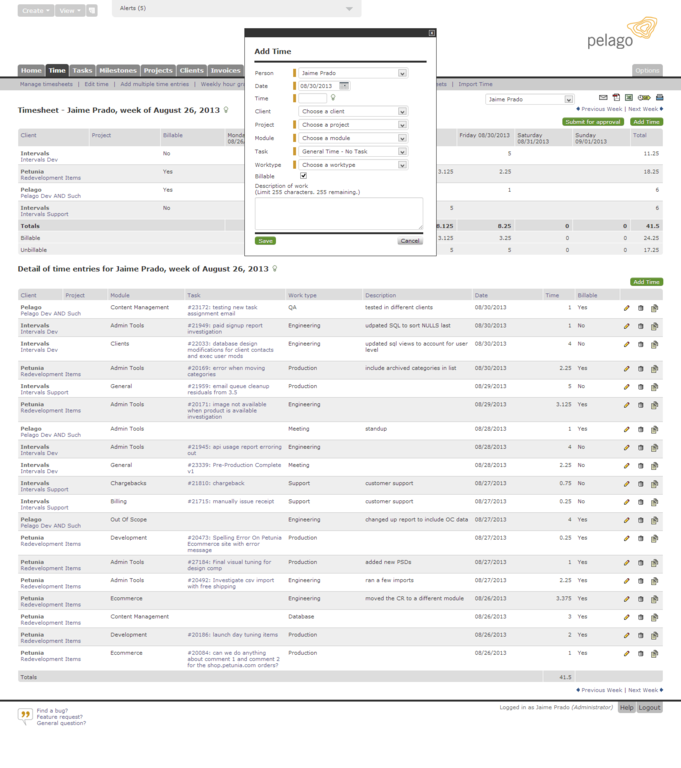
Entering time isn’t quite as easy as on Harvest or Freshbooks, but you have more ways to track your work if you choose. With the addition of Modules, you can move Projects along a pipeline. As an example, you can set up Modules for Consultation, In-home training, Public DS/CC, Group Classes, etc., and watch the progress of the dog from one level to the next.
The thing that stands Intervals apart is how it handles prepaid time. The slider on the Projects dashboard is real, not an estimate. You enter payment credits and the cost per hour and you can see exactly how much is used.
You have free form and logged hours choices for invoicing, just like the other systems. If you’re invoicing for hours logged you have the easy option of choosing starting and end dates to bill. You can add payments to the invoice as you go, which saves you the step of having to save and invoice and then adding a payment afterward. Invoices can be sent via email, saved as pdf, or printed.
Integrations are limited and there isn’t a mobile app for logging on the go. Check out the Intervals Integration page.
Intervals does send a handy daily overview report of your business, time, and outstanding invoices.
Get Dog Training Business Tips!
Receive valuable dog training business tips and resources every week! Subscribe to The Modern Dog Trainer now by submitting your name and email below.
[mc4wp_form]
![5 Things Missing From Your Training Bag]()
by Kat Camplin | Mar 23, 2015 | Training Methods

What’s in your training bag? You may be missing some helpful tools!
Are you having difficulty doing set-ups that allow the dog to succeed? These items are terrific for creating intermediate steps while training impulse control and desensitizing for reactivity.
1. An External Speaker
There is a big gap between playing scary sounds on your phone or tablet and the real, live version of the same sound. Sometimes you just can’t get enough distance to the sound source to not see a backslide in fearful reactions. An external speaker can bridge this gap for you. Hook it up to your phone or tablet and you get to use the same sounds at a slightly higher volume. This OontZ speaker is small, portable, and connects via bluetooth which can make it easier to hide for more realistic set ups.
2. Tasty Goop
Biting puppies need to learn licking is better than biting. Smearing yummy stuff on your hands and arms while working on friendly greetings, putting on collars and leashes, or playing with toys, redirects biting to some reinforcing licking. While peanut butter is tasty, it’s not particularly nice to smear all over yourself. Kong Spread or canned cheese are better options and they don’t need to be refrigerated. Plus, the puppy seems to get all of it off, whereas peanut butter always seems to leave remnants.
3. A Flirt Pole
Flirt poles are awesome. You get to teach impulse control, tug, appropriate play, and chase and grab bite away from human hands and legs. The best part is you get to use your client’s own dog toys, so there isn’t any chance you’ll have to replace toys if they’re shredded due to tiny puppy teeth. If you’d like to make your own, you can find instructions here: How To Make A Flirt Pole. Manufactured flirt poles are available on Amazon, but you can make one yourself easily for under $10 with PVC and rope from Home Depot or Lowes.
4. Wildlife Scents
Whether you’re working on “Leave It” with loose leash walking, or using the opportunity to sniff as Premack reward, knowing where the wildlife scents are is extremely helpful. You can set them up next to specific trees, mail boxes, or cars, and know exactly where they are so you can give the cue well in advance. Recommended scents to start with would be rabbit and squirrel. In areas with more diverse wildlife, look at scents that replicate animals in your area. Wildlife scents are available on Amazon and GunDogSupply.com online.
5. Remote Controlled Car
Remote controlled cars are one of the more useful tools you’re probably missing. They make little engine type noises so you can work on sound sensitivity or socialization. They move so you can work on motion sensitivity and prey drive. You can control them from a distance so you can work on desensitization at a successful location. Use them to work on barking out front windows. You can make the car move while inside with your learner so you can teach an alert or “look at that.”
Putting Items Together
Is your learner succeeding too quickly? Put items together to make things more difficult. Strap a stuffed squirrel to the top of your remote-controlled car, add some squirrel scent and your phone with squirrel chatter sounds, and you’ve got an awesome tool to work on impulse control around prey.
Get Dog Training Business Tips!
Receive valuable dog training business tips and resources every week! Subscribe to The Modern Dog Trainer now by submitting your name and email below.
[mc4wp_form]
![Top 10 Dog Training Conferences for 2015]()
by Kat Camplin | Jan 8, 2015 | Events

Image by Kat Camplin
The Ultimate Dog Training Conference Wish List
Are you required to obtain continuing education credits to maintain a certification? Do you simply enjoy learning new things about dogs? Do you have a wicked sense of adventure? Here are the Best Dog Training Conferences for you to attend in 2015. Conferences are listed in chronological order due to the author’s inability to decide which should be first.
ORCA 7th Annual Art and Science of Animal Training
When: Saturday, March 14, 2015
Where: University of North Texas in Denton, TX
Why: This one day conference has become a staple for trainers. Bringing together trainers and behavior analysts, the conference covers a broad spectrum of knowledge of animal behavior and how to get it. This year’s keynote speaker, Dr. Stanley Weiss, will present “Differential Reinforcement and the Stimulus Control of Behavior.” Other speakers include: Ken Ramirez, Alexandra Kurland, Steve White, Phung Luu, Bob Bailey, Steve Aibel and Al Kordowski.
More Information: http://orgs.unt.edu/orca/conference/
Canine Science Symposium
When: Sunday, March 15th, 2015
Where: San Francisco SPCA in San Francisco, CA
Why: Bringing together professors of Psychology, Anthrozoology, Behavioral Neuroscience, and Behavior Analysis, this symposium covers the science of welfare for shelter dogs, training, canine aggression, and “Non-Science and Nonsense in Dog Behavior.” CCPDT and IAABC Continuing Education Units are available for professionals attending this event.
More Information: https://www.sfspca.org/2015-canine-science-symposium
ClickerExpo
ClickerExpo will be held in 3 locations throughout 2015. Portland, OR is sold out, but Dearborn, MI still has spots available, and ClickerExpo Europe information is still pending.
Dearborn (Detroit), Michigan
When: Friday, March 20-22, 2015
Where: Dearborn (Detroit), Michigan
Why: 3 days of mind bursting information from some of the world’s best positive reinforcement experts. Experience hands-on workshops, round table discussions, and enlightening lectures. Add in Karen Pryor and animal training god Ken Ramirez, and you’ve got a perfect mixture of trainer worship and highly educational learning. CCPDT, IAABC, and KPA Continuing Education Units are available for professionals attending this event.
More Information: http://www.clickertraining.com/clickerexpo/dearborn
ClickerExpo Europe
When: Friday, October 23-25, 2015
Where: Warwickshire, UK
Why: Although the schedule and workshops haven’t been announced yet, just duplicate the Why from above and add an English accent and stunning Warwick Castle.
More Information: http://www.positiveanimalsolutions.com/ClickerExpo_s/2084.htm
ABMA Annual Conference
When: Monday, April 13-18, 2015
Where: Copenhagen, Denmark
Why: Do you really need a reason to go to Denmark? Okay. The Animal Behavior Management Alliance (ABMA) specializes in animal care and training through enrichment. Joining a dolphin trainer with an elephant conservationist, the keynote speakers Ken Ramirez and Rudi van AArde should bring some interesting conversation to the conference. Presentations from some wonderful bird and animal trainers and Dr. Susan Friedman insure you’ve got some pretty strong reasons to hop a plane for a much-needed vacation educational experience.
More Information: https://theabma.org/abma-annual-conference/
DogEvent 2015
When: Thursday, May 14-17, 2015
Where: Paris, France
Why: You’ve always wanted to see Paris and now you have an excuse! 4 days of dog training, behavior workshops, and demos. Speakers include Dr Susan Friedman, Ken Ramirez and Kathy Sdao, and practical demos will be given by Kelly Gorman Dunbar, Chirag Patel and Jo-Rosie Haffenden. Chirag Patel’s “Shaping the Perfect Patient,” should be a must see!
More Information: http://www.dogconseil.com/dogevent2015/en/
Ferretpalooza from Fenzi Dog Sports Academy
When: Friday, May 29-June 1, 2015
Where: K9Jym in Colmar, Pennsylvania
Why: No, this isn’t a Ferret Fest. This is the first annual conference hosted by the Fenzi Dog Sports Academy. Instructors include the dynamic dog sports goddesses Deb Jones, Denise Fenzi, Hannah Branigan, Nancy Little, Margaret Simek and Shade Whitesel. Work on heeling, scenting, retrieves, utilizing play to build motivation, and so much more. This is guaranteed to be the first of many Fenzi events and is a “must attend” for anyone interested in dog sport competition. 5 years from now you’re going to want to be able to say, “I went to the very first conference!”
More Information: http://fenzidogsportsacademy.com/index.php/courses/ipo-courses/8-fdsa/2436-ferretpalooza
SPARCS
Information will be updated when it becomes available.
When: Friday, June 19-21, 2015
Where: Phoenix, AZ (Phoenix Convention Center) and FREE online worldwide!
Why: The conference that has turned dog trainers into couch potatoes for one weekend a year due to their live event streaming, SPARCS (Society for the Promotion of Applied Research in Canine Science,) brings together the most diverse group of canine scientists all in one place. Whether you get to attend via your sofa or get to go in person, you are sure to get your fill of canine cognition, behavior, scent work, science studies, and so much more. Can’t do all 3 days? Each day has a theme:
Day 1: Learning and Memory
Day 2: Dogs Around the World
Day 3: Stress
More Information: http://caninescience.info/
Five go to Sea
When: Friday, August 7-14, 2015
Where: Seattle, WA
Why: You dream of being stranded on a deserted island with some of the best animal trainers in the world. Switch the island for a ship and you’ve got a dream come true. Take a 7 day Alaskan cruise with Ken Ramirez, Kay Laurence, Alex Kurland and Jesús Rosales-Ruiz and experience daily educational presentations followed by dinner with your hosts. You have them at your table, what are you going to ask them?
More Information: http://www.fivegotosea.com/
APDT Annual Conference and Trade Show
When: Wednesday, October 14-17, 2015
Where: Dallas, TX
Why: You’re a professional dog trainer, this is your Association. The Association of Professional Dog Trainers Annual Conference is full of prestigious speakers and engaging seminars. The speakers and schedule for 2015 is still pending. This entry will be updated as information becomes available.
More Information: https://apdt.com/conference/
Force-Free Educational Summit For Pet Professionals
When: Wednesday, November 11-13, 2015
Where: Tampa, FL
Why: With Dr. Karen Overall as the keynote speaker, the rest of the speakers list for first annual summit hosted by the Pet Professionals Guild reads like a Who’s Who of the dog training industry. Presentations from Chirag Patel to Pat Miller to Ken McCort to Theresa McKeon insures this conference will have a little bit of something for everyone.
More Information: http://www.petprofessionalguild.com/Force-free-Summit
Training Camps
In addition to the conferences, these training camps should be on every trainer’s Must Do list.
CHICKEN CAMP
When: June to August, 2015
Where: Columbia, MD
Why: Dogs are incredibly forgiving. If you want to test your training skills, train a chicken! Dr. Bob Bailey and Ms. Parvene Farhoody, MA, teach these Workshops using chickens as a behavior model in order to teach operant conditioning (OC) and applied behavior analysis (ABA) principles.
More Information: http://www.behaviormatters.com/Workshops-operant-conditioning-animal-training.htm
PROFESSIONAL SEMINARS FOR ZOOLOGICAL TRAINERS
When: Monday, April 20-24, 2015 and Monday, August 17-21, 2015
Where: Shedd Aquarium in Chicago, IL
Why: This is a full graduate course adapted to a one-week format for zoo training professionals. Although originally designed for zoo trainers, many dog trainers take the course each year. This course fills up early, please send an e-mail to kcathcart@sheddaquarium.org if you’d like to be put on the waiting list.
More Information: http://www.sheddaquarium.org/Learning-Experiences/Continuing-Education/Professional-Animal-Training-Seminar/
Did we miss one? Comment and let us know!
Get Dog Training Business Tips!
Receive valuable dog training business tips and resources every week! Subscribe to The Modern Dog Trainer now by submitting your name and email below.
[mc4wp_form]