by Kat Camplin | Jan 4, 2016 | Events, Training Methods
The Ultimate Animal Training Conference Wish List for 2016
Education, networking, adventure, and fun! Here are the best training and education conferences for you to attend in 2016. It was particularly difficult to whittle down the list this year. If your conference didn’t make the cut please post registration information in the comments! Conferences are listed in chronological order due to the author’s inability to decide which should be first.
ClickerExpo
ClickerExpo will be held in 3 locations throughout 2016. This year ClickerExpos have slightly different labs and workshops depending on the location.
Reno, Nevada
When: Friday, January 22-24, 2016
Where: Reno, Nevada
Why: New for 2016 are Educational Themes. Themes include: Trainer Skill Development, Teaching People, Aggression and General Behavior Management. Feel free to follow a single theme or skip around. There’s something for everyone! CCPDT, IAABC, and KPA Continuing Education Units are available for professionals attending this event.
More Information: http://www.clickertraining.com/clickerexpo/registration-NV-2016
Cincinnati, Ohio
When: Friday, March 18-20, 2016
Where: Cincinnati, Ohio
Why: New for 2016 is a complete Equine Theme which includes Husbandry, Saddling, Trailer Loading, and much more! This is in addition to the Themes listed for Reno above. CCPDT, IAABC, and KPA Continuing Education Units are available for professionals attending this event.
More Information: http://www.clickertraining.com/clickerexpo/registration-OH-2016
ClickerExpo Europe
When: Friday, October 28-30, 2016
Where: Billund, Denmark
Why: The ClickerExpo 2016 schedule for Denmark has not been released yet. It will be released by 15 February 2016. The highlight so far? The conference is going to be held in the LegoLand Hotel!
More Information: http://www.clickertraining.com/clickerexpo/denmark/register
ORCA 8th Annual Art and Science of Animal Training
When: Saturday, February 20-21, 2016
Where: Dallas, Texas
Why: ORCA is now a two day event! This conference has become a staple for all animal trainers. Bringing together trainers and behavior analysts, the conference covers a broad spectrum of knowledge of animal behavior and how to get it. This year has two themes. Saturday will cover shaping behavior in both animal and human learners, and Sunday will cover concepts and tools for improving animal welfare and human-animal interactions. This year’s keynote speaker, Dr. Iver Iversen, will discuss: “Selection and creation processes involved in shaping of novel behavior: Method and Theory.”
More Information: http://www.artandscienceofanimaltraining.org/conference/
Penn Vet Working Dog Conference
When: Friday, April 8-11, 2016
Where: Philadelphia, Pennsylvania
Why: You may have seen this conference’s DVD’s on TawzerDog. Did you know you could attend the Penn Vet Working Dog Conference? This year’s theme is “Whole Dog 360: A multidisciplinary approach.” Individual topics will be addressed with a series of four (4) – ½ day sessions: Advancements in working dog health and medicine; Training the working dog using current scientifically-based methods; Implications of handler training on the successful working dog team; Driving progress in the working dog field through research & innovation. This year’s keynote speaker will be Ken Ramirez.
More Information: http://pennvetwdc.org/education/conference/
IAABC Animal Behavior Conference
When: Saturday, April 9-10, 2016
Where: Anaheim, California
Why: The International Association of Animal Behavior Consultants has creatively merged their Feline and Canine Conferences into one event. Choose to follow the Feline or Canine track, or pick and choose which presentations you’d like to join. The dual-track conference features speakers discussing the latest science, treatments, and protocols for managing and modifying behavior in dogs and cats.
More Information: https://iaabc.org/conference/2016
Animal Management Behavior Alliance (ABMA) Annual Conference
When: Monday, April 17-22, 2016
Where: Tampa, Florida
Why: The Animal Behavior Management Alliance (ABMA) specializes in animal care and training through enrichment. This year’s theme is “Breaking Down Barriers: New Possibilities in Animal Welfare.” Conference locations include multiple zoos and a post conference trip to Natural Encounters. This year’s keynote speaker will be Dr. Susie Ellis of the International Rhino Foundation. Details will be posted as they are finalized.
More Information: https://theabma.org/abma-annual-conference/
DogEvent 2016
When: Thursday, May 5-8, 2016
Where: Nice, France
Why: You’ve always wanted to see Nice and now you have an excuse! 4 days of dog training, behavior workshops, and demos. Each day has a theme: Shelter Dogs, Behavior Analysis, Training, Canine Nutrition, and Advanced Behavior Techniques. Speakers include Dr. Clive Wynne, Ken McCort, Jean Lessard, Nancy Tucker, and Dr. Jean Dodds. This conference has a limit of 100 attendees.
More Information: http://www.dogconseil.com/dogevent2016/en/
Fenzi Dog Sports Academy Training Camp
When: Friday, June 19-22, 2016
Where: Purina Farms – Gray Summit, MO
Why: It’s bigger. It’s better. It’s at Purina Farms! The Ultimate Dog Sports Training Camp covers Obedience, Rally, Agility, Nosework, Freestyle, and Rally FrEe! Join the dynamic dog sports goddesses Denise Fenzi, Deb Jones, Hannah Branigan, Julie Flanery, Loretta Mueller, Nancy Gagliardi Little, Shade Whitesel, Sue Ailsby, Amy Cook, Julie Symons, and Stacy Barnett for 4 days of fun. Work on heeling, scenting, retrieves, utilizing play to build motivation, and so much more.
More Information: http://www.fenzidogsportsacademy.com/index.php/waiver-of-liability/8-fdsa/6934-fdsa-camp-2016
Canine Science Forum
When: Tuesday, June 28-July 1, 2016
Where: Padova, Italy
Why: The CSF is a biannual event. This year’s topics include: Evolution of canines; Ecology and conservation of canines; Dogs and humans; Applied aspects of canine biology; Behavioural biology of canines; Cognition; Canine genetics and endo/phenotyping. The Forum also includes a Round Table on service dogs that will introduce some of the main issues related to service dogs and defining the needs and critical points of this area.
More Information: http://www.csf2016.com/index.php
APDT Annual Conference and Trade Show
When: Wednesday, October 12-15, 2016
Where: Las Vegas, Nevada
Why: You’re a professional dog trainer, this is your Association. The Association of Professional Dog Trainers Annual Conference is full of prestigious speakers and engaging seminars. The speakers and schedule for 2016 is still pending. This entry will be updated as information becomes available.
More Information: https://apdt.com/conference/
Pet Professional Guild Educational Summit
When: Tuesday, November 8-11, 2016
Where: Tampa, FL
Why: The speakers and schedule for 2016 is still pending. This entry will be updated as information becomes available.
More Information: http://www.petprofessionalguild.com/2016-Summit
Looking Forward to 2017 – WOOF! is Back!
When: Friday, February 10-12, 2017
Where: University of Nottingham, United Kingdom.
Why: It’s back! It’s’ back! The very successful WOOF! European Behaviour & Training Conference has been on hiatus since 2013, but it’s back for 2017. Why look that far ahead? This baby is going to fill up fast! Speakers include Sean Pogson, Susan M. Schneider, Susan Friedman, Steve Martin and Chirag Patel. The full topics and speaker schedule is still pending. This entry will be updated as information becomes available.
More Information: http://www.domesticatedmanners.com/woof2017
Training Camps and Workshops
In addition to the conferences, these training camps should be on every trainer’s Must Do list.
Terry Ryan Coaching People to Train Their Dogs
When: February 11-15th, 2015
Where: Waialua, Oahu
Why: Coaching People to Train Their Dogs is for anyone with an above average interest in dog training, animal training, and/or student instruction. This course is also for anyone who has read the book by the same name and wants to put it into practice.
More Information: http://www.countrycaninehawaii.com/events_TerryRyanCoaching_201602.html
Bailey-Farhoody CHICKEN CAMPS
When: Summer 2016
Where: Columbia, MD
Why: Dogs are incredibly forgiving. If you want to test your training skills, train a chicken! Dr. Bob Bailey and Ms. Parvene Farhoody, MA, teach these Workshops using chickens as a behavior model in order to teach operant conditioning (OC) and applied behavior analysis (ABA) principles. The 2016 schedule is still pending.
More Information: http://www.behaviormatters.com/Workshops-operant-conditioning-animal-training.htm
Terry Ryan CHICKEN CAMPS
When: 2016
Where: Pending
Why: Training a chicken is a stretch and a boost to your mechanical skills. The average chicken is faster than the average dog, giving you a chance to improve your coordination and timing. The 2016 schedule is pending.
More Information: http://www.legacycanine.com/#!chicken-workshops/cfvg
PROFESSIONAL SEMINARS FOR ZOOLOGICAL TRAINERS
When: Monday, March 28 – April 1, 2016 and Monday, August 22-26, 2016
Where: Shedd Aquarium in Chicago, IL
Why: This is a full graduate course adapted to a one-week format for zoo training professionals. Although originally designed for zoo trainers, many dog trainers take the course each year. This course fills up early.
More Information: http://www.sheddaquarium.org/Learning-Experiences/Continuing-Education/Professional-Animal-Training-Seminar/
See the top four reasons that continuing education is so important here!
Sign up below to stay up to date with modern dog training business practices and dog training methods!
Dog Training Business Tips
Receive valuable dog training business tips and resources right in your inbox! Subscribe to The Modern Dog Trainer now by submitting your name and email below. Don’t forget to let us know what you want to learn more about!
[mc4wp_form]
![How To Hold Semi-Private Lessons]()
by Kat Camplin | Nov 5, 2015 | Training Methods
Semi-private lessons are my new favorite type of service. They cover a number of client “problem” areas that we don’t always get the opportunity to address through private instruction or group classes.

- Image via Kat Camplin
What Is A Semi-Private Lesson
Technically, the definition should be fairly obvious. A semi-private would assume that it’s more than one client and less than a regular group class. How you market it determines how it’s viewed.
The Smaller Class
Reactive Rover classes are typically smaller in size, but aren’t really sold as semi-private instruction. This is probably due to the classes taking place in a facility that does other group classes. Marketing a group class as “smaller,” or semi-private allows you to charge more per person per class to make up the income difference you’d normally have in a regular sized class. The smaller class should be no more than 3 or 4 students to make it exclusive. There is a balance with these classes. They have the opportunity to fill up quicker, but you need people with the income to pay more. Sales points can be “more one on one instruction,” or “great for shy or timid dogs.”
Try a few different naming conventions to see which one resonates with your target demographic.
The Group Private Lesson
Private instruction is usually geared for people who can’t make a group class or may have a dog that doesn’t do well away from home. The downside of having a dog trainer show up at your home is it costs more than going to a facility for a group class. If a new client can’t afford your private rate, giving them an option to host a small group at their home and split your rate with friends.
The upside of this type of semi-private is the client fills their own class from their neighbors and friends. The neighbors and friends get to split your private hourly rate and get one on one instruction. This works if all the students have basically the same needs. If one dog is reactive and the others just need basic obedience instruction time will probably not be in balance.
To make these work you really need to be upfront and inclusive to everyone involved. Topics and behaviors covered, the number of weeks the class meets, and what happens if someone can’t make a class should be spelled out in advance. A questionnaire can be helpful to see what everyone’s needs are and find the behaviors that cover the most problem areas. To save you time you’d want to be sure you have handouts and homework for what the lessons cover. The really great thing about doing these “neighborhood classes,” is that neighbors get to work with each other in between sessions, which increases client compliance and time spent training.
If you’re marketing these as a cost saving plan you’d split your hourly rate by the number of students then multiply it by the number of weeks. As an example: Your hourly rate is $100. There are three students in the semi-private class that runs for five weeks. Each student pays $34 a week, for a total of $170 per student. Typically these are run as a package, so payment is expected from each student up front.
Is it worth it? Yes, if you pick the right location. I am interrupted at least once in every neighborhood class by a neighbor that needs a trainer. It’s great exposure, just pick the right neighborhood.
Moving Advanced Clients To Semi-Private Lessons
Semi-rivate lessons are a fabulous way to continue to work with students that may have capped out of all your other classes. Think of these as field trip classes. Finding locations that are dog friendly can be a problem, but it’s usually worth it if you get to work with real world problems and distractions in exotic locations.
Therapy Dogs, DIY Service Dogs, reactive dogs that are too good for a Reactive Class, but not quite ready for the close quarters of a regular class, and students who just want to set new goals, are all great resources for these small groups. How you market and charge for this type of class is up to you. While the hosted semi-private lesson in someone’s home is sold as a cost saving measure, the time spent to set up working locations will probably warrant the “smaller,” class model.
Locations can include dog friendly restaurants, hospitals or medical offices with elevators, public transportation locations like bus stops and train stations, public parks with active baseball games, horse stables, and local hiking trails. Visit each location ahead of time and make a plan for where you’ll work and what you’ll work on. Have a backup plan in case you get there and there is something that prevents you from holding class.
Goals for advanced students can be individualized based on the location. Discuss the goals with each individual student then make sure they know what to do when things are going well and what to do when things are going wrong. Your job for most of these advanced classes will resemble a circus ring leader. You will be watching for unexpected intrusions, giving a heads up to oncoming children, dogs, people, horses, etc., and sometimes running interference with those things. Students work individually unless the students have agreed to work together ahead of time.
Are you already doing semi-private lessons? How are they working for you? Leave us a comment!
![How To Choose A Dog Training Business Name]()
by Kat Camplin | Nov 4, 2015 | Business
Coming up with names for any business can be rather fun. For dog trainers, we tend to think of cute names that may draw clients into training that sounds happy and joyful. Fun aside, naming your business has important difficulties as well as benefits if you plan ahead.

The big problem with business names.
The biggest problem you’re going to have in naming your business is finding one that isn’t already taken. The second biggest problem is going to be finding a name that is available as a web address for your website as well as any social channels you want to use to market and promote your business.
Twitter sets a 15 character limit on usernames, or the @ name. If your business name is Dogs Rock Awesome Dog Training, you’re going to have some problems getting that down to a memorable 15 character name. While Facebook’s limit is 70 characters for Page names, people are using mobile apps more often, so the longer name may prevent them from searching for you.
In a perfect world your business name will be available as a web address domain, Facebook Page, and usernames on Twitter, Youtube, and Instagram at the least. Branding across platforms is important. While we can provide links from the domain to Youtube or from Youtube to Twitter, people need to find you first to click the link. You want to be findable without people having to visit one of your channels first.
Do you really need a business name?
Technically, you already have a business name. Your personal name is your business until you register a Doing Business As (DBA) with your county licensing office as a front for your personal name. Is there anything wrong with John Smith Dog Training? Absolutely not. You are the face for your brand. You’re doing the training. You might as well be transparent about it and use your name.
Pros:
- The web address is probably available for either just your name or with the service: JohnSmith.com or JohnSmithDogTraining.com.
- Once people meet you your name is easy to remember.
- Your name travels with you, so should you move you won’t have to rebrand.
- Your name can change services, so if you add boarding services later you don’t have to worry about changing the web address to reflect that.
Cons:
- No one knows who you are, so marketing can be difficult.
- JohnSmith.com could be any service. Without keywords in the domain name you have to really use your web content to get on the front page of Google searches.
- If you grow to the point you hire employees clients may be confused when John Smith doesn’t show up at their door to train their dog.
Location as your business name.
When people go searching the internet for a dog trainer the most common search is My City Dog Training. While using your city and Dog Training sounds boring, it really will move you to the front page of Google pretty quickly. If your goal is to get up and running quickly and you don’t care about creative names, this is the fastest route.
Pros:
- More likely to get on the front page of Google.
- You can hire any employees without creating confusion.
- Social channels will probably be available if the domain is available.
Cons:
- If you live in a common city name like Springfield, your name may already be taken by a busniess in another state.
- Moving becomes a problem. While you can forward MyCityDogTraining.com to MyNewCityDogTraining.com, you’re still basically starting over with a brand new business.
Creating a name.
When I was thinking of business names I spent a lot of time searching the internet for naming “rules.” One of the most helpful pieces of advice I found was to create a name that didn’t require you to spell it when said out loud. The concept is, if you’re at a networking event, noisy conference, or hanging out in a bar, you should be able to say your business name and have it understood.
The out loud rule is very difficult for dog trainers. Domain names may be available using “K9” instead of “canine,” or “dawg,” instead of “dog,” but those names will require a whole lot of explanation and spelling if you’re passing your name verbally. Is it possible to market and succeed with words shortened and misspelled? Yes, but it will probably take more time and you’d need to make sure you have business cards on you at all times.
Ebay and Google are names that had no meaning before they started. You can let your creative juices flow and just create a name. OgDay? Doggle? Making up words can be fun, just remember that marketing and focused keywords on your website are going to be very important. Also, watch out for bad words or alternative meanings in the middle of made up words. Sinep might sound snappy, but read it backwards.
Putting two or more words together to make one shorter word can help with the character limits on social media channels. An example might be taking the first few letters of Reward Based Training, and creating RewBa Train. Rewba.com and RewBaTrain.com are available, and social channels probably would be. While marketing and branding will still be important, if you do it right this kind of name can be memorable more quickly than a completely new made up word.
If you keep entering domains into a domain search and they’re taken, it may be time to get some help. There are hundreds of business name generators online that can spark ideas and will check domain availability at the same time.
NameMesh will take your keywords and make new words, find synonyms, and give you “new” domain options. New domain options have different endings to .com and are geared toward defining your business. For instance, you can now get .training or .photography. Some fun options might be dog.ninja or canine.guide. Existing domains have first option for the new domain, so if you own dogtraining.com you have the first option to buy dog.training. Competition is still high for the new domains as people buy them for investments instead of use, but using them allows you more options.
Panabee is another name generator that merges words and concepts pretty effectively. Enter a few words and you’ll get quite a few options. Panabee doesn’t include the new domain endings, so use this if you want to stick with a .com, .net, and .org.
If your all time perfect domain name is taken, visit the site and see what’s there. If you see a splash page from a host like GoDaddy, at the top you will see, “Welcome to: (domain name,) This Web page is parked for FREE, courtesy of GoDaddy.com. This usually means someone is sitting on the domain as an investment. Domain name buying for resale to someone who really wants it isn’t as popular as it once was, but it’s still done. If you really, really want it, go to the webhost (GoDaddy in the example above,) and put in the domain name in the domain search. You will get a result page that says the domain is taken, but in tiny text next to that is, “ Still want it? Here’s what to do.” Follow the link and you’ll get a page offering to contact the owner for you to see if they’ll sell. Expect to pay big. Premium domains run between $500 and $2500 on average.
Due diligence.
While it may not be that big of a deal for your business name to be close to another business in another state, you want to be sure you’re not stepping on any toes in your home market. Search for your city and “dog training,” for your area and see what businesses are on the first three pages of Google. It’s also a good time to see who your main competition is and how they’re using they’re keywords and name and branding. If your main competition uses K9, you might want to stay away from any name using that shortcut.
Just because a domain is available does not mean it’s not trademarked. You can do a quick trademark search at the U.S. Patent Office’s Trademark Electronic Search System. The last thing you want is to spend money and time on building brand name recognition only to receive a cease and desist letter.
Did we miss an idea? How did you come up with your business name? Leave us a comment!
Dog Training Business Tips
Receive valuable dog training business tips and resources right in your inbox! Subscribe to The Modern Dog Trainer now by submitting your name and email below. Don’t forget to let us know what you want to learn more about!
[mc4wp_form]
![End Of Year Review]()
by Kat Camplin | Nov 3, 2015 | Business
As we hit the beginning of November it’s time to start planning for the usual annual holiday downtime. Other than much needed days off, how should we prioritize annual administration tasks? What gets us the most bang for the time spent?

Get holiday/thank you cards and gifts ordered
Even if you’re not comfortable sending out cards wishing clients a happy holiday, you can still send out thank you cards. “Thank you for making this year so special.” Why send out cards? Those clients you worked with back in March may be having new problems or may have neighbors who are getting a new puppy. Getting your name in front of them again encourages referrals. Watch for deals on printing websites such as VistaPrint and FedEx/Kinkos.
Send thank you gifts to clients and veterinarians with the largest referrals. A gift basket with healthy snacks that can be shared by the veterinarian team or family can be cheap and easy to make. Delivering gifts in person allows you to see if referrers need more cards, brochures, or are planning any events that you might be able to participate in.
Review accounting software and systems to prepare for tax time
Tax time is typically a busy time for dog trainers since it follows on the heels of holiday puppy season. Taking the time to review your system, whether it’s working, and whether there is a better alternative can save you hours in the next year. How are you tracking your income each day? How are you tracking income and expenses? How are you tracking client packages, discounts, and referral bonuses? If you have a sliding scale of rates, which one did you charge most this year? Are you decreasing your income more than you think? Are items you supply such as treats really eating into your bottom line?
The best accounting system to use is the one you’ll actually use. If you find yourself trying to recreate income and enter receipts weeks after you’ve earned or spent the money, your system isn’t working. If your system requires hours of work each week, it may be time to spend some money on an automated or semi-automated system such as Wave, Xero, QuickBooks or Godaddy Bookkeeping.
Are you saving for retirement or emergencies? This is an area most dog trainers neglect. Just do it. Even $10 a month in a savings account is better than nothing.
Review time-tracking, scheduling, and client management systems.
Are you spending hours each week sending reminders or calling clients to remind them of appointments? Are you entering appointments in multiple places? Have you missed multiple appointments this year? How do you track client applications and waivers?
There are as many systems as there are dog trainers. The one to use is the one that saves you the most time and gets you where you’re supposed to be at the right time. Online forms built into your website can save you some typing, and most forms can forward to a newsletter email list through Zapier.
There are numerous CRM’s (Customer Relationship Management systems) out there. Some are as simple as a spreadsheet, and some have the ability to send reminders, schedule appointments, and store homework. Popular paid solutions include Evernote, Nimble, DogBizPro, SuperSaas, Google for Work, Highrise, and PocketSuite.
How much time are you spending doing individual homework instructions for each client? Should you spend some time building your own library so you can just copy/paste/individualize for new clients?
Review website design, keywords, and search engine optimization.
If you haven’t done it already, first on your list is to set up a Google Search Console account. Formerly known as Webmaster Tools, this service will tell you how Google sees your website, from the density of important keywords like, “dog training,” to which page people leave your website from. The last page they see is important. For example, if visitors are getting to your Contact page and then bailing, your form may be too long.
Is information easy to find? How far into your website does a visitor need to go to find scheduling times, group class start dates, registration, and pricing information? Is your location and phone number on every page? Does your layout and content look professional?
Google yourself. What page of Google does your business appear on? Who are your biggest competitors and how do they rank higher? Check out their keywords, descriptions that appear on the Google search results, page titles, etc. They’re doing it right. Take notes and see how to incorporate some of those ideas into your own website.
Make plans and goals for the new year.
Will you be giving yourself a raise? If so, is it in-line with your competition? Will you announce it on your website or just charge new clients the new amount and old clients the old amount? While it may seem nicer to grandfather in existing clients, the more charging tiers you have the more difficult it is to track exactly how much you’re making each week.
Are you planning a certification or organization membership or do you really want to go to a conference? Work on your budget now so you have the money to do it. Conference registration costs are about $40 a month without airfare and hotel. Can you set aside $5 per client hour for ongoing education and certification costs? How will you remember to do it and put those funds in a safe place?
Are you low on veterinarian referrals? How can you make yourself more desirable and promote yourself to that group of people? Spend some time setting up a plan and the materials you’ll need to introduce yourself.
Can you pivot by adding a new service? Could you be making some money on retail sales? If you’re always sending links to online sources for treats, harnesses, interactive toys, treat bags, etc., does it make sense to do a minimum wholesale order and charge retail prices at the client’s session? The client gets the item right away, and you get a little extra money. Warning, this will usually require a wholesaler’s license and more accounting due to taxes. It may not be worth the headache, but it’s something you should review.
Catch up on learning. Are you behind in some of the newest techniques and training protocols? You might consider signing up with Tawzer Dog DVD Rentals for a few months to catch up. You can also read some of those books you purchased through the year and incorporate them into new training plans for next year.
What items are on your “to do” list for the end of the year?
Dog Training Business Tips
Receive valuable dog training business tips and resources right in your inbox!</strong> Subscribe to The Modern Dog Trainer now by submitting your name and email below. Don’t forget to let us know what you want to learn more about!
[mc4wp_form]
![5 Must Have WordPress Plugins for Dog Trainers Websites]()
by Kat Camplin | Sep 5, 2015 | Business

You’ve got your WordPress website set up and now you want to add some bells and whistles. Here are the 5 Must Have plugins to get you – and keep you – up and running.
Useful WordPress Plugins for Dog Trainers Websites
Security
You many not think your little local dog training website could be a victim of hacking and viruses, but think again. Hacking and viruses can take many forms and can effect your Google rankings. Google can blacklist your site for security reasons, or a virus can redirect all your links to spam topics and degrade your page rank. Yikes!
iThemes Security is a free plugin with some really nice security features that’s easy to use. Just head on over to the Dashboard and let iThemes Security guide you through all the settings. Fix High Priority settings first, then move down to Medium and Low.
There are a number of Brute Force Attack security items that are really helpful. A Brute Force Attack is a computer attempting to log into the Admin area of your website in order to take it over. First, you can set the plugin to lockout anyone after 3 login attempts. Note that if you do this you may lock yourself out, so be sure to keep your login information up to date.
You can also hide the login page (wp-login.php, wp-admin, admin, and login) altogether, making it harder to find by automated attacks and making it easier for users unfamiliar with the WordPress platform to remember. Try /abracadabra or /click-and-treat to personalize the url you go to to login.
Although iThemes Security is very user friendly, you can get some support on the official WordPress Plugin forum.
Search Engine Optimization – SEO
Setting up your website correctly and using your target keywords in the content is the only way to get on the first page of Google search results. The old days of listing a ton of Metatag keywords are over. Content is king and Google is very good at determining what is useful.
Yoast SEO is a hardcore helper in helping you get higher search rankings. Take the Introductory Tour after installing the plugin to get an idea of your options. You can automatically change blog titles, enter Webmaster Tools verification codes, and create XML maps to enter into Google Webmaster Tools so your website is indexed correctly.
On each page or post you can enter Focus Keywords in an analysis window and the plugin will determine your keyword density for that page. You can change page titles and enter Meta descriptions for specific SEO purposes right on each post. If you’re sharing blog posts, you can dictate how they appear on individual social media platforms by clicking on the Social tab. If you want a specific photo, description, or title to appear on Facebook posts versus Twitter posts, you can do that!
Although Yoast SEO is very user friendly, you can get some support on the official WordPress Plugin forum.
“What Did I Just Do?”
One of the problems dog trainers have with maintaining their own websites is having the time. During slow periods you can get a lot done, but it may be two or three months before you get back to it again.
When you have the time you may spend a few hours trying to tweak something specific. You’ve posted in a support forum, done a search on Google and found a bit of code. You follow the instructions and “Oh my gosh! It works! Hurray!” A few months later when you want to change something else you have no idea what you changed, where you found whatever you changed, or even how to undo it to make your new idea work. What do you do?
Keep program and change notes in the WP Admin Microblog. The Microblog is a backend blog that is hidden from visitors to your website. It works just like a mini-blog with post titles and the ability to attach media files and search previous entries. You can use it to paste little bits of code you get from support sources, then enter a description of what it does, hit “save” and you have a record in case you need to undo something later. Do you need a place to put design ideas or links to things you find on other sites that you like? Just create a blog post with the link and you can refer back to it when you get more time.
Although the WP Admin Microblog is very user friendly, you can get some support on the official WordPress Plugin forum.
Mobile Versions
One of the biggest changes to Google search result rankings is the penalty for not having a Mobile friendly version of your website. You must have a mobile version. Period.
While some Templates are responsive, the design may not be exactly as you would like. A smaller version of your main website is groovy, but what if you could really tweak it so Mobile users can find what they need more quickly?
Enter the WPtouch Mobile Plugin. You change the title, set a Mobile specific landing page, tweak menu items, show comments in popup bubbles, and add sharing links for your pages and posts.
Although the WPtouch Mobile Plugin is very user friendly, you can get some support on the official WordPress Plugin forum.
Widgets for Newsletters
Allowing visitors to sign up for your newsletter with no fuss or time requirement is a great way to target new clients. Most newsletter services have plugins to help you out. Each plugin has a shortcode for putting a sign up field on a page or post, as well as a widget to go in a sidebar or on the front page.
MailChimp for WP allows you to link to a specific mailing list so you can capture visitor emails separately from your existing list. As an example, if you want to do a discount for signing up for your newsletter you’ll know who gets the discount and who doesn’t. Support is available on the official WordPress Plugin forum.
Constant Contact for WP allows you to link to a specific mailing list, operate registration for an event, track Analytics, and design your own form. Support is available on the official WordPress Plugin forum.
Related Article: Our Favorite WordPress Themes for Dog Trainers
Did we miss one of your favorite plugins? Leave us a note in the comments below!
![5 Great WordPress Themes for Dog Trainers Websites]()
by Kat Camplin | Aug 24, 2015 | Business

You’ve realized your website needs an upgrade and have decided to use WordPress to build it. One of the cool things about WordPress is you get to start with a template. Templates are basically a design framework that allow you to plug your own photos and text into and you end up with a snazzy site. Some templates come with plugins built in and some templates integrate with plugins better than others. Before purchasing a template, make sure it’s going to integrate with what you want to do.
We’ve put together the best options for paid and free templates. Why pay for a template? The paid options below come with technical support. If you’re new to WordPress and aren’t quite sure you can get started alone, paid options with support are a nice medium between full DIY and paying someone to build a site for you.
Our Favorite WordPress Themes for Dog Trainers

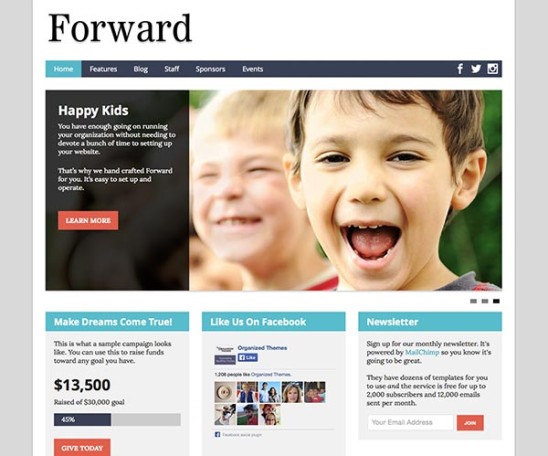
Image via Organized Themes
Organized Themes has a full range of templates available for your site. While some of them are designs for restaurants or stores with huge photos to showcase products, templates designed for non-profits are awesome, especially if you are a non-profit. Rescue organizations and humane societies can use the “Donate Now” button on the front page for fundraising efforts. If you’re not a non-profit, use the large action button for “Register today!”
All Non-Profit Themes, but we specifically like the Forward theme.
Support is delivered by a growing Knowledge Base and Support Forums. All questions in the forums are answered by the developer himself. Since he doesn’t have a full support team, customer support does have specific hours: Monday to Friday, 8:30 am to 5 pm, Central Standard Time GMT -5.
Pricing for these templates are based on either a single theme or period of access to all themes. A single theme with lifetime support and no monthly fee is $59. If you want to try out a bunch of themes before you settle on one, choose the 6 month membership for $89. This gives you access to all the templates as well as support for 6 months. If you don’t need support after the 6 months is up no further payment is needed.

Image via Elegant Themes
Elegant Themes has 87 templates, which can make decisions difficult! Since Google now drops your search placement if your website is not Mobile friendly, stick to browsing the Responsive templates. We like the clean look of the Trim template. Remember, if the template has huge photos you will need to fill those spaces with your own graphics. For many of trainers that could be a problem.
Support is delivered by Documentation, step by step guide for template installation, and Support Forums. All questions in the forums are answered by Elegant technical support.
Pricing is an annual membership fee that gives you access to all 87 templates. The best option is $69 for a year. Once you’re all set up you can cancel your subscription and keep your final website for life.

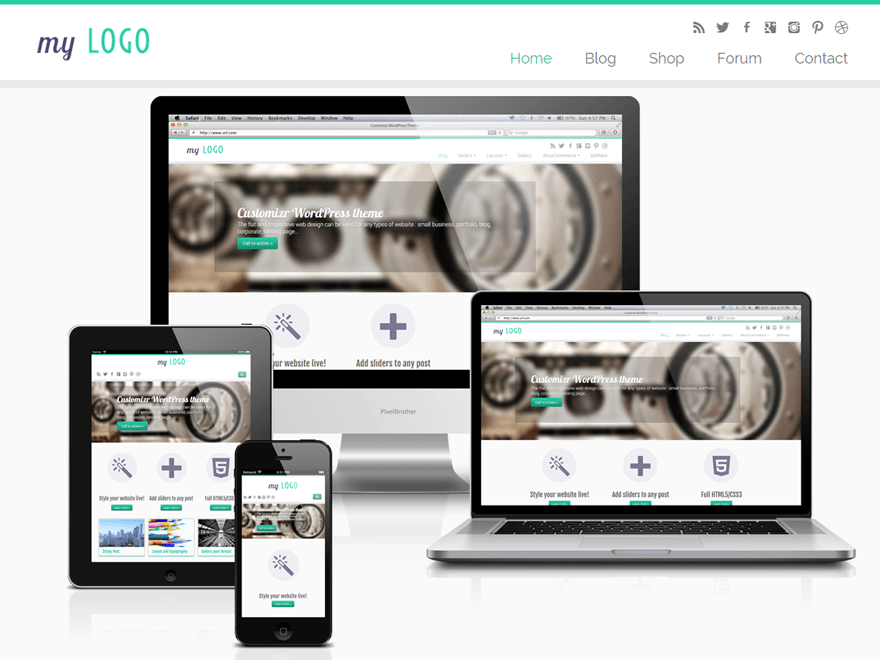
Image via WordPress
If you’re ready to go full DIY, you can download the free version of Cuztomizr, or get the Pro version, which includes access to Premium Support.
Customizr lives up to its name. It’s fully customizable with the Live Preview option, so you see your changes “live,” but unpublished. Checkboxes toggle front page items on and off, the color picker means you get to choose the exact color you want, and you get to use your own logo. This template supports most plugins and is fully responsive for mobile users.
Free Support is available through the official WordPress Customizer forum. Questions will be answered by either SuperUsers or the developer, but Super Users are more common. Start with the Documentation, some of your questions may be answered there. Paid Support is available from the developer though a Support Forum using an activation key. Questions are answered by “WordPress Experts,” which means carefully chosen Super Users and not necessarily the developer. Paid support is $44.95 per year.

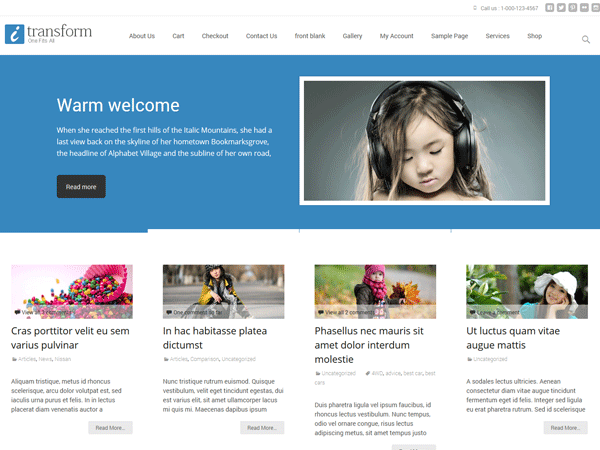
Image via WordPress
i-transform is template with smaller spaces for photos, which means you don’t need to come up with huge, splashy graphics on the home page. It’s Mobile friendly and comes with a toolkit plugin for customization. While the finished theme looks awesome, this is very much a DIY project that will require you to read the documentation on the theme and the toolkit plugin that comes bundled with it to make the initial setup easier.
Free Support is available through the official WordPress i-transform forum. Questions will be answered by either SuperUsers or the developer, but Super Users are more common. Start with the i-transform Tutorial available from the developer. Some of your questions may be answered there.

Image via WordPress
Hueman is one of the more complicated templates due to the variability of sliding menus, headers and footers, and widgets. If you offer a lot of services, have multiple locations, or a lot of staff, utilize the three column front page so visitors can find what they need easily. This template is a very difficult DIY project, so you’ll need familiarity with WordPress and templates and some coding.
Free Support is available through the developer’s Documentation, and the official WordPress Hueman forum. Questions will be answered by either SuperUsers or the developer, but Super Users are more common.
Recommended Article: 5 Must Have WordPress Plugins for Dog Trainers Websites
Get Dog Training Business Tips!
Receive valuable dog training business tips and resources every week! Subscribe to The Modern Dog Trainer now by submitting your name and email below.
[mc4wp_form]