![The Modern Dog Trainer Podcast – Ep. 2 Tips for Designing Your Website]()
by Ines | Dec 12, 2015 | Podcast
The Modern Dog Trainer blog contributors invite the expert website designer and dog trainer, Alice Tong, CPDT, KPA CTP, CSAT, to discuss tips for designing your dog training website and even how to be prepared to work with a website designer if you choose to hire someone.
Subscribe to The Modern Dog Trainer Podcast on SoundCloud or iTunes. Follow The Modern Dog Trainer Blog on Twitter at @ModernTrainer, on Facebook at The Modern Dog Trainer Blog Page, and on Instagram at @TheModernDogTrainerBlog. We love hearing from our listeners! Leave us a review on iTunes to help support our podcast.
Episode 2 – Designing Your Dog Training Website – Podcast Show Notes
 About Alice Tong, CPDT, KPA CTP, CSAT – Training & Website Design
Alice creates websites for a variety of industries, but she specializes in websites for dog trainers, dog walkers, therapists and other service providers who support using positive reinforcement and humane science-based methods with dogs and people. Being a positive reinforcement dog trainer and therapist herself, she has a thorough understanding of the services and clientele in our industry, and an immense passion for helping people and dogs. By supporting you and your website to shine, Alice hopes more people and dogs will have the opportunity to experience the effectiveness and joy that can come from using positive reinforcement and humane science-based treatment methods.
About the Hosts
Links mentioned in the show:
Website Platforms
Photos (Pro-Tip: Always credit the photographer.)
Dog Training Business Tips
Receive valuable dog training business tips and resources right in your inbox! Subscribe to The Modern Dog Trainer now by submitting your name and email below. Don’t forget to let us know what you want to learn more about!
[mc4wp_form]
![An Introduction to Marketing for Dog Trainers]()
by Ines | Dec 1, 2015 | Business

Most likely, you became a dog trainer to help dogs. However, it is difficult to help dogs if your phone isn’t ringing and you’re not getting new clients month to month. In this introduction to marketing for dog trainers, I’m going to discuss 5 strategies you can implement this week to get more clients in the coming months.
Marketing for Dog Trainers
When most people think of advertising, marketing, or sales, they usually get a knot in their stomach. They have become “dirty” words that identify slimy sales people who only care about getting your money. Fortunately, times are changing and I couldn’t be more excited about it!
 Advertising is mostly about interrupting someone’s online experience with undesired ads, pop ups, or auto-play videos. And I’m willing to bet that this kind of advertising doesn’t bug anyone more than me! Fortunately, modern marketing is starting to take a different path.
The approach behind marketing these days is to meet people where they want to be reached. Go where they are looking for help and provide something that they find valuable. For example, if a potential client is searching “how to train my dog” on Google, a modern dog trainer would have an article that shows up on the first page of the search results with tips on “how to train your dog.” This approach offers something of value to a potential customer and will build trust, start a relationship, and drive a desire for more from that resource. Hmm… sounds a little familiar to modern dog training? Essentially, you’re starting to build a positive association for yourself in the eyes of potential customers.
“The Google”

Where do you go to learn more about a certain subject? For most people, that’s a search on Google. Google has positioned itself as THE search engine people use to learn about a problem they’re experiencing. With dog training, problems could include chewing, barking, pulling, digging, etc. Understanding how Google works is important, if not the MOST important, marketing strategy a dog trainer could use. I have personal experience with this.
Late last year my husband and I decided to move from Texas to New York for a variety of reasons. Scary! I knew I had to master Google so that my business would show up in my new service area. Five months before the move I implemented several tactics to demonstrate to the search engine that my business was moving. The techniques I put into place meant I had clients calling me from my new service area within my first month of living there. In fact, I had a client booked before I even had time to file for my new LLC!
The benefits of mastering search engine optimization (SEO) are undeniable. SEO can help every dog training company stay ahead of their competition – new or old. Most of your future clients will find you through Google search results or paid Google Adwords campaigns.
Social Media

Social media can monopolize your time if you’re not careful. Most potential clients will look you up on social media before they give you a ring so you can’t ignore it. A strategic approach is key to not wasting time on social media. Tools like Buffer or Hootsuite can help you mass-schedule posts on multiple platforms at once – time and life saver!
Social media is also picking up speed when it comes to searches. There are millions of searches performed on Facebook, Twitter, YouTube, and more every single day. Sites like Facebook will recommend friends of friends to like pages. Social media plays a crucial role in building trust in potential customers and most potential customers check out you social media to make sure your company is still active. Take some time every week to set up a schedule of posts to share on you social media accounts.
Blogging (and Vlogging)
 Blogging has evolved into something more than an online diary of one’s personal stories. Blogging is now used by some of the most well-known brands like Evernote, SalesForce, and Etsy. A company blog helps you build rapport with current and future customers. A blog page is one of the most visited pages on a website as people research their potential purchase. This is one of the best places to share your company’s story, share success stories, and make announcements. Like social media, an inactive blog can signal to potential customers that you’re not available so come up with a strategy to maintain your blog if you start one.
Getting New Leads
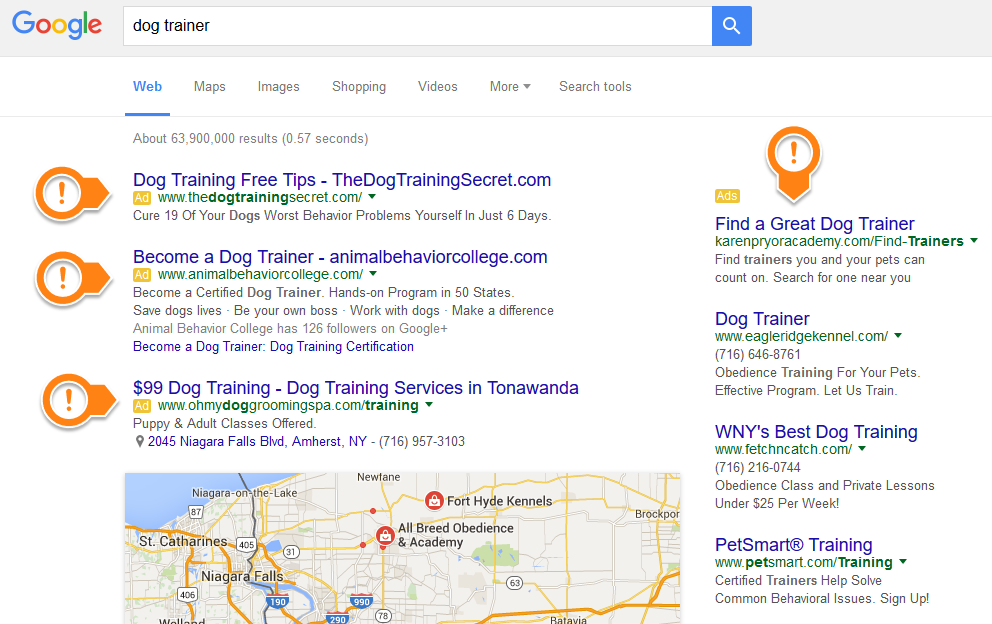
PPC advertising or “Pay Per Click” advertising is intimidating. Many inexperienced small business owners over spend very quickly which leads to a traumatic one-event learning experience. It can be hard to come back from (I should know, it’s happened to me), but PPC advertising with Google Adwords can be one of the fastest ways to get new leads. At first glance, Google Adwords can seem easy, but there are many detailed options you should know about to control your spending. Mastering Google Adwords can easily be the quickest way to grow your business so it is worth a second look.
Digital Marketing for Dog Trainers
Digital marketing is something that modern dog trainers need to learn about right now. Times are changing and business that don’t change won’t make it. Fewer people are relying on word of mouth and are turning toward Google and social media to find the help they need. Make sure you’re there when they’re looking for you!
I’m working on a new book on digital marketing for dog trainers. If you’re interested in growing your dog training business to the next level, going from part-time to full-time, or simply want to start getting more consistent client flow each month,you’re going to want to read this book. Sign up below to receive a notification when it is released and an exclusive discount for subscribers only.
“Digital Marketing for Dog Trainers” will teach you how to:
- Show up on the first page of Google to get more clients
- Get leads immediately with Google Adwords campaigns
- Get more people to call once they land on your website
- Create a blog that makes you unique & valuable to clients (and isn’t a waste of time)
- Manage and automate your social media like a pro
- Start an email subscription list customers will love
- Track and measure your efforts to stop wasting time
- And more because I keep adding to the list every day!
Let’s see how we can grow your dog training business to the next level. Whether you’re going from part-time to full-time or simply want to get new clients more consistently each month, you can benefit from a course I’m working on.
Check out the courses I’m producing to help dog trainers start and grow their businesses.
![Tips for Becoming a Full-time Dog Trainer]()
by Ines | Oct 31, 2015 | Business
This article was provided by the Certification Council of Professional Dog Trainers to accompany our brand new podcast! Learn from professional dog trainers who have made the transition into full-time business owners before. We’re sharing our tips for those who are just starting out. Don’t forget to listen to the first episode of The Modern Dog Trainer Podcast!

So You Want to be a Dog Trainer?
- Love for dogs? Check!
- Want to make your own schedule and work autonomously? Check!
- Desire to make money doing something fulfilling? Check!
Sounds like you want to be a dog trainer! The good news is that dog training can be a lucrative and fulfilling career if you can make it! The bad news is, there are some barriers to entry with choosing a career as a dog trainer.
Becoming a Full-time Dog Trainer
If you’re still reading, it sounds like you’re ready to take the plunge. And as a board member of the leading independent certifying agency for dog training professionals, I believe that you can do it. But before you begin, you should start thinking about some of the things you need to do to be successful. And while you’ve likely thought about stocking up on treats, leashes, and training collars; you have likely not thought about some of the intangibles that are worth your consideration before making the jump into full-time dog training. Things like:
- Your schedule will be all over the place. As a dog trainer, you are in the service industry. People in the service industry work when their clientele do not. For a dog trainer, that means nights and weekends. Think about your current schedule, and think about how that may change when you become a dog trainer. If you have loads of commitments, hobbies, and engagements that happen during night and weekend hours; are you willing to give up that life?
- A good support system. Maybe it is a spouse who is willing to support you as you leave to teach that 7:30pm class or book your Saturday full of clients. Or a healthy savings account that you can dip into in the months before you make it big time. Either way, you need something to fall back on as this can be an emotionally and financially draining profession.
Dog training is very often a second career for people. And many are disappointed to find that after 20 years of building a livable salary for themselves working at their first career, they struggle to make ends meet as a dog trainer. But think about it this way: you may have had a successful career in one field, but entering the dog training field, you are starting back at entry level. That may mean taking jobs that are not your dream job just to work with dogs. . . and doing it at an entry level salary. If you persist, it gets better. . . we promise. But you’ve got to make a name for yourself before you start making big bucks! Oh, and those big bucks we’re talking about. . . probably just a mid-range salary for someone coming out of the business world.
- A love for people. Here’s a biggie. Dog trainers never get into this field thinking about how much they love working with people. They want to help dogs. But here’s the truth. . . dog’s don’t pay your salary, their owners do! So, in order to be a successful dog trainer, you have to be good with dogs and GREAT with people. And many times you may feel like you are in sales, you’re selling yourself and dog training more than you are just training a dog. So brush up on that etiquette, you’ve got people to meet!
So after all of this do you still want to be a dog trainer? Well, here’s the good news: it’s a fun job for the right individual. And very fulfilling. If becoming a dog training professional intrigues you, we encourage you to check out our website at www.ccpdt.org for more information.
Dog Training Business Tips
Receive valuable dog training business tips and resources right in your inbox! Subscribe to The Modern Dog Trainer now by submitting your name and email below. Don’t forget to let us know what you want to learn more about!
[mc4wp_form]
![The Modern Dog Trainer Podcast – Ep. 1 Going Full-time]()
by Ines | Oct 31, 2015 | Podcast
The Modern Dog Trainer blog contributors invite the Certification Council of Professional Dog Trainers President, Brad Phifer, to discuss how to prepare yourself to become a full-time dog trainer. See the CPDT’s accompanying article on going full-time as you listen to the podcast!
Subscribe to The Modern Dog Trainer Podcast on SoundCloud or iTunes. Follow The Modern Dog Trainer Blog on Twitter at @ModernTrainer, on Facebook at The Modern Dog Trainer Blog Page, and on Instagram at @TheModernDogTrainerBlog.
The Modern Dog Trainer Podcast – Episode 1 Podcast Show Notes
 Guest Bios:
Links mentioned in the show:
Education
Marketing
Referral Gifts
Certifications
Humane Hierarchy
Dog Training Business Tips
Receive valuable dog training business tips and resources right in your inbox! Subscribe to The Modern Dog Trainer now by submitting your name and email below. Don’t forget to let us know what you want to learn more about!
[mc4wp_form]
![A Dog Training Client’s Journey]()
by Ines | Oct 10, 2015 | Business, Communication
When a prospective client calls you, it is unlikely that they know exactly what to expect. Usually, all they know is that they are in over their heads and they need professional help. Here we discuss the process a successful dog training guides their client through to create a satisfying customer journey.
Acquiring a Dog Training Client
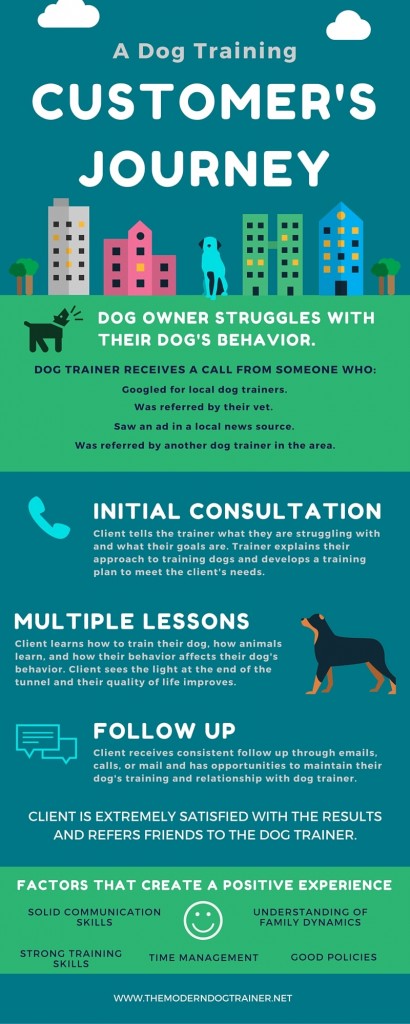
Clients usually get your contact information through four main sources.
- Search Google for local dog trainers
- Their vet refers them to you after you’ve created a strong relationship with the vet.
- Advertising you have paid for in local news sources.
- Another trainer refers them to you if they are unqualified or don’t have time.
Initial Dog Training Consult
The client then goes through an initial consultation either on the phone or in person. This is where you gather as much information about their case as you can. During this consultation, you can develop a training plan that will suite the needs of the dog as well as the family’s situation. This takes a deep understanding of animal behavior training and setting realistic goals for this particular dog and family. Each family will require different environmental setups and each dog will learn in their own way. The more families you work with, the more you will expand your tools in your toolbox.
Several Lessons to Follow-Up
Several lessons are usually needed to make progress in any case. Rarely will one lesson solve an issue. Several lessons allow you to address other issues that may pop up and will allow you to make sure clients are implementing training techniques correctly. Client’s quality of life should improve quickly and they should start to see the “light at the end of the tunnel.”
Follow-Up After Dog Training Lessons
Most new trainers fail when it comes to this part of the client’s journey. (It is something I have done in the past due to lack of experience and understanding.) It is easy to complete lessons and then never initiate conversations with the client again once their problems are “fixed.” However, this is a huge missed opportunity! Maintaining a relationship with the client means you can offer them more services (and continue your income). They will maintain their dog’s training better in the long run. And, ultimately, you’ll stay fresh in their mind so when their friends complain about their dog’s behavior, they can quickly recommend you!
Many factors play a role in satisfying clients. Dog training is a challenging service because much of what contributes to the success of the dog’s training is out of your hands. You can make recommendations, but there is no way to quickly “fix” the dog without complete cooperation from the owner. Even then, many other factors contribute that are out of your control – genetics, history, environment, etc.
Factors that you CAN control include:
- Good communication & social skills
- Strong training skills/knowledge
- Understanding of family dynamics
- Good policies, time management, upholding your promises/appointments
- Follow up with client after lessons are complete
- Provide additional services for maintaining training for dog & relationship with owner
Being a successful dog trainer means being an ever-learning business owner so you can provide the ultimate experience for your customers. In the end, the most successful businesses have a lot of word of mouth referrals. What part of the dog training client’s journey do you need to improve? Share your thoughts in the comments below!
Get Dog Training Business Tips!
Receive valuable dog training business tips and resources every week! Subscribe to The Modern Dog Trainer now by submitting your name and email below.
[mc4wp_form]
![How Mobile Payment Apps Are Helping Dog Trainers Succeed]()
by Ines | Sep 28, 2015 | Training Methods
Time is money – all dog trainers know that.
In the old days, for trainers to get paid, clients would have to lug around cash or checks to a training session. That required your clients to have to remember to withdraw cash, or bring their check book. And often times they would forget, forcing you to pester them continually until they get around to writing said check and putting it in the mail. That all lead to extra work on your client’s end, and then leaving you with further trips to the bank to deposit your hard earned dollars.

Electronic invoicing and payments have surfaced to slightly improve this laborious process. This puts less strain on clients (i.e., more time to pay) while giving them payment flexibility (i.e., pay with e-payment, not check). However this requires dog trainers to sit in front of a computer after a long day’s work and send out invoices, which doesn’t even guarantee that payments will be made on time (or at all).
PocketSuite – The Best Dog Training Business Mobile Payment App
Technology has evolved once again! Tools like Square and Venmo allow dog professionals to accept payments and credit cards from their phones while offering convenience to their clients. More advanced apps, like PocketSuite, even allow clients to reserve sessions and appointments upfront with credit card, enabling trainers to process payments while walking out of each session without hassling the client one bit.
Mobile payment apps as a whole offer core benefits compared to what you might be stuck using today, which in turn will help you run a more successful pet professional business.
Fast
Do work, get paid. That’s how mobile payment apps drive business – disrupting traditional invoicing so there’s no cumbersome process or ongoing game of “chase-and-remind” for clients who are late on payment. QuickBooks’ reign of clunky/desktop invoicing is over. Mobile and instantaneous payment methods free up dog trainers to put their time where it counts – on their actual skillset. With extra time on your hands, you are free to complete more sessions and win more clients.
Affordable
Typically, dog trainers who wanted to accept credit and debit card payments had to invest in a merchant processor account. These accounts come riddled with extra fees (e.g., gateway fees, monthly minimum fees, statement fees) totaling between $25 to $35 per month. But now mobile payment options give you the ability to process credit card transactions without the infrastructure of a merchant processor account. Such mobile payment options free you from long-term contracts and numerous hidden fees, offering clear pricing and fast deposits for a fraction of the cost. And the best ones come without any hardware at all.
Convenient
That’s convenience for both you and your clients. While you’re enjoying a life without invoicing and waiting for payments, your clients will enjoy a life with a lot less check writing, cash withdrawing and wallet opening. It’s freedom for both parties. At the same time, mobile payment apps can protect trainers from canceled jobs and client no-shows, by securing customer credit cards upfront when reserving appointments, all the while delivering clients an “Uber-like” experience.
Mobile payment apps flat out just make life easier for today’s pet professional. Dog trainers in particular will find that this independence, flexibility and support that these apps give them when running a business, will yield them more time and money – to help drive their business towards success.
Sign up for PocketSuite for Free!
Get Dog Training Business Tips!
Receive valuable dog training business tips and resources every week! Subscribe to The Modern Dog Trainer now by submitting your name and email below.
[mc4wp_form]