

5 Misconceptions Dog Trainers Have About SEO

5 Misconceptions Dog Trainers Have About SEO

Part of having a successful business means you need a website that works for you. Ideally, you want a website to be attracting clients to your business even when you’re sleeping. Many dog trainers are missing out on the benefits of SEO and what it could do for their businesses whether they know SEO exists or not. Thankfully, it’s not as scary as you might think and a lot of SEO can be done in “DIY” fashion on a $0 budget. Today, I’m going to dive into some of the myths I’ve seen other dog trainers believe over the years.

1) You Don’t Know What It Stands For

The acronym is much easier to type and say so “SEO” is used infinitely more often than “Search Engine Optimization.” This means that the term scares people away and is general “marketing speak” amongst many small business owners and dog trainers. Fortunately, it doesn’t have to be that way. SEO is an umbrella term used to described any way in which you change your website to improve the way it shows up in search engines. Changes as small as editing a page’s title or changing the description of an image is considered SEO. Don’t let scammers fool you into thinking it is too much more complicated than that.

2) You Think They Can Pay Someone Else To Do It

Unfortunately, as small business owners, we’re constantly bombarded by ads and promotions on how someone can magically snap their fingers and get our website to rank on the first page of Google. All for only $300 per month! Just think of all the new clients you could bring in with that kind of exposure. Too good to be true? Yep…

Unless you’re paying Google directly via AdWords, you’re not going to get your site to rank by paying anyone. There are loads of scams out there preying on unsuspecting business owners that are promised mysterious rankings for a small monthly fee. To get on the first page of Google results, you have to earn it by:

  1. Providing helpful, relevant information to the people that are searching
  2. Optimizing the technical aspects of your website to help it function better for visitors.

3) You Don’t Understand The Point Of It

SEO has remained this mysterious, unclear marketing term that many new business owners shy away from. In reality, it’s easy and important for all businesses to understand. SEO, or Search Engine Optimization, is a FREE way to gain new website visitors and clients. Simply put, there are ways to improve your website so that it will be more easily found in Google and other search engines. You can improve your website by providing the right content, getting listed in (appropriate) online directories, writing relevant blogs, making it appear faster to visitors, and many more ways.

I agree – it can be overwhelming to learn about all the different ways you can improve your website, but you want to keep chipping away at it over time. Every little bit helps your website and your business get found online when people are looking for help. Best of all, when you have a small starting up budget, you can make most improvements for FREE!

Don’t know what improvements to make? Check out my course: DIY SEO for Dog Trainers.

4) You Don’t Do The Right Research (And Make The Wrong Assumptions)

After spending hours in forums online discussing dog training with other professionals, it’s easy to forget how the average dog owner would search for common issues such as resource guarding or leash reactivity. When optimizing for search engines, you should think about the kind of people you want to attract to your website and understand the terms they’re likely to use to find help for their problems.

Here is a comparison of how the terminology might differ between a professional dog trainer and an average dog owner.

Terms Dog Trainers Might Use

  1. Resource guarding
  2. On-leash reactivity
  3. Dog manners group class
  4. Crate training
  5. Positive reinforcement based training

Terms Dog Owners Might Use

  1. Snapping and growling with toys
  2. Barking at other dogs on walks
  3. Dog obedience training
  4. Puppy potty training/house breaking
  5. Positive dog training

With this understanding, you want to make sure your website is written with the vocabulary that is familiar and natural to your target audience. They’re using the search engine to find YOU!

5) They Don’t Even Realize Their Website Is Hurting Them

Living in a smaller town means that many small businesses have not invested in websites that perform well and many don’t even have websites to begin with! I come across horrific websites all the time that a) don’t make me want to go to their business and b) that I can’t even find the business hours or location even if I did want to visit them. Don’t be that business.

With most people turning to mobile searches instead of to their neighbors to find help these days, you cannot afford to miss out on potential customers looking for trainers just like you in your area. A bad website could:

  • Load so slowly that the visitor hits the back button before they even get to see your site.
  • Be so complicated that the visitor just goes back to search for another business to help them.
  • Make the location of the business so vague or unapparent that the visitor can’t tell what state, let alone what city, the business is in.
  • Rank so poorly in search engines that you can’t find the business’s website even if you were to type in the exact name of the business.

“Nearly 60 percent of searches now from mobile devices.” – Search Engine Land

Outside of not being able to be found online or a super slow load time, your website could be hurting your reputation, too. An outdated or 90’s looking website could look unprofessional and could even lead people to believe that you’re out of business! A website is your virtual storefront. Take care to make it visually appealing and helpful so potential customers give you a chance to earn their business.

An SEO Course For Dog Trainers

online course for dog trainers for SEOFeeling overwhelmed? Wish someone would walk you through the right steps to optimize your website? I’ve put all my tips and tricks into a 5 week, open enrollment, email course to walk you through:

  • an SEO Audit – learn about how your website is performing and what is missing so you know where you stand.
  • technical SEO improvements – changes you can make yourself without hiring outside help.
  • a content strategy – learn about what content your website’s pages need to include to attract the right customers.
  • a blogging strategy – know what to write about to attract local dog owners to your site without wasting your time.
Uses for Interactive Pet Cameras in Dog Training

Uses for Interactive Pet Cameras in Dog Training

Petcams, like nanny-cams, are the next big thing in the pet industry. Beyond their entertainment value, there are some real reasons to get one and encourage your clients to get one too.

Benefits Of Pet Cameras In Dog Training

At first glance, petcams appear to be mostly for entertainment and for pet owners to talk or view their pets while they’re away at work or vacation. However, after having the opportunity to use a petcam for my own dogs, I quickly discovered there were many more reasons to have a petcam, especially as it relates to dog training.

Dog Behavior Observation – You can use a petcam to observe a dog’s behavior while the owners are away to screen for separation anxiety, reactivity, or destructive behavior. Getting insights into what the antecedent to a behavior is will drastically help your dog training results.

Marketing Your Dog Training Business – As a dog trainer, you could get a petcam to live-stream your dog training classes online or to live-stream training sessions during a board and train program. Showing customers what goes on behind closed doors builds trust in you and your business to create passionate fans and returning customers.

Interrupting Behavior – Many petcams now allow you to talk to a dog on the other side of the screen. You can use this feature to interrupt barking or other destructive behavior right when it happens, even if no one is home. Of course, interrupting behavior is only a temporary solution and a proper behavior modification plan should be in place, but this could be helpful.

Features To Look For In A Petcam

Sound Detection – One of the benefits of a petcam is to detect when the dog is barking or reacting to outside disturbances. Unless you plan on staring at the petcam every minute while you’re away, a petcam that can detect sound can be a really great way to keep tabs on the activity within your or your clients home.

Motion Detection – It can be very helpful to know if a dog is lying calmly throughout the day or pacing repeatedly to determine their level of anxiety while being left alone. Choosing a petcam that can detect not only sound but also motion is key for using one in dog training.

Two-Way Communication  – If you’re interested in using a petcam to interrupt behaviors initially, you should look for a camera that has two-way communication. You’ll want to be able to hear what noise is going on in the background that may be causing the disturbance and  talk to the dog to redirect their attention. Two-way communication is a key part of using a petcam for dog training.

Wide-Angle View – A wide-angle view allows you to see more of the room. This allows you to see things that the dog might be doing in the corner of the room or see what they’re staring at outside.

Live Steaming! – As a professional dog trainer, you could even use a petcam to promote your business and live stream any aspect of your day! You should find a camera that allows you to regularly schedule live broadcasts or at least lets you toggle on or off the live stream option.

Our Experience With The Petcube a Remote Wi-Fi Pet Camera | Pet Monitor System

Every once in a while, I get a request from a company to do a product review. I don’t accept all products as that isn’t the main point of this blog, but sometimes I see a product that interests me and that I think would interest my readers. The Petcube is one of those products I didn’t want to pass up and I’m glad I didn’t.
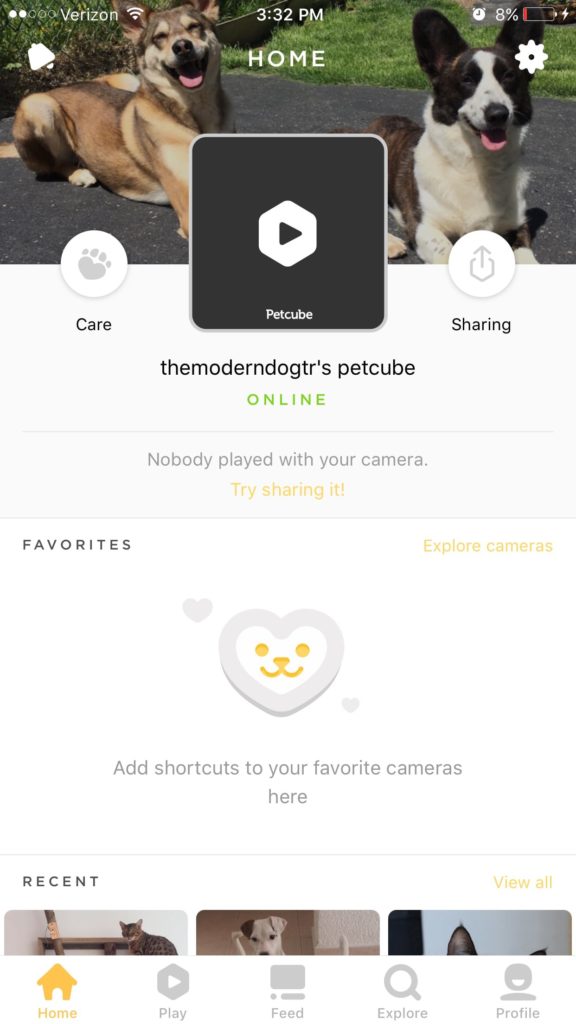


(You can get your own Petcube by going through this affiliate link to get $10 off: http://mbsy.co/petcube/TheModernDogTrainer)

The Petcube had more uses and value than I had initially expected. Since I work from home, I don’t often leave the house for long periods of time so I hadn’t thought about getting a petcam before.

The Petcube was surprisingly small (it’s only 3x3ix3 in). It easily fit in the palm of my hand and was stationed on my current entertainment center without being an eye sore. Its design in the shape of a box is both modern and stable so you don’t have to worry about knocking it over.

It has 1080p HD video with 138° wide angle view and daytime and automatic nighttime mode so you always have visibility of what’s going on. You can choose your own settings for motion detection, sound detection, recording videos or not, notifications of activity, and much more.

The setup was extremely easy and they have a great setup walk through with the app. Everything about the camera is controlled on the app on your Android or iPhone. One thing to note is that since it is app-based, you can’t view the video online unless you start a live Facebook stream.

Here’s a video from the Petcube showing the quality of the video and the wide-angle view.


Here’s another quick video to demonstrate their neat night mode option.


The user interface of the Petcube app is pretty user friendly. Settings can be found in a couple different locations, but I think they are making improvements to that. You can share your camera with their integrated social network.

You can register in the app whether or not you have a Petcube. Once registered, you can also view or interact with other people’s pets, not just your own. Thankfully, you have total control over who sees your pets and how they are able to interact with them.


One feature of the Petcube that I wouldn’t recommend using is the built-in laser. They included this with the “Petcube Play” version, but as many dog trainers know, dogs can become light sensitive and begin obsessing over lights and lasers.

I tried out the talking feature to see what my dog’s reaction would be. They heard my voice, stood up, looked around confused, and whined a bit because they did not understand where my voice was coming from. It was briefly entertaining but I wouldn’t continue it because it would increase my dog’s anxiety while I’m away which is the opposite of what I want. Additionally, their obedience cues have not been proofed to the point of just hearing the sound of my voice.


Benefits of the Petcube

Schedule When You Stream – The Petcube allows you to schedule when you’d like to share the video from your petcam to stream online and you can even stream right to Facebook. As a dog trainer, you could schedule training demonstrations or simply broadcast a group class so that potential customers can see what they’re missing out on. This could be a unique, fun way to promote your services to potential clients and stand out from other training facilities.

Motion Detection, Sound Detection & Two-Way Communication – The Petcube and its various settings allow you to keep track of the activity that matters most to you and utilize it in a multitude of ways depending on what you need for training.

Get the Petcube Bites – This upcoming new version of the Petcube offers a treat delivery feature which further increases its value as a dog training tool. With this new feature, it will become a powerful competitor to the PetTutor. The treat delivery itself is unique in that it doesn’t simply drop a treat, it tosses it so you can see the dog catch and enjoy the treat.

You can learn more about the Petcube petcams and get your own Petcube by going through this affiliate link to get $10 off: http://mbsy.co/petcube/TheModernDogTrainer

What petcams are you fond of? Leave us a comment below!

7 Important Parts of a Successful Dog Training Group Class

7 Important Parts of a Successful Dog Training Group Class

Group dog training classes are one of the most popular ways that dog trainers interact with their clients. Group classes allow past clients to come back to refresh their skills, new clients to get started in basic dog training, and for private lesson clients to grow their skills and their dog’s skills around more distractions.

There are a variety of group classes you could hold. Some dog trainers start with basic puppy and obedience classes then progress to group tricks classes or nosework classes. More experienced dog trainers hold reactive dog classes or confidence building classes for overly-shy dogs and their clients.

Why Teach Group Dog Training Classes?

Group classes help owners receive dog training help at a reduced cost since group classes are typically less expensive than private, one-to-one lessons. Classes also allow your clients to meet others in their situation which is great when they are struggling and need some encouragement. As a dog trainer holding group classes, you have the power to reach many more people and you can work to create a real, connected community to help you build a successful, sustainable dog training business.

When you’re first starting out, some important pieces of a great group class may elude you. Unless you’ve observed a mentor or taken a group class yourself (and perhaps even if you have), you may not be aware of some of the critical aspects of a successful dog training group class. Here are some recommendations to help you make it the best experience possible for your students.

1. Initial Written Expectations

Start by thinking about what your clients want to get out of the class. What do they want to be able to do with their dogs? Put clear expectations about what will be expected of them to achieve this result. In a welcome email, you can include information about where the class will be held, when you’ll meet, what they should bring, and you could even go into specifics such as how they should enter or exit the room to avoid dog-dog confrontations. The more detailed and specific you are, the more organized you’ll appear and the more prepared your clients will be.

(Related Article: How to Prevent Overwhelm and Increase Compliance in New Dog Training Clients)

You’ll want to send out expectations via email a couple of times before the class begins. I would never expect someone to read an email I send out less than 48hours before a class. You can also request a reply to your email to confirm all the students have received it and it didn’t end up in their spam folder. If you request a reply and don’t receive one, follow up with a phone call to make sure they read the instructions and are aware that you’ll be sending communication via email.

Well thought out expectations and communication is key to a successful group class.

2. Space

Find a space for your group dog training classes that will help dogs and their owners feel safe and comfortable. Think about ways you can improve the level of comfort in the class. Should you offer chairs? Should you ask students to bring a non-slip mat for their dogs? Should you bring visual barriers to help dogs keep calm?

Control the space your students are occupying by placing markers or barriers between them to make sure everyone stays at a safe distance from each other.

3. Curriculum

When deciding on your curriculum, consider your student’s experience. Will students in your class know the mechanical skills required to train their dogs already? Do they know what positive reinforcement is and how it works? If not, you’ll want to have a sort of orientation to get your students acquainted with how dogs learn, dog body language, what is and isn’t realistic when it comes to their behavior, and more. Once your students understand the way they’ll be training, then you can coach them on how to utilize this information to train their own dogs.

There are hundreds of choices when it comes to group class curriculum. You can create your own from scratch or collaborate with other trainers that are willing to share what they have.

A fairly common curriculum I’ve seen is Sue Ailsby’s Training Levels Program. The first few levels are a great starting point for basic obedience and dog sports.

For reactive dog classes, I’d strongly recommend reading Emma Parson’s book, “Teaching the Reactive Dog Class: Leading the Journey from Reactivity to Reliability.

You can hold classes with a specific start and end date or you could host open enrollment classes that allow you to continuously accept new students in your class.

4. Confidence

Make sure you are confident enough to speak in front of a few other people and lead them through the steps of the curriculum.


Project your voice. Have the confidence to let your voice be heard. You know more about dogs and dog training than anyone else in the room. Your students have already invested their time and money to listen to you speak so speak with confidence and project your voice so that everyone can clearly hear what you have to say.

Step in when a student is struggling. A group class should always have a few minutes of one-to-one attention so that each student can be successful. Step in when you see a student getting frustrated or annoyed at their dog before things escalate too much.

Ask students to listen. If you have any chatty-Cathys in your class or children that are being disruptive, do not be afraid to redirect their attention for the sake of the whole class. Other students appreciate it when the teach asks for order – they’ve all paid to listen to you teach, not listen to anyone else. If you can’t control the class, your students will have an unpleasant experience and may not return.

Let people know when they should be listening and when they should be practicing with a signal. You can even use a visual (red light/green light card) or an audible bell to let people know when to begin otherwise some may get distracted or start practicing before you’re done instructing. This signal only improves communication and expectations.

5. Games

If your students are starting to master the material, have a few games up your sleeve to increase the difficulty and level of fun. There’s a book with many different games you can play in your group dog training classes called “Gamify Your Dog Training” by Terry Ryan.

6. Community

In a group classes, unlike with private instruction, you can great a really fun sense of community. I would even argue that this benefit of group classes is underutilized by most dog trainers, but it can be critical for building long-lasting relationships with your clients that keep them coming back for more. Get people talking to each other and make real connections with your students so that they feel supported and want to come back.

7. Next Steps For Students

Part of creating a great experience for your students is having a clear next-step to take with their dog so that they aren’t left without direction. Take the lead and introduce some possible next steps for your group class graduates. Will you offer a Level 2? A class with more games or even a beginner dog sport class to keep people motivated and practicing? Will you offer an ongoing meetup they can attend with their newly well-behaved dog? Will you offer additional private lessons to help them overcome specific scenarios they’re struggling with? What next steps should your students take to continue working with you?

Offering ongoing services either in group form or private lesson form is important to maintain your income as a dog trainer. Many people, including me when I first started out, rarely work with clients again after their initial goals have been met. How can you position your services to help your clients maintain their dog’s training while you continue to generate income over time for your business?

Ep. 13 – Sarah Filipiak, CDBC, on Becoming a Pro Dog Trainer

Ep. 13 – Sarah Filipiak, CDBC, on Becoming a Pro Dog Trainer

Sarah Filipiak, Certified Dog Behavior Consultant, is a skilled professional dog behavior expert and has now turned to helping others become professional dog trainers. On today’s podcast, she talks to us about what it takes to be a true “professional” in the dog training industry. She’s started her own online “Becoming a Pro Dog Trainer” course, beginning May 22nd, to help other dog trainers starting out or improve their practice as dog trainers. (Should you click the link and purchase the course, The Modern Dog Trainer will make a small commission. These commissions help us maintain our website, Facebook groups, and keep more materials available for free.)

Subscribe to The Modern Dog Trainer Podcast on SoundCloud or iTunes. Follow The Modern Dog Trainer Blog on Twitter at @ModernTrainer, on Facebook at The Modern Dog Trainer Blog Page, and on Instagram at @TheModernDogTrainerBlog. Don’t forget to join our FREE Facebook Group, “Startup Tips for Modern Dog Trainers.” We love hearing from our listeners!

Please leave us a review on iTunes to help support our podcast!

Show Notes


Ep. 12 – Jennifer Shryock of Family Paws™ LLC and Dogs & Storks®

Ep. 12 – Jennifer Shryock of Family Paws™ LLC and Dogs & Storks®

is the dog training industry’s go-to expert when it comes to families, children, and dogs. We were really excited to have her on our show this month to discuss how she got this expertise and share with us how working with babies and children as a dog trainer can be challenging, but extremely rewarding.

Subscribe to The Modern Dog Trainer Podcast on SoundCloud or iTunes. Follow The Modern Dog Trainer Blog on Twitter at @ModernTrainer, on Facebook at The Modern Dog Trainer Blog Page, and on Instagram at @TheModernDogTrainerBlog. We love hearing from our listeners!

Please leave us a review on iTunes to help support our podcast!

About Our Guest

Jennifer Shryock B.A. is also a Certified Dog Behavior Consultant (CDBC) and owns Family Paws™ LLC in Cary, NC. Her Dogs & Storks and Dogs & Toddlers programs allow dog trainers to better understand how children affect the household so they can be better coaches to parents and better trainers for family dogs.

As we learned during our eye-opening discussion on the podcast, babies and young children in the home contribute uniquely challenging situations that can cause unforeseen conflicts, even for the most experienced dog trainers. Her support helpline and programs are available to parents and dog trainers worldwide.

You can check out Jennifer’s programs and conference here:

6 Places to Get a (Fairly) Formal Education In Dog Training

6 Places to Get a (Fairly) Formal Education In Dog Training

With so many different resources about how to become a dog trainer out there, it is difficult to pick which program is going to provide you with a quality, up-to-date education on dog training. Below I’m listing a few programs that I’ve either taken myself or have had trusted friends take and enjoy. These programs will teach you how to train dogs with lessons on the science of animal learning and training.

If you already know how to train dogs, but you’re interested in a course that will teach you how to run a successful dog training business, check out my 12-week Start Your Own Dog Training Business Course.

Have a favorite program you’d like to add to the list? Leave it in the comments section below!


1) The Academy for Dog Trainers

In 1999, Jean Donaldson founded the Academy for Dog Trainers. Jean Donaldson’s book, The Culture Clash, was ranked #1 for training and behavior by The Association of Pet Dog Trainers. This school for dog trainers is one of the most highly acclaimed schools out there for professional dog trainers.  The Academy for Dog Trainers now has many instructors including several world renowned dog behavior experts.

The Academy is virtual so you can take the courses from anywhere with a laptop. They include weekly webinars and discussions to further develop a sense of community and utilize video coaching to practice training mechanics. If you’re interested in getting a thorough dog training education from the ground up, this is a great choice.

2) Susan Friedman’s Living and Learning With Animals Course

I took this course a few years ago and I would deem this as an absolute necessity for all animal trainers as it dives into the basic principles of learning theory, applied behavior analysis, and science-based animal training. This course is college-level and has a great online community forum to discuss ideas and work through the program.

Homework is assigned out weekly and the short-answer format allows you to explain your logic behind your answers. The instructor’s assistant then evaluates your answer and gives you a few more possibilities or scenarios to think about. In the end, you take a short answer exam that brings together all the information you learned in the course. I have no doubt that this single course contributed greatly to my ability to handle and understand animal behavior issues. This is truly a great critical thinking course that all animal trainers should take.

3) IAABC Courses

Or more specifically, the Animal Behavior Consulting Principles & Practice is a great place for you to get a comprehensive overview of what it takes to take on behavior cases. You start with the basics of animal learning, applied behavior analysis, and what it means to be an animal behavior consultant.

“The IAABC Animal Behavior Consulting Principles & Practice Course is a unique twelve-week, multi-module course providing a comprehensive overview of the many facets of animal behavior consulting for all species.” You’ll learn from several different instructors, all of which are well-respected as experts within our industry, throughout the course which allows you to grasp different perspectives on animal behavior as you go through it.

Be sure to let them know The Modern Dog Trainer sent you on the form if you register.

6) Karen Pryor Academy

The Karen Pryor Academy or KPA is extremely well-known in the dog training industry. They are the go-to experts for clicker training around the world. As a participant, you’re also provided with marketing materials and lesson plans to help your dog training business get off the ground.

This course sticks to clicker training foundations and advanced level skills. Something to keep in mind is that while I love applying clicker training concepts to address and change a dog’s emotional state for behavior issues such as reactivity, this is something I learned from mentors and isn’t something that is taught in the academy.

If you’re considering training service dogs, training trick dogs, or sticking to basic obedience training, their Dog Trainer Professional Program is definitely a great course to take.

5) Victoria Stilwell Academy

The Victoria Stilwell Academy teaches dog training foundations as well as how to manage and communicate with clients and run a successful business. VSA’s Dog Trainer Course requires two trips for “intensives” where you’ll test out your new training knowledge and skills under the supervision of instructors and mentors. This course only occurs a couple times a year, but is hosted in the USA and the UK.

You can see starting course dates and learn more about her program here.

6) Become a Pro Dog Trainer by Sarah Filipiak

Sarah’s new 6-week online course walks you through the core principles of professional dog training. She teaches the foundations you’ll need to know to train dogs. You’ll also learn about dog body language and how to choose which training technique based on the dog in front of you. This course comes with a 6-week dog training course curriculum you can start using immediately and several handouts.

Have a favorite program you’d like to add to the list? Leave it in the comments section below!


Looking into starting your own dog training business? Grab our free eBook, “10 Common Mistakes New Dog Trainers Make With Their Businesses.”

If you’re thinking about starting your own dog training business, take advantage of this free eBook to avoid some detrimental mistakes that many dog trainers make.

Are you spending your time on the right tasks to grow your business? Are you worried about making continuous income throughout the year? Will your business be sustainable for years to come? Prepare yourself with the help of this eBook!

Pin It on Pinterest