![5 Places To Hold Group Classes]()
by Liz Wyant | Nov 8, 2014 | Business
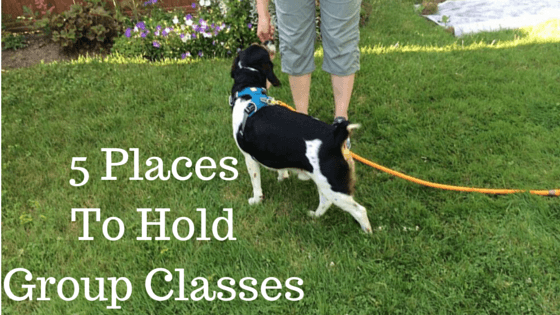
If you are a dog trainer without your own private training facility, you can sometimes feel relegated to holding only private in-home sessions. However, with some creativity and planning, you can hold group classes in many different places.
Public Parks
Public parks can often provide you wide open spaces to hold group classes. They enable you to spread dogs out so even space-sensitive dogs can succeed. Holding group classes in parks is often easier if you have somebody to partner with so that one person can teach while the other can run interference with curious bystanders or loose dogs. Be sure to check any city regulations about using parks for personal gain.
Veterinary Offices
Many veterinary offices have spacious lobbies. They often love having a trainer “on staff,” so to speak, so they can refer clients to you. If you can establish a good working relationship with a vet, it can become mutually beneficial with each party referring potential clients to the other. Classes are a great way to keep clients coming back to their office and you’ll be able to make new relationships with clients.
Local Pet Stores
Most of the big box pet stores have their own staff trainers, but many local pet stores have decent open areas and would love to have a trainer hold group classes there to bring customers in their doors. If you promise to promote their products, they may even allow you to use the space for free. Additionally, holding group classes in a pet store provides for GREAT distraction training!
Parking Lots/Garages
Parking lots/parking garages can be fantastic for group classes. Being on concrete allows for distracted dogs to focus a little more easily, yet there is often still grass close by for potty breaks and sniffing rewards. Also, like public parks, they are very large and permit you to spread your clients out so all the dogs have ample space. Just make sure you have permission to be there.
Halls/Basements
Sometimes churches or AmVets type clubs will rent out their halls or basements for a reasonable fee. Be aware that some may require you to be an active member to get this benefit, but it certainly does not hurt to call around and ask.
Remember that when you are out in public or using somebody else’s space, it is important to leave the space as clean as or cleaner than it was when you arrived. Doing so ensures that you and your clients will always be welcome in the future.
What other places do you use for group training?
Recommended Links
![5 Reasons To Encourage Crate Training With Clients]()
by Liz Wyant | Nov 7, 2014 | Training Methods

Crate Training Can Seem Peculiar To Clients
For those unfamiliar with crate training, it can seem cruel, almost as if the dogs are being caged like zoo animals. However, as a savvy trainer, it is important to be able to explain to your clients a few reasons they should strongly consider crate training.
Know Where The Dog Is
Explain to your clients the great peace of mind that can come from knowing exactly what scene they will be walking into upon their arrival home – their dogs, happily wagging, safely contained in a crate, nothing in their home destroyed. Day after day, consistently.
Home Security Systems
Many people these days have home security systems. Remind your clients that if their alarm system goes off and the police are notified, the police WILL enter their home, with or without them present. Wouldn’t your clients rather know their dog is safely out of harm’s way due to being happily crate trained?
Windows = Automatic Dog Trainers
When dogs have access to windows during the day because they are free roaming, they can learn some valuable lessons. Valuable to them, at least. These include: barking scares the mail carrier away; barking scares pedestrians away; barking scares passing dogs away; barking scares delivery people away. That means your client’s dog has learned that barking excessively makes things go away. This is not really a lesson most people want their dogs to possess! Crate training keeps the dogs away from windows, preventing them from getting over-aroused multiple times throughout each day.
Learn To Relax
Dogs that are permitted to roam around the house, pestering the cats, barking out the windows, and finding other ways of entertaining themselves have a high probability of getting into trouble. Crate training teaches dogs to relax and enjoy downtime, especially when left with a lovely chew toy or work-to-eat toy in their crate.
No Issues With Other Household Animals
Many of your clients will be multi-pet owners. Whether those pets are all dogs, dogs and cats, dogs and birds, or some other combination, crate training ensures the safety of all animals in the household. Encouraging your clients to crate train means they will not ever have to be concerned about coming home to an injured or dead pet due to a fight that may have started over something as insubstantial (to people) as a tissue on the floor or play that escalated without supervision. Clients enjoy knowing that all of their beloved pets are safe and happy and will remain so.
Many clients may balk at the idea of crate training. Being able to calmly explain different benefits of it will enable them to start working through their antipathy towards the idea.
What are some other reasons you can think of to encourage crate training?
Recommended Links
![5 Dog Training Supplies You Should Ask Your Clients To Bring To Each Lesson]()
by Ines | Oct 10, 2014 | Business
Prepare Your Clients As Much As You Prepare Their Dogs
When you’re starting out as a professional dog trainer, you probably come to lessons prepared with extra treats, a treat pouch, and a clicker. You might even bring a variety of toys in the trunk of your car. This is a wonderful way of being prepared to train your client’s dog, but you can miss out on excellent learning opportunities for the client if they know you always bring the goods anyways.
Create Expectations
 Ensuring that you have the proper tools for training is important to accomplish the training goals you set out to achieve, but we’d like to advise that you let that preparation fall in your clients hands. Encouraging your clients to provide all the necessary equipment helps them in these ways:
- It teaches them to think about their dog’s perspective. Reinforcers should be items their dog wants to work for. Ultimately, your clients need to be able to figure this out on their own.
- It teaches them how to be prepared for anything. Having them be responsible for supplying a variety of reinforcers and management tools helps them learn about when and how to use the tools you ask them to provide.
Dog Training Supplies Your Clients Should Supply
Treat Pouch
We’ve taught classes and lessons with and without recommending a treat pouch. We’ve found that, by far, clients who use pouches are less likely to bribe their dogs than those that don’t wear them. Clients that don’t wear treat pouches are more likely to hold a baggy of treats in their hands while training which is essentially bribery. Pouches help keep the food out of the clients hands as they learn how to juggle the leash, clicker, and reinforcers.
Clicker
Not all positive trainers use clickers, but more and more trainers are incorporating them into their training. Having a dog (and owner) that is “clicker savvy” can help address behavior issues down the road. We recommend teaching owners and their dogs at least one behavior with the clicker so that both are familiar with the concept and implementation of it. Check out our favorite explanation of what clicker training is so you’re sure you know how to explain it before you work with your next client!
Low and High Value Treats
One of the most important lessons you can teach a client is how and when to use each treat. Therefore, asking them to bring multiple types of treats to class or to a lesson is a great way to show them when each one will work and why it matters.
6 Foot Leash & Harness
Clients can now purchase a variety of tools to attach to their dogs. You must be extremely specific when recommending a leash and harness. Leashes come in a variety of lengths and structures. If you just say “a leash and collar” you can end up with endless combinations including a flexi-leash with a prong or choke chain! Your directions should get as specific as “Please bring a 6 foot, non-retractable, nylon or leather leash and a front attach Easy-Walk harness.” Anything less and you could end up with a harness that tightens around the dog’s body when it pulls or a double attachment retractable leash!
Relaxation Mat
While you’re speaking and giving instructions in class, the dogs usually get ignored as their humans (hopefully) listen. Providing them a mat to lie on while waiting for the next exercise communicates to them to be patient and gives them concrete information about what they should be doing. It is fairly easy for owners to reinforce their dogs while they continue listening to you speak. This relaxation exercise will help dogs learn how to just “hang out” while their owners pay attention to something else.
Ultimately, placing more responsibility on the client will teach them more important lessons than always bringing the necessities for them. They will be continuing on the training in the future without you so they need to learn those skills sooner rather than later. Share your thoughts about this idea in the comments below!
Recommended Articles: