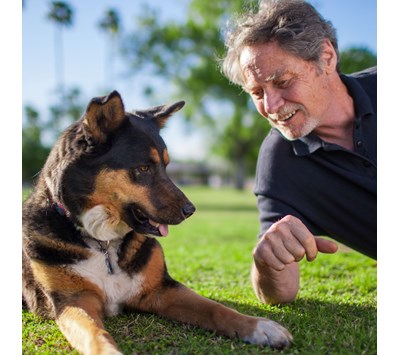
SPARCS 2015: The Potential Of Social Learning In Dog-Human Interactions With Dr Márta Gácsi
Utilizing Social Learning In Dog Training
 Most people view their dogs as social partners. Evidence indicates dogs view themselves in this way too.
Attachment is a behavior system. Dogs develop an attachment bond to their owners based on dependency and on functionality. Dogs can establish attachment in three short handling sessions and are able to establish successful, new social bonds (for example — puppies raised as guide dogs — first by puppy raisers and then with their owner). Even puppies spontaneously pay attention to humans communicative actions.
Social learning is an effective way to solve problems. In the Detour Test (toy is in full view, but behind a v-shaped fence that dogs can go around to get the toy), dogs who were shown demonstrations on how to get the toy from both humans and other dogs, did significantly better than dogs who figured it out on their own.
Do As I Do
Imitation of human demonstrated actions on command is known as “do as I do.” Dogs appear to have the ability to learn the rules of imitation in a relatively short time. And the generalization of the rules leads to the ability to imitate novel actions. A study by Fugazza and Miklosi in 2014 suggests that DAID is more effective for teaching complex actions.
Model Rival Training
In this form of social learning, the trainer interacts with a model while the dog watches the interaction. The model is a rival because the model gets the social interaction and the dog watching does not (during the modeling time).
Efficiency Of Social Versus Operant Training
Using puppy pairs (approximately 3-4 months old), two tasks were tested. One group was trained to do the simple tasks with operant training (clickers and treats); the other group used social learning to train the tasks. It was found that more puppies learned the tasks in the social group.
Social And Operant Learning Go Hand In Hand
Dogs needed to be trained for a study where they would be getting an MRI. The dogs needed to lay still for eight minutes without any reward — cannot expect food (no drooling allowed), it would be noisy, and they would not be able to see much. There would essentially be no inherent reward for doing this task.
Using both social and operant learning, dogs were taught this behavior. Prior to being in the MRI scanner, 5 — 20 sessions were used to teach a variety of important behaviors using a variety of reinforcers. Then dogs were trained at the scanner in 7 — 11 sessions. The trainers and owners communicated to the dogs via social reinforcers that being on the scanner bed is fun. Model rival training was used several times during this phase. A side note — no time limits were ever incurred on the dogs — they were always allowed as much time as they needed to be comfortable in performing the task. The trainers/owners handled the dogs in a way that they appreciated (worked for) their praise.
In Conclusion
Social learning occurs spontaneously.
Social learning in connection with operant learning is an effective training model.