![Lessons From A Weekend With Ken Ramirez]()
by Liz Wyant | Dec 4, 2014 | Events, Training Methods

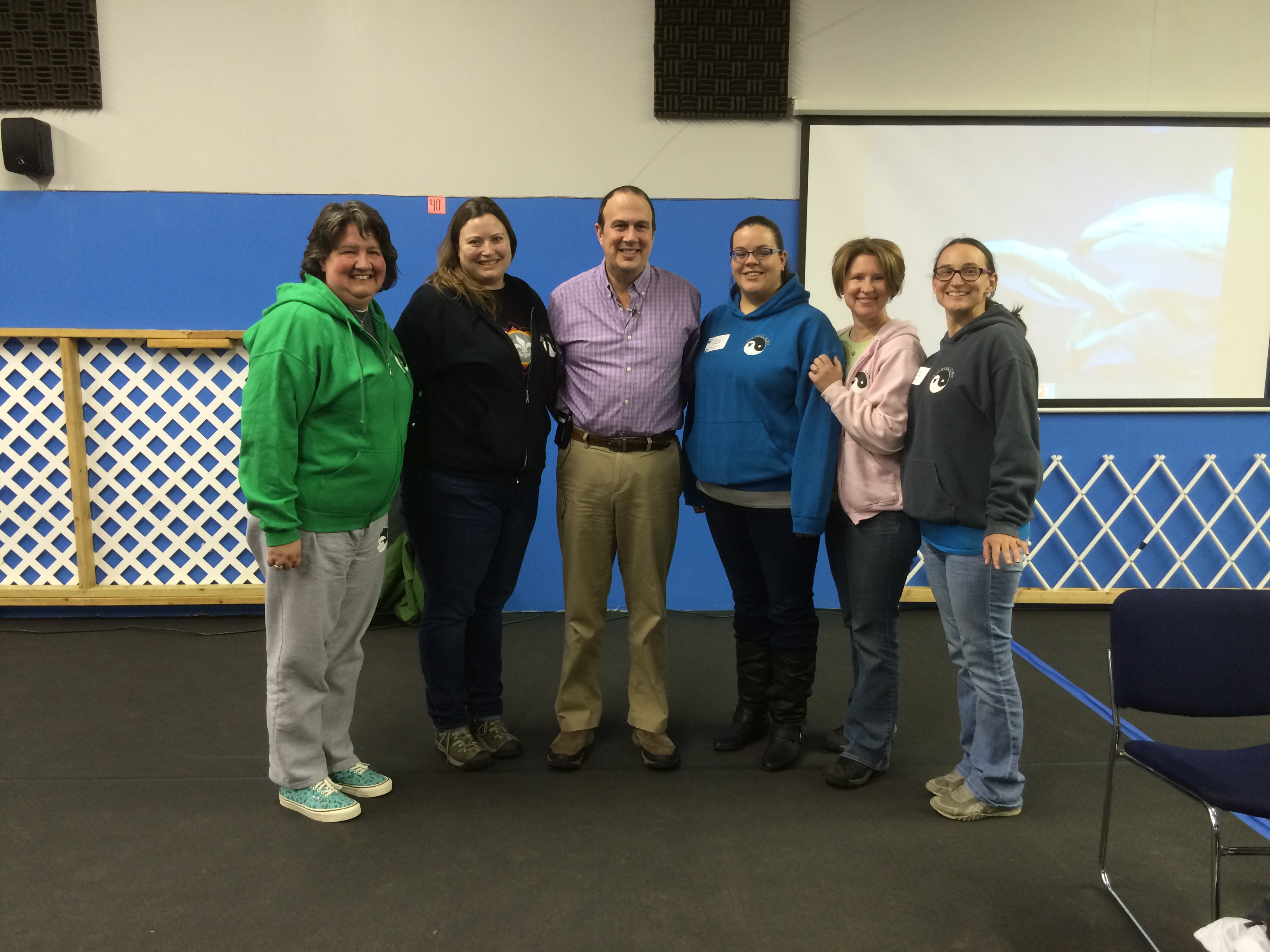
Ken Ramirez, Liz Wyant (the author of this article), and some of her friends at his Cleveland seminar.
A Weekend With Internationally Recognized Animal Trainer, Ken Ramirez
Ken Ramirez has been in the animal training/behavior world for over 35 years. He has worked with guide dogs, law enforcement K-9s, zoo animals, and marine animals. He has worked at Chicago’s Shedd Aquarium for 26 years, most recently as the training advisor. In October of 2014, he started a new role as the Executive Vice-President and Chief Training Officer of Karen Pryor Click Training. Ken is an avid proponent of force-free animal training.
In November, Ken presented a two-day seminar we were able to attend. 26 pages of notes later, here are some of the concepts we felt were most important.
Training 101
Ken describes training as teaching an animal what the rules for living in a particular space are. He emphasizes that it should be a shared process; the animal should WANT to be with that person and should WANT to train.
Ken feels the cornerstones of animal care are:
- Health Care
- Nutrition
- Environment
- Behavior Management – As Ken says repeatedly, “training is not a luxury.”
That last point is what struck me the most – training is not a luxury. So often our clients factor in costs of health care, food, and grooming, but not training. Training is only used when something goes bad, not to provide the mental stimulation that dogs need to have a basic, happy and healthy life.
Least Reinforcing Scenario/Stimulus (LRS)
Ken explained the LRS as the most positive approach to dealing with unwanted behavior. It was developed in the zoological training community as a way to operationalize the mantra of “ignore the unwanted behavior.” Though very basic, it can be a powerful tool. The Least Reinforcing Scenario is simply a 2-3 second neutral response after an animal gives an unwanted behavior, followed immediately by another opportunity to earn reinforcement. For example, you cue a dog to sit and it lies down instead. Immediately when the dog lies down instead of sits, give a neutral response for 2-3 seconds and then cue the dog to do a different cue that you are positive they can successfully complete.
So what is a neutral response? There is no straight answer to this. It is not a freeze, it is just a continuance of what you are doing – if you are looking at the dog, keep looking at the dog. If you were in the process of scratching an itch, keep scratching the itch. The key is to just maintain the environment so the dog is neither punished nor rewarded. This is only effective for a dog that is accustomed to working in a positive reinforcement environment. When you reward, reward, reward and then don’t, the dog will notice the lack of rewarding. There’s no need to extend the time or get emotional – just 2-3 seconds of a neutral response is enough feedback.
Alternative Reinforcers
Alternative reinforcers are learned reinforcers. They can be anything – clapping, toys, touch, play, words, or anything else the animal values. They give you a chance to provide some variety in your reinforcers to keep the dog excited about working with you. Alternative reinforcers need to be trained as behaviors so the dog understands what they mean. This means it needs to be paired with food and marker signals and practiced for weeks. Once the dog begins to value the alternative rewards, you should still use treat rewards 80% of the time during training sessions.
For alternative reinforcers to be effective, the trainer and animal must already have a predictable and solidly established relationship. It is incredibly important to constantly maintain the strength of the alternative reinforcer by keeping it paired with food. Also, be mindful that if a dog’s behaviors deteriorate after using the alternative reinforcer, the alternative reinforcer is NOT a reinforcer at all!
These are just a few of the topics that Ken discussed. He kept everybody captivated for two full days and we left feeling invigorated about training and ready to try his ideas. Should you get the opportunity to see him, we couldn’t recommend him highly enough!
Have you tried using LRS’s or alternative reinforcers? Tell us in the comments!
Get Dog Training Business Tips!
Receive valuable dog training business tips and resources every week! Subscribe to The Modern Dog Trainer now by submitting your name and email below.
[mc4wp_form]
![Becoming The Best Teacher You Can Be]()
by Ines | Oct 24, 2014 | Communication, Events
At the APDT Conference last week we had the pleasure of listening to Sumac Grant-Johnson‘s speech called Build A Better Trainer. Sumac is a wonderful dog and people trainer. She engaged the audience like few speakers were able to. Everyone was laughing and enjoying themselves during her speech. Here are some of the highlights of her presentation.

Teaching Skills For Dog Trainers
Many trainers get into dog training for the dogs. However, you have to work with people to make a living so having some people skills are important to being a successful dog trainer.
Sumac has broken down the steps every teacher should take when instructing a class or lesson into an easy-to-remember acronym: OIA. OIA stands for Observe, Interpret, and Act. She encourages all trainers to learn as much about human body language as they do about dog body language. This will increase your ability to understand clients who might be struggling. She stated that if there is a failure rate of more than 25% in a class after instructions are given then the issue lies with the instructions given, not the students.
Observations
As a teacher, you must be able to observe your student’s actions. Look at what they do correctly and incorrectly. See what might be inhibiting them from achieving the goal behavior.
Interpret
Once you’ve made accurate observations, you can then interpret what you’ve observed. Bring into consideration environmental factors such as space, distractions, fears, and noise. She mentioned that you can let clients know what they can do if they cannot hear you appropriately.
Learning Styles
A good instructor understands how to utilize different approaches so that all learning styles are incorporated into their teaching. Learning styles can be broken down into visual, auditory, and kinesthetic. Make sure you’ve researched these styles so that you can identify the learning style of each client.
Knowledge Base
Every client will have a different history and knowledge base. Sumac recommended we read the book
How Doctors Think by Jerome Groopman. You never know right off the bat what kind of training knowledge, behavior knowledge, or experience a client may have. What they know can hold them back in some cases due to prejudices or biases.
One of the most important parts of her presentation was the recommendation to never express differing or conflicting opinions right off the bat or they’ll put up barriers.
Act
After observing and interpreting your client’s behavior, you’ll want to act accordingly. Consider adjusting the environment, avoiding putting people on the spot, and mark and reinforce correct behavior. Sumac recommended the use of words like good, nice, or great as marker words before explaining what they did correctly. Make sure you give your students achievable steps towards the goal behavior just like you would when working with their dogs.
In the end, she states that as dog trainers, we all of ONE job. That is to help people meet THEIR goals. This presentation was one of our favorites out of the whole APDT Conference in Hartford. She is an excellent presenter and intelligent people-person. She claims she used to be extremely shy as a child, but we find that extremely hard to believe! Thank you
Sumac Grant-Johnson for sharing your knowledge with us.
![Things You Should Know Before Taking On Aggression Cases]()
by Ines | Oct 23, 2014 | Events, Training Methods
There is no doubt that dog training is dangerous, but you’d be surprised by how many dog trainers are not taking the right precautions when they work with aggression cases. Michael Shikashio, President of the IAABC and outstanding certified dog trainer, hit the nail on the head with his speech at the APDT Conference in Hartford last week. His talk, Staying Safe in Aggression Cases, discussed the following points:
Be Aware Of The Responsibilities Of Aggression Cases
When you take on an aggression case, you’re taking on a lot of responsibilities whether or not you’re aware of them. Consider the liability of handling an aggressive dog. What will your procedure be if the dog bites a family member, another dog, a stranger, or yourself? What are the legal ramifications of such an incident? If you are bitten, you could suffer from physical and psychological injuries as well as a damaged reputation. What will happen to the dog if he bites someone? Are you mentally prepared to handle such a case? Ignoring the possibilities does not make them less likely to occur. You must be prepared for the worst even if you’re expecting the best.
Gather As Much Information As You Can
Michael discussed the usefulness of paper or online questionnaires, but stated that ultimately those cannot compete with an in-person discussion session with the owner. There are non-verbal cues that you can pick up on in person. Speaking with a client in their home makes them more comfortable and you can examine the environment for lesson set ups in the future. Gathering a detailed bite history in person can help you get more information about each incident.
Setting Yourself Up For Success
Michael discussed that there are some simple steps you can take to protect yourself during the first meeting with the dog. Clear written and verbal instructions are a must. Even then, he encourages you to call the owner when you arrive and before you get out of the car to make sure all instructions have been followed. You must assume that the dog will bite if given the opportunity so wear appropriate clothing to the meeting.
Discuss management techniques the owner can put into place such as using two leash attachment points (collar and harness), a waist leash, muzzles, gates, and barriers. He encourages you to demonstrate the proper fitting of all harnesses or collars with the owner on a stuffed animal before the first meeting with the dog.
Back Up Protection
Unfortunately, we know we cannot trust owners to follow instructions 100% of the time or 100% correctly. Accidents happen so have your own personal shield against attacking dogs. Wear secure shoes, avoid loose clothing, and make sure your treat pouch is secure. Bring items like a spray shield for a last resort reaction if you’re attacked. Make sure to remove hats, sunglasses, and scarves before the meeting.
Defensive Handling
One of the most common mistakes trainers make is assuming the dog is alright with them and letting their guard down. Dogs can easily push past their thresholds in order to gain access to treats or food. Luring dogs into your space that aren’t ready to be that close can set yourself up for a bite. Using the treat and retreat game is important, but make sure you toss treats at a good distance behind the dog to keep a safe distance. Also, avoid sudden movements during this game.
Defensive handling is best learned by shadowing an experience trainer, states Michael. Things like leaning away from the dog while training, knowing strong leash grip techniques, and knowing how to use your center of gravity should be practiced well before your first aggression case.
Know Your Options
Ultimately, if you are bitten, you had better know where the nearest emergency room is. Knowing this information before the lesson will make an accident less stressful. You won’t be left wondering where to go or asking your client to look it up for you. It is also not a bad idea to keep a first aid kit in your car for emergencies.
We’d like to give a big THANK YOU to Michael Shikashio for presenting this very important information to trainers at the APDT Conference this year. You can contact Michael for more information at Complete Canines.
Have you started taking on aggression cases? What precautions do you have in place to protect yourself?
Recommended Articles
![6 Lessons Learned From Ian Dunbar – Dog-Dog Aggression]()
by Ines | Oct 22, 2014 | Events
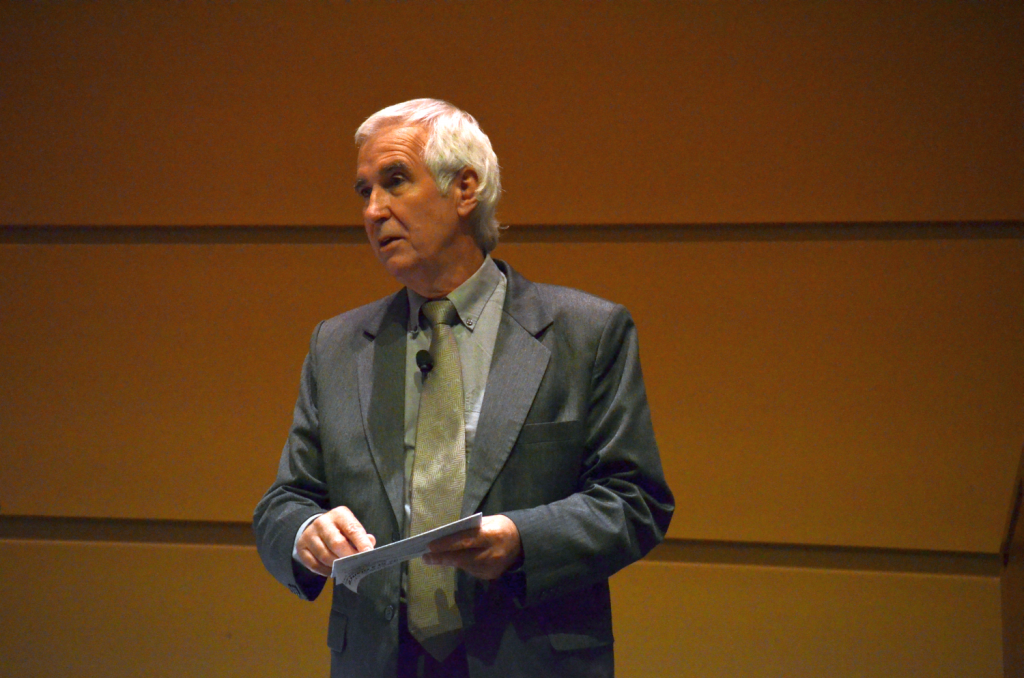
Dr. Ian Dunbar is the founder of the Association of Professional Dog Trainers (APDT). He is known as a leader in the humane training movement and is a national advocate for proper puppy socialization. We attended his talk during the APDT Conference in Hartford and have consolidated some of the best points.
Preventing Your Dog From Being Attacked
One behavior that is so incredibly simple its scary can save a client’s dog from being attacked. One of the biggest triggers for fights is hard eye contact from one or both dogs. Asking your dog or a clients dog to turn in front of you and give you eye contact can single-handedly prevent dog fights. This behavior keeps you dog’s eye on you and their back to the other dog. This behavior doesn’t have to be on cue. Simply lure the dog in to the position and continue feeding until the strange dog has passed. This behavior sends the message that your dog is not interested in engaging in any way with the strange dog. What kind of dog is going to instigate a fight with a dog who’s turned his back?
Continuous Training Isn’t Optional
Just like in people, anxieties get stronger as the dog ages. Puppies and children are not born with phobias or fears, but as they get older their anxiety increases. This is the reason clients must understand that training is not a one time commitment – it is a lifetime commitment. It should continue throughout the dog’s life to prevent regression.
5 Reasons Puppies Are Not Socialized Correctly
Dr. Ian Dunbar mentioned that owners have 5 usual excuses for not properly socializing a puppy.
- Fear of disease.
- Fear of overwhelming a puppy.
- Puppy already seems to be well-adjusted.
- Unable to recognize puppy’s warning signs.
- Denial and the expectation that the puppy will grow out of problem behavior.
Dr. Dunbar claims that socialization is very important in preventing dog-dog aggression, but many owners fail at doing this correctly. Owner education is the solution to this.
Differential Classical Conditioning
While classical and operant conditioning are not exclusive from each other, you must give rewards to the dog no matter his behavior in order for classical conditioning to occur. Differential classical conditioning means treats when the dog is showing desired behaviors (no barking, sitting, etc) and verbal praise or lower valued treats when the dog shows a slight reaction such as growling. Here is the breakdown:
- No trigger – No rewards.
- Trigger present, small reaction – Give verbal reassurance. Increase distance in the future.
- Trigger present, no reaction – Jackpot with rewards.
This process allows the trainer to reward desired behaviors more strongly while maintaining classical conditioning during all exposures to the trigger.
Using Secondary Reinforcers For Classical Conditioning
We all know that bringing food into a strange group of dogs can cause issues. Using a secondary reinforcer that is only valuable to your client’s dog and not other dogs will help prevent resource guarding issues. Lots of work must be put into making a secondary reinforcer strong enough to use for classical conditioning, but it is a great alternative to using food in training.
The Jolly Routine
This training technique was founded by Bill Campbell in the 1980s. Stiffness and anxiety fuel reactive dogs. Clients can overcome their anxiety by putting their training to a rhythm. This makes their learning progress more smoothly as well as their dog’s. The jolly routine involved acting very excited and happy when the trigger appears. Dancing is usually involved to truly get in the groove and eliminating anxiety. It is very difficult to feel upset if one is dancing. Dancing and treating are perfect accessories to a classical conditioning protocol.
We enjoyed learning about Dr. Ian Dunbar’s perspectives on dog behavior and his concepts behind treating dog-dog aggression. What do you think about these main points?
Recommended Articles
![APDT Conference – Day 1]()
by Ines | Oct 16, 2014 | Events
This week we are attending the APDT Conference in Hartford. As day one comes to a close, we want to share some of our favorite moments.
Conference Opening Ceremony
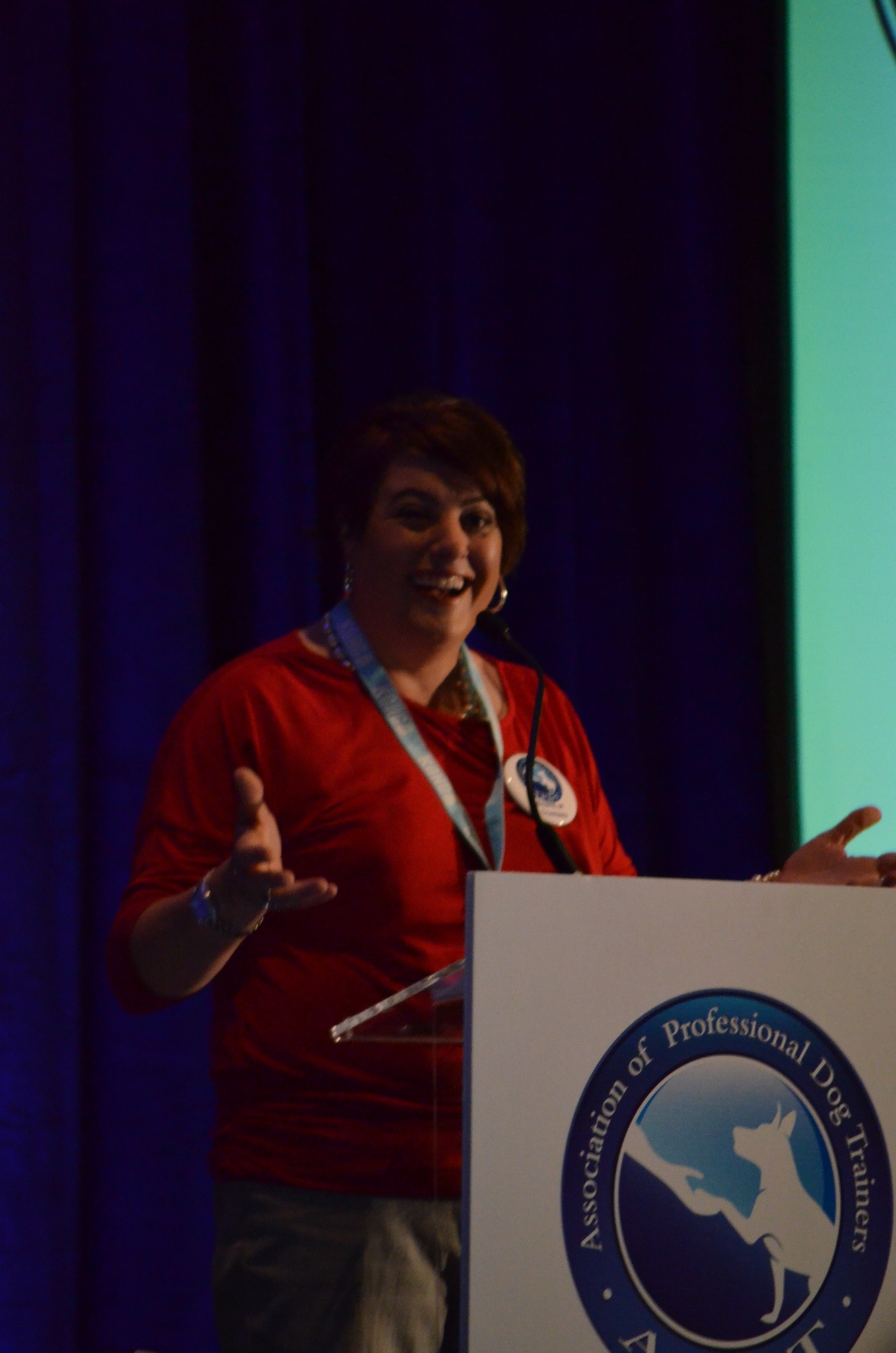
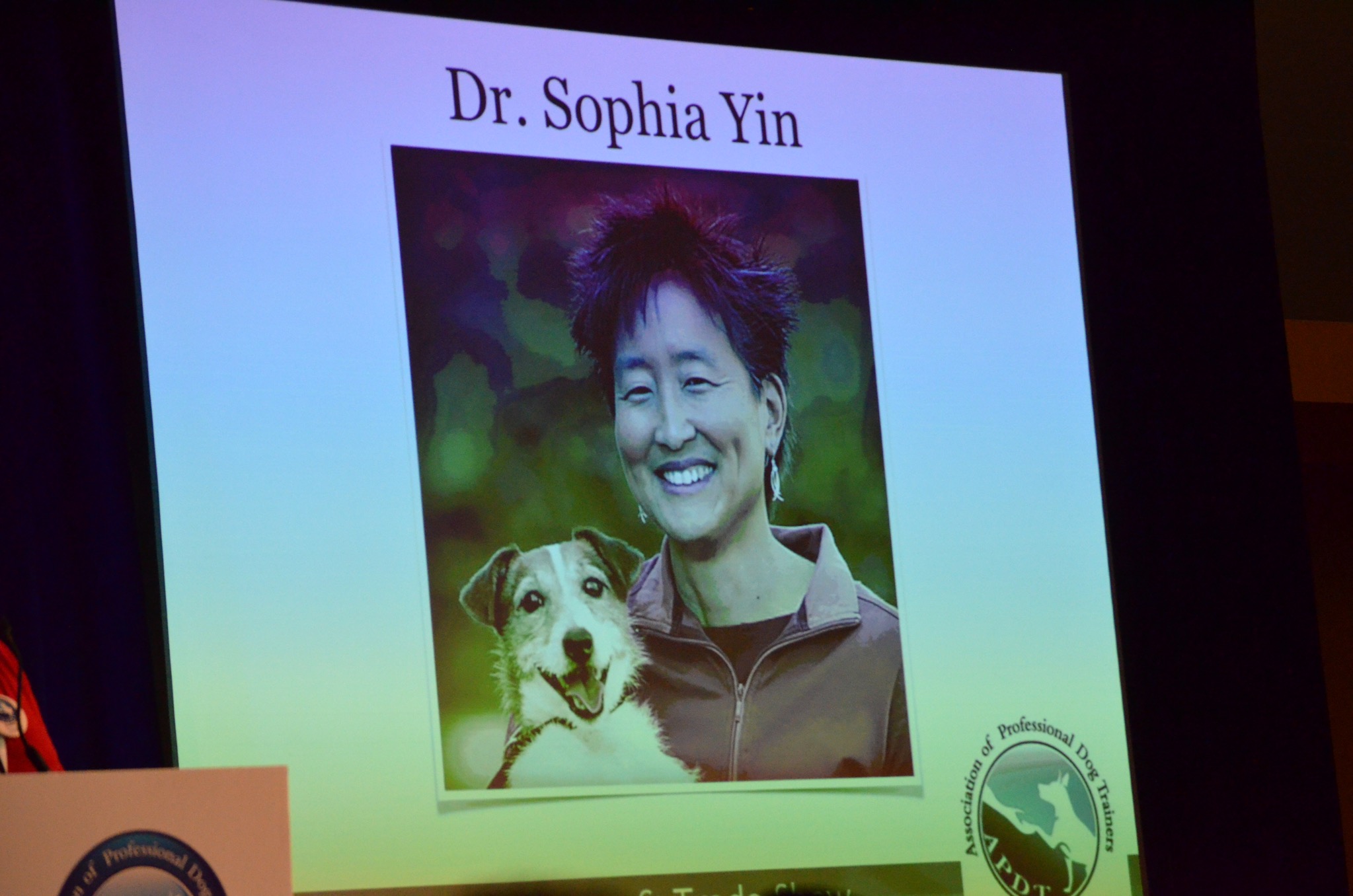
Amber Burckhalter from the APDT Board of Trustees gave a beautiful introduction and moment of silence for Dr. Sophia Yin who passed away just a few weeks ago.
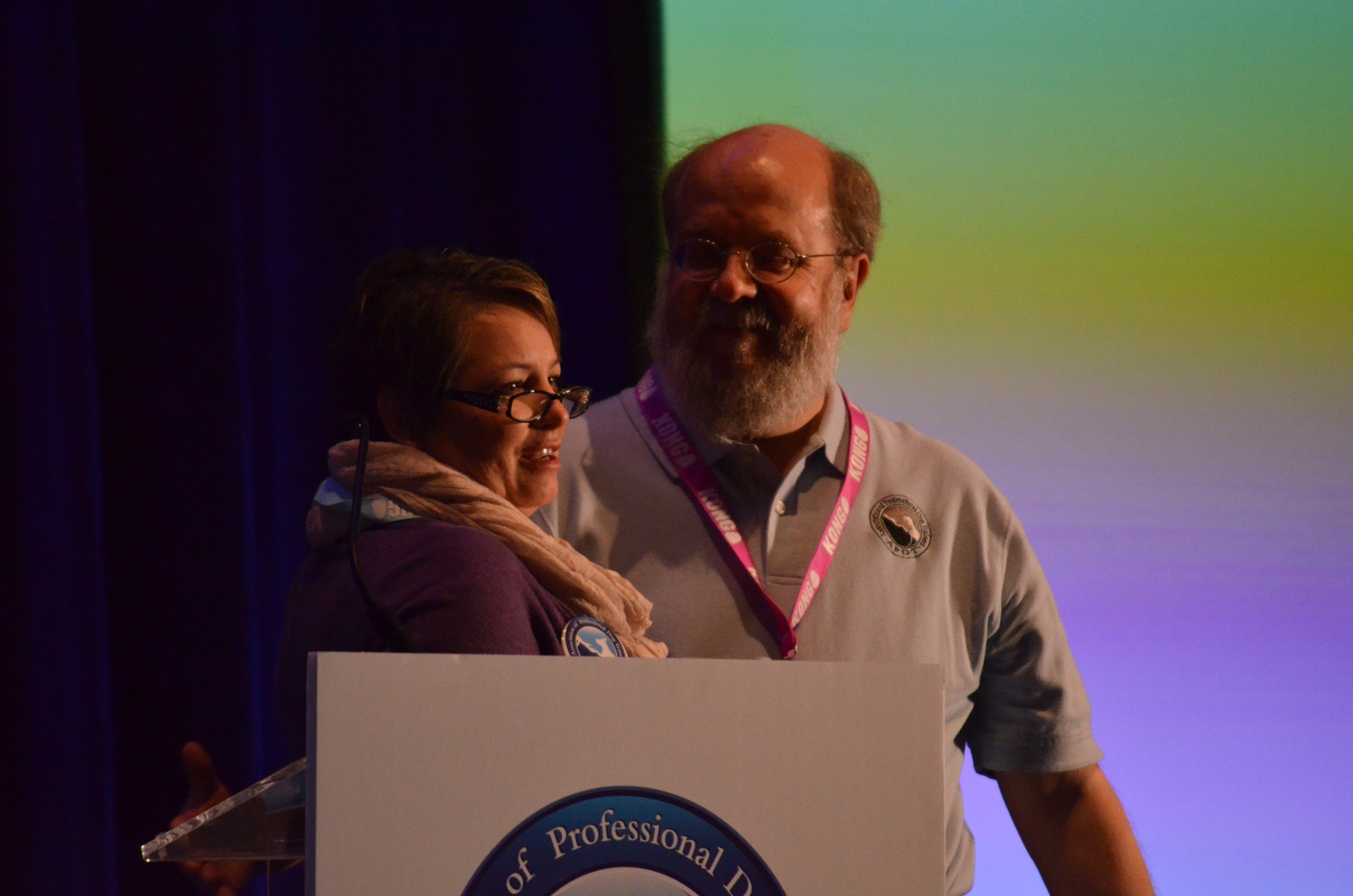
Jill Marie O’Brien, also a member of the Board of Trustees, awarded Don Hanson with the member of the year award.
Karen Pryor, who was currently hosting a workshop in Europe, accepted an award of Lifetime Achievement from the APDT. Then Patricia McConnell, Phd., gave a heartfelt speech as the keynote speaker.

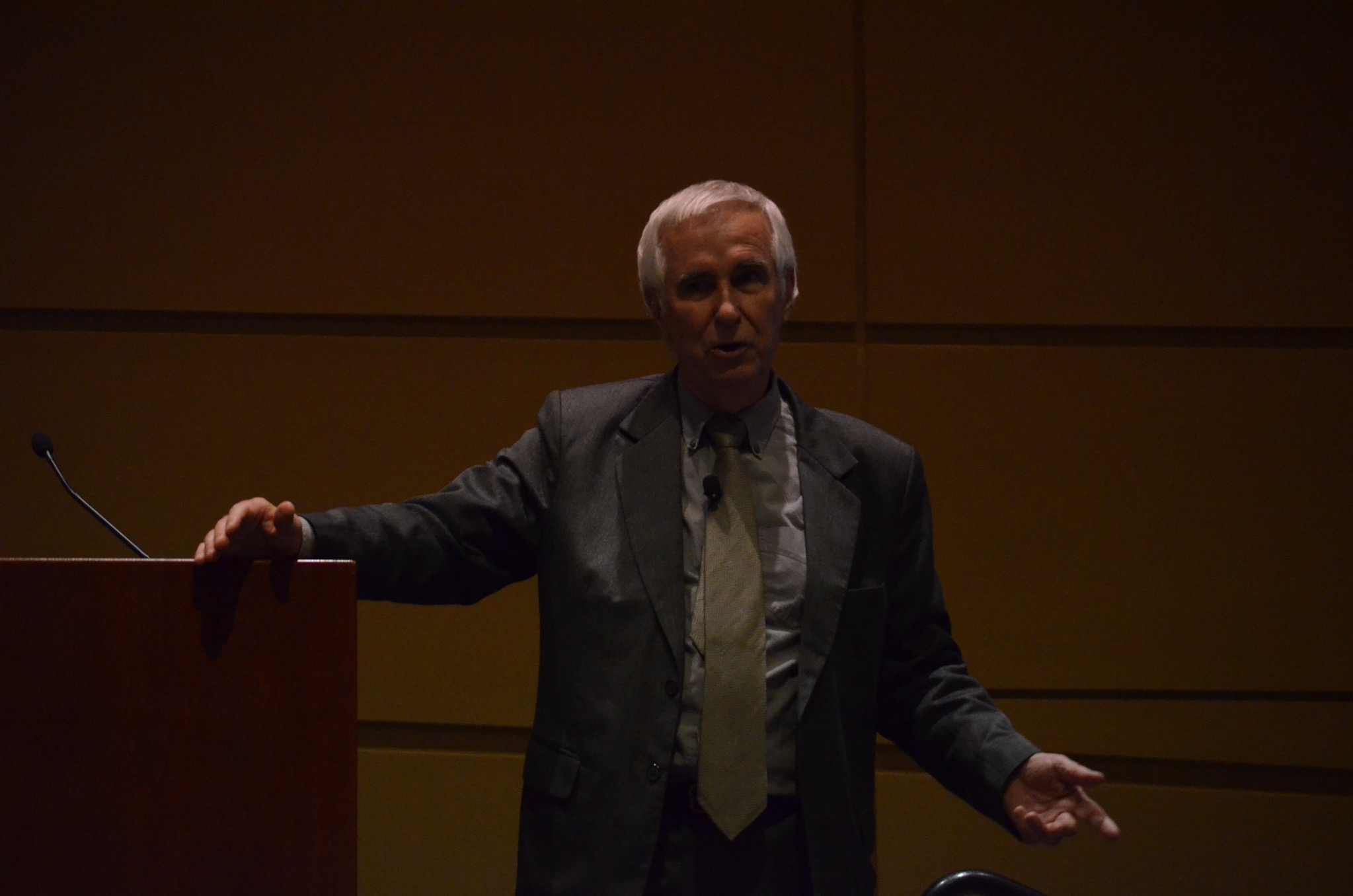
Dr. McConnell’s speech was followed by Ray Coppinger who spoke about the evidence that supports the evolution of dogs – which he showed was little to none!

After a brief 1.5 hour lunch break the seminars began. Among the variety to choose from, we chose to attend Ian Dunbar. His talk about puppy socialization and dog-dog reactivity was entertaining. The practical applications of his discussion points will be interesting to put into place, but we enjoyed his straight forward perspective about dogs.
Day two will commence shortly and we look forward to sharing more information and pictures later. Make sure to follow up on Twitter @ModernTrainer.
![First Annual Pet Professional Guild Convention]()
by Ines | Oct 11, 2014 | Events
The Pet Professional Guild Convention
It was recently announced that the Pet Professional Guild, founded by Niki Tudge, will be hosting their first annual convention next year. The PPG was founded to support force-free training techniques and promote education and research in the dog training industry.
A world where people and pets can live together to their mutual benefit and where pets can live and function free from physical and mental pain, stress and fear as valued family members.
It was established in 2012 and has since grown to over 900 members. The PPG abides by a few Guiding Principles that resonate with science-based training methods.
The Force Free Summit – Reaching for a Higher Standard
 In 2015, their first annual convention will be held in Tampa, Florida during November 11, 12, and 13. They are planning a live streaming event and have come up with three concrete goals for the event:
- Help build awareness of our organization and build a stronger collaboration of force-free pet professionals.
- Help build communication and networking opportunities with the veterinary community and veterinary educators.
- A very interactive and fun educational format.
The development of an organization composed of force-free training professionals who choose to base their techniques on science is truly something remarkable. We are looking forward to seeing how the pet professional guild convention will pan out and will keep you posted here as well as on Twitter.
Recommended Articles