![The Best Approach for Addressing Aversive Techniques and Equipment with New Clients]()
by Thomas Aaron | Dec 18, 2014 | Communication
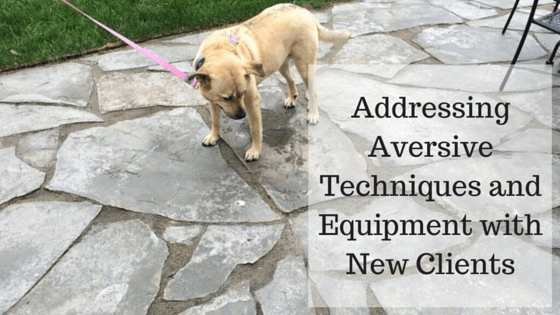
While dog training based on positive reinforcement is quickly gaining mind share, it is not the only game in town. Dog training philosophies range from very aversive, punishment-based paradigms to those that strive to be completely force-free in their approach. And somewhere in the middle of this range, there are trainers who identify themselves as “balanced” to describe their belief that effective dog training requires the use of all four of B.F. Skinner’s learning quadrants (positive reinforcement, negative reinforcement, positive punishment, and negative punishment).
The truth is some of the best behaviorists and behavior analysts of our time have refused to completely disavow punishment in dog training, and most dog trainers who really think it through will acknowledge that not all methods that fall into the positive punishment or negative reinforcement quadrants are inhumane. For example, here is an excellent summary of Dr. Susan Friedman’s “Humane Hierarchy” of dog training. But pretty much all positive reinforcement trainers recognize that methods which empower dogs to make and be rewarded for “correct” decisions tend to be quicker, more effective, longer lasting, and more humane. These methods primarily reside under the umbrella of positive reinforcement.
As positive dog trainers, there are a number of situations where we will find ourselves face to face with people or tools dedicated to aversive methods. For example:
- In shelters and rescues that utilize a variety of trainers from the community. It is not uncommon to find shelters that have adopted aversive methods on the recommendation of available, local aversive trainers.
- In the client’s home when they inform you they have tried aversive equipment or other aversive trainers. And do not be surprised when they tell you some of the trainers or equipment have yielded some degree of success, which they do not want to lose.
- Your client says things that indicate they have bought into the methods of aversive celebrity trainers. On television, such trainers seem to get near-instantaneous results. It only makes sense that a client may have tried to emulate these trainers.
- You might find yourself in a conversation with an aversive trainer. Whether in your community or online, it is difficult to avoid the diversity that exists among dog trainers.
Here is a brief guide about what you should or should not do in these situations.
- Don’t say aversives do not work. It is true that aversives have a failure rate and potential side-effects. Positive trainers have a failure rate as well, often a side-product of a lack of trainer experience or a lack of client follow-through. However, aversives do indeed work, otherwise they would not have been the predominant method of training dogs until the recent growth of positive training mind share. In fact, aversive trainers sport a lot of major titles and accomplishments in nearly every dog sport niche.
- Don’t be critical of the client. The owner would not have called you had they not realized they needed help. They have recognized that what they have been trying is not working, and they are humble enough to ask for YOUR help. Plus, they are indeed your bread and butter.
- Explain the potential side-effects of using aversives. There are many reasons people may be willing to avoid using aversives. For example, aversives might create an unwanted association between the punishment and whatever the dog happens to be looking at; or it could cause complications in the bonding between the owner and the dog.
- Be professional in your discussion of aversive trainers. Nothing turns off a client more than being unprofessional. One aspect of being unprofessional that is difficult to recover from is speaking badly of other trainers. Simply state that you know of the aversive trainer (if you do), that you understand what their perspective was (if you do), and that your take on the problem and how to solve it is a bit different.
- Challenge the client to give your positive approach a try. When the positive approach and its benefits are explained in a clear, educated fashion, most clients are willing to give it a try. Ask the client to bare with you for a few weeks and apply themselves to your method.
- Don’t get in over your head. Some training goals are easier to reach than others. For example, it is easier to teach a dog to sit-stay than it is to cure leash reactivity. If you are not accomplished at working with a particular issue, refer your case to a positive trainer who is — and shadow that trainer if possible. By doing so, the positive approach gets a fair shot, as does the client. And you get to learn something.
We’d love to hear what you have learned about responding to aversive techniques in your own dog training practice in the comments below!
Get Dog Training Business Tips!
Receive valuable dog training business tips and resources every week! Subscribe to The Modern Dog Trainer now by submitting your name and email below.
[mc4wp_form]
![Interacting Professionally With “Traditional” Trainers]()
by Liz Wyant | Dec 2, 2014 | Communication

Interacting Professionally Online and In-Person With A Variety Of Dog Trainers
Traditional trainers (those who introduce physical corrections into their training of some sort) are as passionate about their training methods as force-free trainers are about their methods. Unfortunately, this can often cause confrontations when the two types of trainers come together, either in person or via the internet. Arguing is stressful and non-productive, so what are some options for gracefully handling these interactions?
(As an aside, the vast majority of traditional trainers are not interested in arguing and being rude to force-free trainers – this article is to help when dealing with the small minority that revel in being hostile.)
Turn The Other Cheek
Often traditional trainers start slinging around names and insults to rile up force-free trainers. Though it can be frustrating, you should try to ignore this. On the other hand, take the higher ground and do not reciprocate by throwing derogatory terms and names back at them.
Don’t Get Pulled In
Sometimes the easiest option is to walk away. If you know that you are not going to be able to retain your composure whilst discussing your side, give yourself the power to remove yourself. Getting riled up is not going to affect the other person. It will simply make you miserable and possibly reflect badly on your reputation.
Agree To Disagree
Often you just reach a point in conversations where the discussion is going in circles. Your mind is not going to change and neither is their’s. At this point, agree to disagree. Continuing the conversation is going to accomplish nothing other than to annoy you and waste your time. Ending the conversation this way will preserve your sanity and reputation.
Know Your Facts
Before getting involved in discussions, make sure you know your facts. Be prepared to cite books, articles, and other reputable resources that show the power of positive reinforcement. If you are confident about your training methods and why you use them, having the resources to back up your arguments will be helpful.
Above all, remember that positive reinforcement works for people, too. So often, force-free trainers are so passionate about their techniques that they get riled up and lash out when challenged. Arguing will not change minds. Use your personal dogs and the dogs you train as good examples of the power of force-free training. Always keep in mind that everyone is working towards the same goals, you are just pursuing different pathways to get there.
What do you recommend for interactions with traditional trainers who want to argue?
Get Dog Training Business Tips!
Receive valuable dog training business tips and resources every week! Subscribe to The Modern Dog Trainer now by submitting your name and email below.
[mc4wp_form]
![3 Ways To Incorporate Your Client’s Children In Training]()
by Monica Callahan | Nov 15, 2014 | Communication
Involve The Whole Family In Training
When working with a family and their dog, the children are always excited to help mom and dad train their dog. Parents often push the kids to the side and get frustrated when they keep interrupting. Instead of continually being interrupted, you can incorporate the children in the training. Here are three ways to incorporate your client’s children in training.

1. Recall Games
Children love high energy games, whether they are running or the dogs are. Recall games are a great way to incorporate the client’s children because it can get the dog running and wear them out. Have the children stand across the living room and practice calling the dog’s name once and treat when the dog arrives. They’ll think it’s amazing when the dog listens. Eventually they can play hide and seek and have the dog find them throughout the house. This is also a great bonding game for the dog and children and turns their children into rewards for the dog.
2. Treat Deliverer
This idea would be geared toward the better listener in the family. An example would be working on crate training. If mom or dad has the clicker, just let the child know that whenever they hear a click, they are to give a treat to the dog. When the dog enters the crate and mom or dad click, the child can then deliver a treat to the dog or drop it in the crate.
3. Distraction Training
Children are a big distraction to dogs, and their movements can also be highly alarming to them. You can use their quick movements to proof their dog’s current behaviors or desensitize a worried dog to the child. In the beginning, have the child move slowly and then work up to quicker movements.
Children love to feel like they are being useful. With some simple tweaks to training, children can certainly be incorporated. Once children reach a certain age and maturity, they could even take over training. Training is a great way to bond with their dog, and a pleasant, respectful relationship between children and their dog is important in a family. The next time you have an interruptive child at your training session, don’t allow the parent to get flustered, suggest they help instead.
What are some other ways you, as a trainer, can incorporate children throughout the training process?
Recommended Articles
![Becoming The Best Teacher You Can Be]()
by Ines | Oct 24, 2014 | Communication, Events
At the APDT Conference last week we had the pleasure of listening to Sumac Grant-Johnson‘s speech called Build A Better Trainer. Sumac is a wonderful dog and people trainer. She engaged the audience like few speakers were able to. Everyone was laughing and enjoying themselves during her speech. Here are some of the highlights of her presentation.

Teaching Skills For Dog Trainers
Many trainers get into dog training for the dogs. However, you have to work with people to make a living so having some people skills are important to being a successful dog trainer.
Sumac has broken down the steps every teacher should take when instructing a class or lesson into an easy-to-remember acronym: OIA. OIA stands for Observe, Interpret, and Act. She encourages all trainers to learn as much about human body language as they do about dog body language. This will increase your ability to understand clients who might be struggling. She stated that if there is a failure rate of more than 25% in a class after instructions are given then the issue lies with the instructions given, not the students.
Observations
As a teacher, you must be able to observe your student’s actions. Look at what they do correctly and incorrectly. See what might be inhibiting them from achieving the goal behavior.
Interpret
Once you’ve made accurate observations, you can then interpret what you’ve observed. Bring into consideration environmental factors such as space, distractions, fears, and noise. She mentioned that you can let clients know what they can do if they cannot hear you appropriately.
Learning Styles
A good instructor understands how to utilize different approaches so that all learning styles are incorporated into their teaching. Learning styles can be broken down into visual, auditory, and kinesthetic. Make sure you’ve researched these styles so that you can identify the learning style of each client.
Knowledge Base
Every client will have a different history and knowledge base. Sumac recommended we read the book
How Doctors Think by Jerome Groopman. You never know right off the bat what kind of training knowledge, behavior knowledge, or experience a client may have. What they know can hold them back in some cases due to prejudices or biases.
One of the most important parts of her presentation was the recommendation to never express differing or conflicting opinions right off the bat or they’ll put up barriers.
Act
After observing and interpreting your client’s behavior, you’ll want to act accordingly. Consider adjusting the environment, avoiding putting people on the spot, and mark and reinforce correct behavior. Sumac recommended the use of words like good, nice, or great as marker words before explaining what they did correctly. Make sure you give your students achievable steps towards the goal behavior just like you would when working with their dogs.
In the end, she states that as dog trainers, we all of ONE job. That is to help people meet THEIR goals. This presentation was one of our favorites out of the whole APDT Conference in Hartford. She is an excellent presenter and intelligent people-person. She claims she used to be extremely shy as a child, but we find that extremely hard to believe! Thank you
Sumac Grant-Johnson for sharing your knowledge with us.

by Ines | Sep 26, 2014 | Business, Communication
Using email newsletters is currently the best way to reach existing and potential clients. Email newsletters let you continue to provide value to your existing clients. They also help you reach out to potential clients who want to know more about you are and what you do. Receiving client’s emails through an email newsletter service, like MailChimp, gives you legal permission to contact them in the future to raise awareness about services you could offer them.
This step-by-step guide to getting your free MailChimp email newsletter account set up will get you started.
Create an Account
Click their red “Sign Up Now” button in the top right corner of the window. Use your business’ email address and a creative password to create your account.

Don’t forget to verify your email before moving forward.
Confirm You Are Human
Once you click the blue “activate account”button in your email, you’ll need to confirm that you are indeed a human by completing the phrase from the reCAPTCHA.

Set Up Your Profile
Next it will take you to the “set up your profile” page. Complete this page as completely as possible. Make sure to put in your real name, website address, and a physical mailing address (legally required).

Set Up a Email List
Next you’ll want to create a sign up form so that people can submit their emails to sign up on your website. Select “Create a List” in the botton row.
 Give your list a name (like “The Modern Dog Trainer Main List”), a default “from email,” and a default “from name” that people will recognize.
Once your list is created, select the “create a sign up form” option:

Select the “Embedded Forms” option to create a form you can put on any website.
Creating Your Sign Up Form
Set your sign up form title. Something like “Subscribe to Our Newsletter!” works just fine. Experienced email marketers usually offer a free PDF ebook with simple and fun information in exchange for an email address, but this isn’t always necessary.
Here we recommend only asking for the basic necessities like your reader’s first and last name and email address. The easier it is for them to sign up, the more likely they will be to register. Some sites only ask for email addresses, but it may be to your advantage to recognize clients as they sign up for services.
Set the form width to something between 200 and 300 pixels. Then copy and paste the form onto your website’s sidebar.

Content For Your Newsletter
Once people sign up through the form, people will be expecting contact from you pretty quickly. If you wait too long before sending the first email, they may forget they even signed up for your newsletter in the first place. Make sure that your first contact with your new follower includes information that they will find useful and valuable. For example, you can think about what the most behavior issues you encounter are and provide quick and easy tips to help with management and prevention.
We hope you’ve enjoyed this tutorial about how to set up an email newsletter using MailChimp! Don’t forget to share this valuable information with your friends.
Recommended Articles