The old saying of “fighting like cats and dogs” does not have to be a reality. With a little bit of patience and management, your clients’ dogs can learn to accept new cats into the household. Help your client work through these steps and soon they may have the joy of seeing their dog and cat snuggling together in bed.
I will be sharing my own experience of integrating my rescued cat, Malcolm, in with my American Pit Bull Terrier, Inara.
Malcolm and Inara
Day 1 – The Grand Arrival
Just like when bringing home a new dog, cats can also benefit from a decompression period. Whether they were a stray, or came from a shelter, or a foster home, or a pet store, or wherever, cats don’t like change. The new cat will really appreciate a chance to settle in with some peace and quiet to learn the smells, sounds, and activities of its new home. I did this by setting up my spare room for Malcolm. He had food, water, a litterbox, and comfy blankets to lie on. I would take a book and just go in and read, sitting on the floor, while he explored his new room and me. When he solicited attention I’d give it to him, but I didn’t push it on him.
It’s important to make sure the bedroom door remains firmly shut though. We want the cat and dog to be able to hear and smell each other without being able to touch.
It is so important give the dog plenty of attention during this period. Sometimes it’s easy to get caught up in the wonders of a new pet and spend all your time with the new arrival. Do spend plenty of time with the new cat, but don’t neglect your other pets.
Baby Gates Are Your New Best Friend
When both the cat and dog seem relaxed with the situation, you can move on to the next step. I cannot emphasize enough that days should be dedicated to these steps, not hours. Going slowly at first, even though it’s hard, will pay off in the end. And if you have any hesitation on whether either animal is ready, don’t move forward. And if at any time either animal is stressed, slow down and back up a step.
Now it’s time to open the door. However, for the safety of both cat and dog, you want a barrier. I chose to use a tall metal baby gate to provide separation. If I’d had any doubts that Inara might go over it, I would have stacked two gates. Then alternate sitting on each side of the baby gate, doling out yummy treats to both cat and dog for appropriate, non-confrontational behavior.
Here are two videos from when I was at this step with Malcolm and Inara. Neither are exciting at all – this is what you want though! Boring is good. In the first video, Mal isn’t quite up to going over to the baby gate, but that was okay. The second video is long, but I didn’t cut it because it shows what a slow, steady process this is. In that video, they do have their first official greeting.
The Raising Of The Gates
This is a big step, but if you have done your homework and not rushed things, it should go very smoothly and without fanfare. At this point, dog and cat are relaxed while sniffing each other through the gate and there has been no barking, growling, hissing, spitting, or swatting. So once again, it is time to arm yourself with something comfortable to sit on, a book, and yummy treats (for the animals, not you). Then raise the baby gate up about a foot. You want the cat to be able to easily come and go underneath it, but you don’t want it high enough that the dog can get under it. Quietly sit and read and whenever the cat is brave enough to come out and explore a little, dole out treats. Whenever the dog is being gentle in her behaviors towards the cat, dole out treats.
Final Steps
Once this major milestone has been reached without difficulty, it should be smooth sailing. Before letting the two have free roam of the house together, put the dog in her crate or in a bedroom and let the cat explore the house. We want him comfortable in his full surroundings before he is expected to happily deal with a dog AND new surroundings. If you are comfortable that the dog will not bust her crate to get to the cat, you can leave the cat out while you’re at work and dog is crated (or in a bedroom).
Eventually you can give them both free reign in the house together. It’s so important to ensure that the cat always has escape routes from rooms and high places to flee to if necessary. I kept the baby gate up but raised for quite a while, just so Malcolm always had his safe place.
Even though there is peace in the household, I am a firm proponent of “better safe than sorry.” Keep cat and dog separated at meal times and separated when you are not at home. All it takes is one incident and you have a seriously injured or dead cat or dog. A little management goes a long way to maintaining a happy household.
Malcolm’s foster home had dogs, and Inara grew up with a cat, so you’ll see by the Youtube dates that within a few days these two were fully integrated. I do NOT encourage this speed and would have gone infinitely slower if they both weren’t already familiar with the other species.
Good friends
What other tips do you have for integrating dogs and cats?
Get Dog Training Business Tips!
Receive valuable dog training business tips and resources every week! Subscribe to The Modern Dog Trainer now by submitting your name and email below.
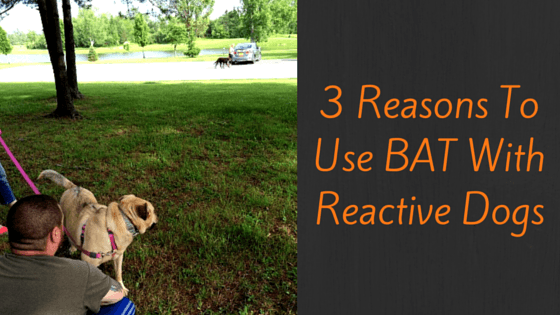
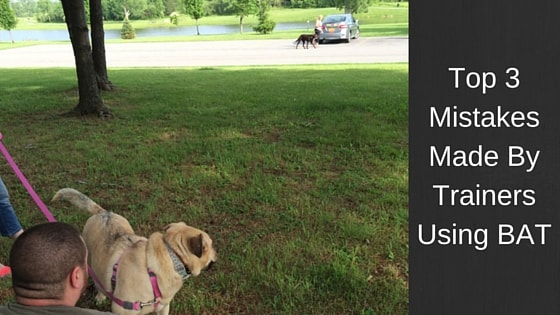
This is part 3 of a 3-part series on Behavior Adjustment Training (BAT), created by Grisha Stewart. In the first posting you learned about the basics of BAT and how a “perfect” session should look. In part 2, you learned why it is so effective for reactive/aggressive dogs. This final installment is to discuss the three most common mistakes made by trainers utilizing BAT. Though the technique is simple in theory, perfecting it takes time.
1. Leading The Dog
Letting the dog pick his own direction and speed of movement is probably the hardest thing for trainers and clients to do. BAT is very calm, and it is easy to slip into the mindset of, “he’s doing really well, so let’s encourage him to go a little closer to his trigger!” BAT is about empowering the dog and allowing him to make his own correct choices.
When doing BAT, you want the dog to investigate his surroundings and sniff his way around. Even though it may seem like he is ignoring the trigger/decoy, he knows it is there and is gathering information in his own manner. As a trainer, you want to encourage your client to stand back and follow the dog’s lead. Even subtle body shifts on the behalf of the handler can encourage the dog to move faster than he is comfortable doing, so make sure you encourage your clients to remain entirely neutral regarding movement.
2. Letting The Dog Go Over Threshold
Remember in part one where the lifeguard analogy was used? It is your job as a trainer to help the client keep the dog from “drowning,” or getting too close to his trigger. You want the dog close enough that he is aware of the trigger and is gathering information in a very relaxed manner. If you see him start to tense up, or stare a little longer, or start moving faster, you need to help his owner guide him a little further back up the beach into safe territory.
As stated above, it is too easy to think that the dog is unaware of the trigger. This is where your expertise in body language becomes critical. You need to help your clients learn to see that minute changes in the dog’s body that indicate he is starting to get a little over aroused, and then ensure they have the leash skills necessary to gently guide him away.
3. Guiding The Dog Into “Training Mode”
Since most, if not all, of your BAT clients will be proponents of force free training, their dogs are probably very familiar with what treats mean: TRAINING. And they love training, because training = TREATS! Obviously this is not a bad thing by any means. However, when doing BAT, you want to try to keep the dog out of training mode. By training mode, I mean that lovely “what do you want me to do next for you, huh huh huh???” attention that the dogs often go into due to their eagerness to work with their owners. Training mode is a lovely thing to see. Just not during BAT!
Dogs in training mode often are very good at tuning out many lesser distractions. This means they may not notice their trigger until they’ve worked their way too close, at which point they rapidly go over threshold. You want the dog to stay in relaxed leisure mode. This is why it’s so important that if you are going to “seed” the ground with some treats to encourage sniffing and exploring, that you do so when the dog is not watching you.
Want To Learn More?
BAT is very complex and one little series of blogs does not do it the justice it deserves. To learn more, you can watch a lovely free BAT Overview video that Grisha offers.
You can also watch a full 2 hour BAT Intro Webinar that Grisha put out. It is $29 but well worth the money if BAT is something you’d like in your toolbox.
Finally, to get the full immersion and become more proficient and comfortable in its use, you can take an online course called BAT 101.
Get Dog Training Business Tips!
Receive valuable dog training business tips and resources every week! Subscribe to The Modern Dog Trainer now by submitting your name and email below.
Due to the generosity of IAABC President Michael Shikashio, The Modern Dog Trainer was able to send a writer to the Animal Behavior Conference in Chicago, IL. Notes from day 1 can be found here.
Kristin and Dr. Ballantyne conducted a small research project on the impact that living with a pet with behavior issues can have on the owners. The research consisted of 63 participants, 40 of whom answered all questions. The questions covered how their pet’s behavior impacted their social and personal lives. Their results showed the impact is huge, sometimes devastating. Owners feel stress, guilt, embarrassment, and socially isolated from friends and family. Couples can have increased arguments due to disagreements on how to manage/care for the pet. People can feel judged by society, friends, and even family.
They spoke about how even professionals occasionally come across as judgmental to those with difficult pets. How many times have you heard, “there are no bad dogs, only bad owners.” Imagine the impact that one simple statement has on a person who has tried their hardest and still has a difficult dog.
They said that as trainers, we have a responsibility to keep in the mind how any management instructions we give our clients will impact their lives and possibly create isolation from friends and family. Most of the participants said that their trainers and veterinarians provided hope and trust. That’s not to be taken lightly! Kristin runs a support group for people living with difficult pets, where owners can come and talk to other people who truly understand. No training tips, just emotional support.
They spoke about euthanasia for maybe two minutes, and how it is the last show of love we can give our pets, yet people often don’t extend this grace when the decision is made for a behavioral/mental illness in the pet. This leaves owners again feeling judged and blamed. Just a personal note here, but just in the couple of minutes that this was discussed, the entire room was sniffling and many were wiping eyes. It was profound to me to see how many of us had obviously been touched by a shared experience of euthanizing a beloved pet or helping somebody else come to that decision.
To end, they discussed how trainers are first responders – people reach out to us in a time of crisis. This is a huge responsibility. We might not have the tools for dealing with the emotional crisis and that’s okay. We cannot be trainers and therapists or we get compassion fatigue and burnout. We don’t have to have all the answers. So what can we do?
Let clients know it’s normal to have these feelings; validate them.
Let them know it’s okay to still love their pet. When people accept the dog they have, instead of the dog they wanted, everybody is happier.
Use reflective and empathetic listening.
Use self-care to avoid compassion fatigue.
Read a book entitled “Trauma Stewardship: An Everyday Guide to Caring for Self While Caring for Others” by Laura van Dernoot Lipsky.
Introducing Highly Reactive And Aggressive Dogs by Ken Ramirez
The author of this blog having a fangirl moment with Ken Ramirez.
Ken received a grant to do research on introducing three reactive/aggressive dogs to each other, using the same techniques used in zoos and aquariums. The research is still proprietary so cannot be shared to those who were not present at the seminar. However, trust me when I say it was fascinating and you should definitely keep your eyes peeled for when it becomes available to the general public.
Simplifying Complex Training Tools by Ken Ramirez
Ken considers an advanced concept anything that ventures beyond “reward desirable behavior and ignore unwanted behavior.” He made sure to specify that just understanding the theory isn’t enough – you must have the practical skills before using a tool, let alone introducing it to a client. He said that training is all about adapting and changing procedures based upon the animal’s behavior. He discussed many different tools that trainers should have in their toolbox:
Recall Signal (not a tool but included in lecture due to frequency of misuse)
End Of Session Signal
For each of these, he discussed what the science has shown, how and when to use them, and whether he personally uses them or not. He ended by talking about how all tools exist for a reason. Many are very specialized and seldom needed, but we shouldn’t throw them out of the toolbox. We need to understand all the tools and how to use them if we want to help people STOP using them. On the other hand, don’t use a tool just because you have it. Successful use of complex tools depends on thorough understanding of the benefits and challenges of their use.
Final Thoughts Of This Writer
I cannot thank Michael Shikashio and the IAABC enough for his generosity in providing The Modern Dog Trainer a ticket to this conference. It was an absolutely amazing experience and I learned so much. It is frustrating as I know the blogs I wrote of this conference cannot convey the sheer brilliance of the speakers that were present, nor the massive amount of information they so generously shared with all of us.
Get Dog Training Business Tips!
Receive valuable dog training business tips and resources every week! Subscribe to The Modern Dog Trainer now by submitting your name and email below.
Due to the generosity of IAABC President Michael Shikashio, The Modern Dog Trainer was able to send a writer to the Animal Behavior Conference in Chicago, IL.
On April 18th and 19th, the IAABC (International Association of Animal Behavior Consultants) held a conference on animal behavior at The Anti-Cruelty Society in Chicago. It was two full information-packed days. Fortunately, I had taken my laptop because 14 pages of single-spaced, typed notes later, I was floating on an education high!
Steve Dale – Being Real About The Human/Animal Bond
Steve started the weekend with a bang, throwing out some sobering statistics about the state of pets in our world today. Obesity issues, behavior issues, health issues, end of life issues. However, as he pointed out, many of these issues are because we love our pets so very much. Loving them to death, you could say. He did offer some other reasons we are seeing so many more behavioral issues in our beloved pets:
we pay more attention to our animals, so we are bound to notice more issues
“latch key” pets, home alone for much of the day
genetic predisposition
aversive training techniques
lack of training/socialization
not listening to real experts, only Google “experts”
treating pets like people
So, as a modern dog trainer, what can you do to help combat this?
community involvement
education of clients/public
social and traditional media
introduce yourself to public officials
good marketing – senior discounts, kitten classes, work with a shelter
As a Certified Veterinary Behaviorist, Dr. Ciribassi said the issue he sees the most is fear based aggression. He discussed how so often it is made worse by well-intentioned owners trying to punish the behavior out of their dogs to maintain pack leadership. Doing this simply creates what he calls conflict aggression. The dog is throwing submissive body language – he is not at all confident. But he has learned that humans are unpredictable and that aggression gets him out of the situation. Dr. Ciribassi said that conflict/fear-based aggression generally shows up either at sexual maturity (6-8 months) or, more likely, social maturity (1-2 years).
Dr. Ciribassi’s protocol for treating this is:
counter conditioning
remove exposure to inciting stimuli
desensitization
appropriate use of psychoactive pharmaceuticals
Dr. Ciribassi said he does not advise taking dogs off pharmaceuticals if they are working. Work with a vet to taper them to the lowest effective dose, but trying to wean a dog off is similar to trying to wean a diabetic off insulin. It’s a disease that isn’t cured, a medical abnormality. He did say that it’s a lifelong process, that we never “cure” these problems; we just help people manage the problems so the dogs can stay in the home.
Dr. John Ciribassi – Possessive Aggression/Resource Guarding
“Dominance – assertion of one member of a group over another in acquiring access to a piece of food, a mate, a place to display, a sleeping site, or any other requisite that adds to the genetic fitness of the dominant individual…” E.O. Wilson
When Dr. Ciribassi talks about resource guarding, he has two different tests for it. The first, the equal opportunity test, involves putting a valued resource equidistant between two dogs and releasing them at the same time. The dog that gets the resource is more dominant when it comes to equal opportunity. However, the next test, the established possession test, is more telling. In this test, one dog is given a valued resource and allowed to enjoy it and establish possession. The other dog is then released. Whichever dog ends up with the resource is more dominant when establishing possession. The established possession test is the one Dr. Ciribassi was talking about during this session.
He pointed out that resource guarding has nothing to do with hierarchy between a dog and a person. It is all about resource holding potential. If it were based on dogs being dominant over people, it would imply that dogs would be able to come over and get us to leave something we have that they want. It is simply not about hierarchy. It is about value, possession, and the need to maintain control over a resource.
When it comes to resource guarding, punishing the dog or taking away the item is the worst thing to do. It increases the likelihood of the dog increasing their guarding or moving on to guarding benign objects. Dr. Ciribassi emphasized that hand feeding is not recommended because it keeps that conflict present with the dog.
Dr. John Ciribassi – Separation Anxiety
Dr. Ciribassi started by saying that people cannot cause separation anxiety. It’s a genetic abnormality. What people can do, however, is exacerbate the issue. He said that before beginning treatment/b-mod, it is essential to not only get an extensive behavioral history, but also a physical exam and lab work to rule out any medical issues. This is especially critical when the issue suddenly rears its ugly head in a dog that is full-grown.
Dr. Ciribassi said that the overall goal of treatment is to reduce dependence on owners and reduce significance of departure and arrival routines. This is managed through an extensive treatment plan that would require its own blog. He does pair the behavior modification with anti-anxiety medication.
Dr. Ciribassi listed several factors that can affect the outcome of treatment:
the older the dog at time of diagnosis, the poorer the prognosis
a dog with multiple diagnoses (noise anxiety, conflict aggression, etc) will have a poorer prognosis
can the owners follow through with the extensive modification to their lives?
can the owners follow through with medication compliance with their dogs?
Laura spent some time telling us of the lessons she learned from working with exotic animals that have helped her become a more effective dog trainer, especially on the human side of things. Here are some of her tips:
When working with your clients, it is important to remember “WOOF.”
W – What you want
O – One thing at a time
O – Observable and definable
F – Five words or less
Be an empathetic teacher to both animal and owner
Give discrete criteria that is easily followed, less than 5 words:
“leash thumb in pocket” or “leash hand along seam”
Have owners practice the skills before the dog gets involved
We shape human behavior – avoid flooding your clients!
Teach proactive husbandry care
Slow steps = progress
Learning is dynamic
Finally, Laura shared with us what she teaches first to clients – TACOS!
T – Targeting
A – Attention to handler
C – Cue a behavior
O – Offer a behavior
S – Stationing or settle on mat
Dr. Ciribassi, Steve Dale, Ruth Crisler, Michael Shikashio – What Is A Veterinary Behaviorist, A Behavior Consultant, A Trainer?
This was a panel discussion to round out the day. Many ideas were bounced around and much emphasis was made on the point that trainers, behavior consultants, vets and veterinary behaviorists all have to work together as a team to aid clients. Here are a few basic points that were thrown out for discussion:
Trainers prevent problems behaviors
Behavior consultants solve problem behaviors
As trainers and behavior consultants, we never make diagnoses – we refer to vets
There are only about 65 true Veterinary Behaviorists in the United States.
That was all just on day one!!! Click here for notes from day two!
Get Dog Training Business Tips!
Receive valuable dog training business tips and resources every week! Subscribe to The Modern Dog Trainer now by submitting your name and email below.
This is part 2 of a 3-part series on Behavior Adjustment Training (BAT), created by Grisha Stewart. Part 1 can be read here. In the first part you learned about the basics of BAT and how a “perfect” session should look. In part 2, you will learn why it is so effective for reactive/aggressive dogs.
1. BAT Respects The Dog
As a modern dog trainer, you know that the dogs on the other end of your leash deserve respect as thinking, feeling creatures. Too many trainers feel that dogs need to be flooded to help them “get over” their fears or reactivity. Even the best of intentioned force-free trainers may sometimes keep dogs right at their threshold point for counterconditioning and desensitization purposes. BAT, however, never forces a dog to get closer to their trigger than they are comfortable doing.
2. BAT Gives The Dog Choices
As stated above, BAT gives the dog the ability to choose whether and how to approach their trigger. Giving a dog the ability to make choices empowers him. Empowering a dog can make a fearful dog more confident and help a reactive dog learn other, more appropriate ways of dealing with their triggers. Letting the dog choose their speed and approach also keeps stress at a minimum, which makes learning easier.
3. BAT Teaches Dogs They Can Move Away
Though this may sound odd, sometimes dogs haven’t learned that they are capable of moving away from their trigger. Starting at a safe distance allows them to learn this skill before they reach the point of no return and get magnetized to their trigger. Teaching dogs that they have the power to retreat can keep a fearful dog from lashing out and give a reactive dog another option.
Want To Learn More?
Though BAT is simple, it is not easy. If you are interested in learning more, you have the following options:
You can watch a lovely free BAT Overview video that Grisha offers.
You can also watch a full 2 hour BAT Intro Webinar that Grisha put out. It is $29 but well worth the money if BAT is something you’d like in your toolbox.
Finally, to get the full immersion and become more proficient and comfortable in its use, you can take an online course called BAT 101.
Get Dog Training Business Tips!
Receive valuable dog training business tips and resources every week! Subscribe to The Modern Dog Trainer now by submitting your name and email below.
As a modern dog trainer, you most likely enjoy learning about new techniques, or new twists on more classic techniques. If you have not yet heard of Behavior Adjustment Training (BAT) by Grisha Stewart, you are in for a treat. This will be the first of a three-part series discussing BAT, its applications, and most common mistakes made by trainers/owners.
BAT My Dog? What?
Grisha developed BAT after studying similar techniques and seeing how they could be tweaked to improve upon them. Her own reactive dog, Peanut, was very fearful of people, and she was seeking a way to help him live his life safely and happily. She is a firm believer in force-free training and empowering dogs, so she wanted a technique that would teach Peanut to acclimate to and even learn to like people, while always giving him the option of approaching or moving away.
BAT Basics
BAT is, quite simply, allowing your dog to make choices. Permitting dogs to make choices empowers them, making them more confident. So often, people want to control every aspect of their dog’s lives, thereby shutting their dogs down because they have learned that communication of their needs will just be ignored. A conscientious trainer will help people learn where they can offer some leeway to their dogs and allow them to express their needs safely.
BAT can be quite dull to watch to the untrained eye! In short, what it looks like is a dog wandering around on a long leash in an open area, occasionally glancing at whatever the item of their reactivity is. It’s much more complex though. As a trainer, you are teaching your clients to be lifeguards to their dogs. Let’s consider that the small waves at the beginning of the ocean are a visualization of the dog’s threshold and under threshold means being several yards up on the beach away from the ocean.
When the dog is safely under threshold, owners follow their dogs and allow them to move where they’d like, sniffing what they like, peeing where they like. In essence, being dogs. However, at a distance at which your dog is still comfortable is their trigger, what they are fearful of or frustrated towards or aggress towards. We’ll say it’s another dog for this article.
On The Shore Or Drowning?
So your client’s dog, Fido, notices his trigger, the other dog. If he glances at it and continues wandering around, that’s great. You’ve started at a safe distance. At some point though, Fido is going to meander closer to the other dog. Your job as a trainer is to help your client keep Fido from getting too close, beyond where he can handle it. Dogs can and will take themselves over threshold without our guidance. Essentially, keep him from drowning. We want Fido at a distance where he has noticed his trigger and is interested, but can easily disengage on his own.
If Fido starts getting overly interested or too close to the other dog, the lifeguard (his owner) needs to step in and save him. This is done through a variety of BAT leash skills that encourage Fido to turn away, rather than force him. What you do not want is to get to the point where your client needs to haul Fido away on a tight leash.
A “perfect” BAT session should consist of Fido being able to explore his area and gather information about the other dog, on a nice loose long line. Fido will sniff around the ground a little bit and then perhaps air scent the dog. Because he is not too close, he will return to calm exploration of his area. When permitted to move freely, you will see Fido approach the other dog in a gentle curve, without anxiety, fear, aggression, etc. As Fido sniffs his way slowly to the other dog, his handler will get more involved, keeping him from going faster than he can safely and calmly manage. With the help of his handler, Fido won’t get closer than he can handle, but he does notice his trigger. Your client will only guide Fido if he starts stepping off the beach and into the water, getting too close to his trigger.
Stay tuned for part two of this three part series on BAT!
Want To Learn More?
BAT is very complex and one little blog does not do it the justice it deserves. To learn more, you can watch a lovely free BAT Overview video that Grisha offers.
You can also watch a full 2 hour BAT Intro Webinar that Grisha put out. It is $29 but well worth the money if BAT is something you’d like in your toolbox.
Finally, to get the full immersion and become more proficient and comfortable in its use, you can take an online course called BAT 101.
Get Dog Training Business Tips!
Receive valuable dog training business tips and resources every week! Subscribe to The Modern Dog Trainer now by submitting your name and email below.





 Due to the generosity of IAABC President Michael Shikashio, The Modern Dog Trainer was able to send a writer to the Animal Behavior Conference in Chicago, IL.
  This is part 2 of a 3-part series on Behavior Adjustment Training (BAT), created by Grisha Stewart. Part 1 can be read