Most dogs learn the same way. Wait, really? Let’s back up. The difference is not in the learning; it’s in the training. I’m sure you’ve experienced that each breed requires training specific to their tendencies, and each pup can be as individual as each of us. By paying attention we can even recognize that there are anomalies with in a breed—like the Border Collie that doesn’t stalk or isn’t sensitive to movement, or the Bulldog or Frenchie that happily walks without the passive aggressive Buddah stops. Beyond even this, we know to change our training approach when we witness behavioral issues such as fear, anxiety, or aggression. And yet, it remains true that dogs still learn the same way! Surprising?
Similar, Yet Different
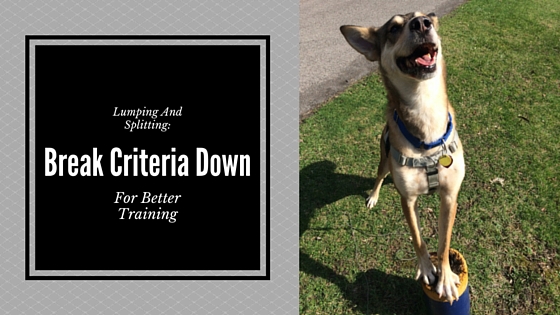
Each dog is different. In the same way that students excel in certain subjects and struggle in others, dogs do, too. I believe this happens because of “Lumping and Splitting”. The term lumping is asking a dog to learn multiple aspects of training at the same time by introducing the behavior simultaneously. Splitting is taking one behavior and teaching it through gradual and incremental steps. All dogs eventually learn the “Triple D’s” (distance, duration, and distraction) but the approach is what must differ for each dog.
Lumping
For some dogs when it comes to understanding the basics of a stay, they’ll get an easy “A”. However the moment a distraction is introduced the house of cards falls apart. This often happens when the trainer tries to muscle through and “lump” new criteria together, causing the dog to fail. Although “splitting” up the stay itself and introducing distractions in tiny itty bitty increments may take a bit longer, the lasting effects in the overall behavior will be golden! Combining the Triple D’s too quickly is the lumping that so often causes big failures resulting in frustration for the dog and for your client.
I sometimes see it when a new client shows me they’ve been teaching a stay by extending their hand like a traffic cop while slowly backing away from their dog as if it were a bomb, chanting “staaaaaay, staaaayyyyyyy” which inevitably results in failure, because they’ve increased the distance too much too soon.
One Step at a Time
Let’s look at the same behavior split it up into smaller pieces working each of the D’s one at a time. First: duration. Reward your client’s dog with a treat for nothing more than sitting in front of you. If you can get the pup to stay in the sit for 10 seconds in between treats then it would be an appropriate time to move onto the next D!
Second: distance. The dog will always dictate when he’s ready for more distance by his success in his stay. With some dogs you might find leaning back is plenty of distance initially. The more you breakdown the criteria, the more successful the dog will be.
Lastly: distractions. Using kissy noises or thigh pats incrementally added can be plenty of distraction at first. It’s critical to keep rewarding each small distraction. This will help ensure your rate of success without allowing the dog to fail.
Donna Hill has an outstanding video that thoroughly explains this concept:
Splitting can help you teach any behavior. A great trainer will be able to identify when to make like a tree and split!
Get Dog Training Business Tips!
Receive valuable dog training business tips and resources every week! Subscribe to The Modern Dog Trainer now by submitting your name and email below.
Do you find some clients saying: “I just want my dog to calm down”? I often think they are really saying they wish their dog would listen to them rather than lose their spunk or nuttiness. Often times when dogs are aroused by their environment be it a squirrel, another dog or a human, the behaviors that they know well in their day-to-day life such as sit and down, go right out the window because they’re so aroused and excited.
As a trainer we can help their brains comprehend what arousal feels like so that the pup can perform all his basic tasks when aroused. Tug-of-War is a tried and true way to teach impulse control when aroused. It is incredibly important as a trainer to watch the dog’s behavior change as you tug and to remember that in the beginning it can be pretty intense for the pup, so taking breaks to reduce stress from the intensity is also key.
Darth Vader vs. Luke Skywalker
Tug-of-War can sometimes be viewed as the Darth Vader of games for dogs; designed to encourage aggression, when in fact it isn’t evil at. Take it from me: if tugging made dogs aggressive then I would have the most aggressive dogs on earth. When tugging is used properly it serves as a game of bonding between you and your client’s pup. Tugging can be used as a wonderful tool to create what I call “synthetic arousal”. Granted; arousal is arousal, but when we can incite it through tugging, arousal can help proof the behavior and make your client’s dogs super solid!
Dress Rehearsal
It’s probable that the directions and exercises we give our clients to practice throughout the week will be rehearsed in a quiet and safe area. They often choose spaces such as their living room or bedroom, which are good starts but can tend to act like a vacuum. If they rarely push their pup to practice new behaviors in more stimulating environments, the tendency is that is the dog can only perform the behavior in a quiet and calm area.
So, how do we take the show on the road? Enter, stage left: Tugging.
Establishing the rules to this kind of play first is of utmost importance. A good trainer first must institute the ground rules around mouthing, choking up on the toy, and jumping—teaching clearly what’s prohibited. Making sure too that the dog will drop the toy on cue is an example of the small, yet critical pieces of impulse control necessary for easy and successful arousal training. I’ll often make simple adjustments when unwanted behavior arises such as dropping the toy mid-game and walking away—remembering that I’m the one making the toy dance and without me it’s just a rag on the floor.
Just Before the Curtain Goes Up
After your client’s dog has the foundation of tugging with rules, it’s time to move on to doing a type of circuit training where basic commands such as sit, down, stay, and leave it are added to the tugging games. Prime the pump by asking your client’s dog to sit a few times rewarding each time with food. Then present the tug toy and tug with the pup for a short time. Follow by asking for a drop and a few sits. If you notice that the pup has some difficulty sitting or holding a sit because they are aroused, slow down on the tugging, as this is no different than fine-tuning the equalizer on a Hi-Fi stereo.
Opening Night
Just as all successful performances are the result consistent and fun rehearsal after rehearsal, we know that dog-play is no different. The circuit training allows for dogs to continue thinking even when they are aroused. With this type of training you’ll be setting them up for amazing amounts of success where they will be able to do more than just stay at home. They’ll probably even lose the old title of “crazy” and maybe even be nominated for an Oscar.
How will you be using tugging in your training?
Get Dog Training Business Tips!
Receive valuable dog training business tips and resources every week! Subscribe to The Modern Dog Trainer now by submitting your name and email below.
“Lazy Dog Training” is a term I use when working with clients. Clients often feel overwhelmed by the amount of training that is truly needed. Because we are trainers and know the importance of training, it’s easy for us to show up with the energy of Richard Simmons; hitting them with a barrage of knowledge when we walk in the door. Sometimes this amount of information can overwhelm certain families making the task of training seem very daunting. For these folks lazy training can be an amazing tool for both you and your client’s toolbox since it is passive training.
Inadvertently Rewarding Other Behaviors
There are certain behaviors that can be taught and various exercises that can be done in which you are rewarding the main behavior while “secondary” and “tertiary” behaviors are also being rewarded. This is “good fallout”; a happy trickle if you will. These lazy techniques give you a 2-for or a 3-for, for the work of one.
Why not hit two birds with one stone?
One of my favorite examples of this is the Elevator Game. In this game, you are specifically teaching a dog not to jump. You begin by lowering a treat from above a sitting dog and click and treat for being able to lower the treat to the dog’s face without him jumping. Although you are rewarding the main behavior, what else is the dog learning simultaneously? The beginnings of a stay! (The staying part of the behavior would be the “secondary” behavior being learned simultaneously.) As you add a little distance and duration and, eventually, distraction, you will end up with a great little stay!
Another passive game I play is Kong-to-go-to-bed. I often start with this when doing a consult. Have the family stuff a Kong and then set up a bed or a crate a few feet away. Give the Kong to the dog and notice the dog will generally go and lay with its new stuffed Kong in bed. At first glance it might seem like that’s all that’s happening but in actuality you’ve got a magic Kong! It’s dispensing rewards for being in a down in a dog bed!
Continue the exercise by periodically walking over and exchanging the Kong for a treat. Walk away with the dog following you and then give the Kong back. The dog should return to his bed. After some repetition, cue “go to your bed” and give the Kong and watch the owner’s jaws drop as he goes to his bed on cue.
Change The Client’s Perspective
Another way I teach passive training is to change the client’s perspective by asking them to catch their dog being good. So many dog families are so quick to punish a pup when they do something wrong but rarely do they reward when the dog is doing something right. I will generally ask them to ask themselves this question, “is your dog being good or naughty this second?” If the pup is being good, feed and praise him! With a treat pouch on their hip, have them click/mark and capture moments in the day when their pup is being good. By doing this you will have a pup that is actively engaging with its owners trying to figure out “what makes them click?”
The moral of the story is to remember that just because it’s lazy training doesn’t mean the job isn’t getting done. Let’s teach owners how to train smarter, not harder.
What are some ways you will use or are using lazy training?
Get Dog Training Business Tips!
Receive valuable dog training business tips and resources every week! Subscribe to The Modern Dog Trainer now by submitting your name and email below.
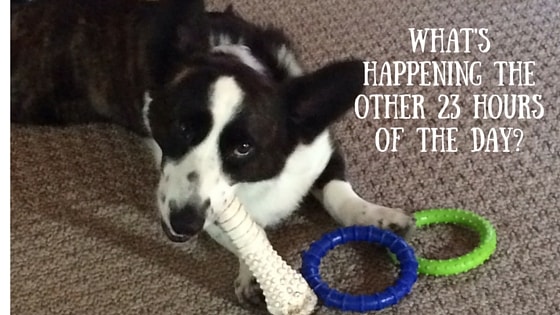
The way to success in becoming a star athlete or a master criminal is achieved in the same way. The more a skill or behavior is rehearsed the better and more natural it becomes. So often dog parents may come to you wanting to change a dog’s behavior. Of course we are interested in the behavior at hand, but we should be even more interested in what is happening the “other 23 hours of the day”.
Having tunnel vision by focusing on the unwanted behavior isn’t enough. We’ve got to look at what is happening behind the scenes at all of the rehearsal time before the curtain goes up. A pro-golfer is likely to practice other calisthenics to improve his game and I’ll bet your clients dog has his own version of cross-training, too. It reminds me of Mickey, the inventive trainer in Rocky. Mickey had Rocky chase chickens to find a new and more agile way of becoming quick on his feet. Somewhere when you aren’t looking, the pup has invented his own technique for getting the result he desires.
Let’s say you feel like your client’s dog is unnecessarily barking for attention and you are at your wit’s end with this. First, we’ve got to figure out when and where else this behavior is being reinforced. Does he get practice barking away “intruders” like the UPS man or a neighbor dog being walked by the window? Although you might not be directly rewarding the pup for this action with a cookie, just the act alone of the “trigger” going away can be the reward itself to the dog. “I bark, and it goes away”, thinks the pup. “Success!” The repetition of this story is in itself a rehearsal. In turn, the rehearsal of the behavior gets stronger and more habitual. The behavior will eventually become second nature for the dog.
As a professional dog trainer even I get stumped sometimes. Imagine my astonishment when I saw my dog, Dexter with his paws on the kitchen counter! I racked by brain trying to figure out where he had learned this behavior. How had he been rewarded, and where was this rehearsed? After a week of question and observing him like a hawk, I saw him jumping up on the gate in the back of my van to gain a better vantage point. That was it! If it worked for him in the van, he’s bound to “learn” it will work for him in the kitchen. Because animals are such excellent problem-solvers they can piece together the puzzle through masterful trial and error learning. This can make the pup both clever and sly quickly, but it’s also why they are so fun to shape and train.
If the rehearsal of behavior is the key to success, then eliminating or, at least, minimizing the opportunity for the unwanted behavior is the way to begin. Common sense tells us that we aren’t going to keep the UPS guy from coming to the door, or keep other dogs out of our neighborhood, but what we do have control over is what our pup rehearses.
Let’s imagine that I am a master car thief with years of practice. Although I’ve been successful for years, one day I get pinched. I go to jail. I’m kept from practicing my craft. If one day my sentence is up, and I return to society without rehabilitation (learning a replacement behavior) I’m likely to fall back into my old ways to achieve success with my desired result. Moral of the story: If you prevent the villain from rehearsing the behavior while rehabilitating (teaching them alternative actions and behaviors), then they are much less likely to go back to their old crime.
So how do you prevent the pup from repeating bad behaviors? I teach and reward the “opposite” behavior or a DRI (Differential Reinforcement for Incompatible behavior). With barking, for example, I teach and reward a quiet cue. For jumping, I teach and reward a solid “down” or a “belly up” behavior. We should work to reward an appropriate behavior rather than starting by punishing the inappropriate behavior. We must also keep in mind those other 23 hours in the day.
Addressing the time when the dog is alone or not around us is important. For example, you can recommend crating the pup while leaving upbeat music playing to drown out sounds from outside to prevent perimeter barking. Employing simple preventatives, such as making sure the pups are well exercised and left with a food-stuffed toy to keep them engaged, can prevent them from rehearsing old behaviors.
Dogs will always be rehearsing behaviors. It’s up to us to teach and reward the behaviors we want rehearsed. How do you get to Carnegie Hall? Practice.
Get Dog Training Business Tips!
Receive valuable dog training business tips and resources every week! Subscribe to The Modern Dog Trainer now by submitting your name and email below.