
by Ines | Jan 17, 2017 | Business
Ever wonder if your city is big enough for you to start your own dog training business? What about if people in your community make enough to pay for a professional dog trainer? Questions like these and others can be answered with smart market research.
If you’re wondering whether you should try to “make the leap” as a professional dog trainer with your own business or not, market research can help you confirm or refute your assumptions.
The Purpose of Market Research
Market research done right will help you understand the kind of people you want to serve and will provide answers to questions like:
- Who should I serve in my community?
- What services should I offer?
- What are people in my area willing to pay for?
- Should I specialize? If so, what specialty should I focus on for my location?
- Will I have enough customers to support my business?
- What should I charge for my services?
- How can I differentiate myself from my competitors?
- How can I serve my customers better than my competitors could?
I see a lot of these questions being asked in Facebook groups by new dog trainers, but the answers you might get on Facebook could be irrelevant or mislead you because they don’t consider your geographic area and the demographics that are represented.
Gather General Population Statistics
Some specific statistics you should pay attention to as a dog trainer and make a note of include:
- Population within your service area
- Personal income per capita – This is considered the average income earned per person in a given area in a specified year. It is calculated by dividing the area’s total income by its total population.
- Growth or decline in either population or personal income over the last 10 years.
- Percent of the population that own dogs
- General demographics of the population – Is the general population mostly families with small children or are they an aging community with lots of retirement centers?
Market Research is About More Than Statistics
The best market research involves getting out there in your community and asking real people about their lives and their struggles. Statistics are known as secondary information. Primary information is the information you gather directly from the source – your future customers!
In an effort to help my readers and new dog trainers out there, I’ve created a FREE 5-day email course to walk you through the steps of market research. I’m really excited about this course because I see so many newcomers ask if their current city can support a new dog training business if they start one. This course will make it easy to answer that question and so many more that people typically have when they’re starting out.
Learn more about the course and sign up for FREE below!
 Free Market Research Mini-Course for Dog Trainers
Sign up for my 5-day course, “Market Research Course for The Modern Dog Trainer.” In this course, I’ll send you five modules (one each day) that should take you no more than 15-30 minutes to complete.
The five modules include:
- Module 1: Ask the Right Questions to Find the Right Answers
- Module 2: Gather Important & Relevant Stats on Your City’s Population
- Module 3: Learn About The Dog Owners in Your Community
- Module 4: Research Your Competitors & Find Differentiators
- Module 5: Learn About the Factors that Contribute to Sustainability & Success as a Dog Trainer
With the help of this course, you’ll:
- Learn what questions you should ask and research before getting started.
- Find out if your city is populated and economically strong enough to support your dog training business.
- Learn about the specific challenges that dog owners in your community are struggling with.
- Understand what your community needs from your dog training business.
- Feel confident knowing that you’ll be investing time and money into a business that actually has a chance at being successful.
- Have fewer fears about starting up your own dog training business.

Fill out the form below to join the course for FREE!
Sign up for my 5-day course, “Market Research Course for The Modern Dog Trainer.” Receive five modules (one each day) that should take you no more than 15-30 minutes to complete.
Feel confident knowing that you’ll be investing time and money into a business that actually has a chance at being successful.
![Guest Post – What It’s Like to Start a Dog Training Business from Scratch]()
by Ines | Jan 10, 2017 | Business
This is a guest post by an up and coming positive gun dog trainer in California. In this post, he talks about what it’s like to start up a dog training business from the ground up. Learn about how he got started and the opportunities he pursued to help the transition.
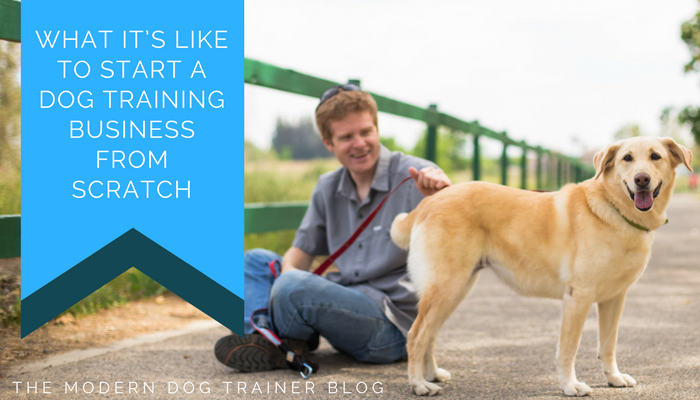 Hello! My name is Zane Brown and I own and run Reliable Retrievers LLC in Fresno, California. I opened my dog training business in late 2016. I’m here to share my story of what lead me to open my own dog training business and what it was like along the way.
The start of my journey to become a dog trainer happened at a time when I really didn’t realize how my life’s direction would change, or even what the significance was at the time. In 2014, a Labrador puppy came into my life that would change it all for me. This young pup and I had such a unique bond. He inspired me to take a positive reinforcement obedience class, and before I knew it, I was hooked. I was fascinated with what you could achieve with this revolutionary new method.
 Now, on to the events that helped me to realize my dream and take the first step. It all started in early 2016 when I got an email from Thomas Aaron of Fetchmasters LLC in Denver, Colorado. I had been emailing back and forth with Tom for several months about positive gun dog training. One of the first things that we had talked about was that he held workshops every year but he wasn’t sure when the next one would be. I kept eagerly checking his website every few weeks, but never noticed any update. Then, one day, Tom emails me and tells me that the workshop is on for this coming May, and that there might even be a scholarship available, if I acted now. I quickly emailed Tom back and said I was interested in attending!
This was what I had been waiting and hoping for, I couldn’t let this opportunity slip away. As excited as I was, I was also a little nervous because of the monetary commitment: there was the hotel (with a dog no less!), 3 meals a day, half day boarding for my dog (while we attended the lecture part) and finally the gas I would have to spend for the 9 days. However, this is what I wanted to do and positive training was my passion, so I took the leap of faith, and I haven’t looked back since. I decided that the pros would vastly outweigh the cons in taking this chance because I would get to learn a friendlier way to train gun dogs, something that was of a very personal significance to me. I grew up around the traditional way of training gun dogs, yet I had always wanted to find a friendlier, more positive way to train them. Something about the nature of positive reinforcement techniques just resonates with who I am as a person.
The 9 days were incredible. We learned so much about the fundamentals of dog training, had some fun times working in the field, and made some lasting friendships along the way.

Starting Up My Dog Training Business
When I returned home, I wasn’t really sure where to start, but I knew I wanted to get the ball rolling and start working with dogs. It was a little nerve-wracking, but I decided I wouldn’t that let stop me. To be honest, I wasn’t sure when my next day paycheck would come in, and that really terrified me because I had always been rather conservative with money.
Well, the ball took a while to “get rolling.” For my specific venue of dog training, there were certain things I would need; the main one being a safe and legal location to discharge firearms. One of the biggest challenges has been looking for land to lease that would accommodate these needs. Another major challenge has been self-confidence, which I believe goes hand in hand with the fear and uncertainty of whether or not your business is going to thrive and succeed. For a while there, I was unsure of my abilities to train dogs, despite all I had learned.
One of the things that I discovered in starting my own business is that there is a factor of uncertainty to this whole process. This is not meant to scare anyone reading this. It’s just a reality that I want to share so that you understand. You can’t let the uncertainty stop you if you want to work for yourself. With that said, I think that it is important to realize that you can ask for help, and that there is nothing wrong with that. In starting your own business, it is definitely a bonus to have support and someone who has been through the process and can guide you. If you’re starting your own business and you’re stuck, there is help and support out there. Please feel free to reach out to me.
Recommended Reading: Why You Should Do Some Market Research Before Starting Your Dog Training Business
Business Tips for Dog Trainers
Perhaps one of the most significant events in my journey so far was when I found The Modern Dog Trainer and Ines McNeil. A friend of mine invited me to join a Facebook group all about startup tips for dog trainers. Up until this point, I lacked a little bit of focus on getting things started, but with the tips from Ines, that cleared up quickly. I think the major factor that helped clarify the process and gain a good sense of direction was The Modern Dog Trainer business course. One of the main ways that it helped me was to know how to appropriately protect myself legally. It’s a topic that no one wants to talk about, but it’s a necessity if you’re going to be a dog trainer. Another way is it helped me with knowing how to build my website and how to market myself. These things are essential in today’s world. You have to have an online presence and you have to get your name out there.
Getting My First Client
 I will just share one last quick story. I was really nervous about who my first client was going to be. However, one day, a few days ago in fact, I decided to grab the bull by the horns and just go for it. A prospective client emailed me about my services and after talking with a trainer friend of mine I felt a surge of confidence and responded to the client. During this conversation, I realized that I had an idea about where exactly I wanted to start with this client in the training process. It was also the fact that he came to me not just for dog training, but also for advice on hunting itself. It hit me that I had been hunting since I was about fifteen and I knew a lot about it. I have a lot of hunting experience, and done different types of hunting (upland, waterfowl). These are the things that gave me this boost in confidence.
I also remembered words from another trainer-friend of mine, “You have to start somewhere.” So, that is my story, or at least the beginning of it. It began with the unique connection between a dog and his human, and it has grown into so much more that. However, I believe it’s important to remember where it all started, whom it started with, and remember the humble beginnings.
My Future Goals
One of my biggest goals is to spread awareness of positive reinforcement gun dog training in California. In addition to offering training services, I want to start an educational division of my business where I offer workshops and seminars to demonstrate the power of positive methods on dogs.
I also want to affect change on a national level, starting with the Boy Scouts of America organization. As an Eagle Scout, I know firsthand just how important this organization is in the lives of young people. There are a lot of critical skills that this organization teaches. I wish to aid in that effort by discussing with them and presenting them with a science-based, proven, positive reinforcement methods for their Dog Care merit badge requirements. It is my hope that positive reinforcement training continues to gain traction and a foothold in the world of hunting dogs.
 Looking into starting your own dog training business? Grab our free eBook, “10 Common Mistakes New Dog Trainers Make With Their Businesses.”
If you’re thinking about starting your own dog training business, take advantage of this free eBook to avoid some detrimental mistakes that many dog trainers make.
Are you spending your time on the right tasks to grow your business? Are you worried about making continuous income throughout the year? Will your business be sustainable for years to come? Prepare yourself with the help of this eBook!
Get the eBook
![Grow Your Dog Training Business with Smart Facebook Strategies]()
by Ines | Dec 27, 2016 | Marketing
My affiliate disclaimer applies to this post.
 It’s not a secret that dog trainers spend a lot of time on social media. Why not optimize your time on Facebook to grow your business?
Facebook is a powerful platform for sharing your message and reaching new, potential clients. These strategies can help you grow your audience and make the most of your time on social media to turn “Likes” into customers!
Set a Clear Goal for Each Post
Do you want people to simply like it and move on? Do you want viewers to read the article and sign up for something? Is the article on your website set up with a email sign up form to capture the emails of people that are interested in what you have to offer?
These are simple inbound marketing questions that you should ask anytime you post on social media. What action do you want the reader to take? Posting for the sake of posting means you’re missing the whole point of social media for marketing your business.
Use action words to encourage interactions like likes, comments, or shares. Ask thought-provoking questions to get readers to open the link and read your articles. Get creative, but make sure every post will contribute to your overall goals to grow your dog training business.
Related: Smart Facebook Marketing Strategies eBook by Brittany Ann
Use a Tracking Pixel on Your Website
By copying and pasting the Facebook tracking pixel code to your website, you’ll be able to target people who have visited your website with any future advertising or promotions you want to run. People who visit your website could be your current customers AND potential clients that haven’t committed to hiring a dog trainer yet.
You can use the Facebook Pixel to stay in touch with these people over a few weeks and stay top-of-mind for whenever they’re ready to hire a dog trainer.
Promote Posts Strategically
Facebook’s always urging you to (financially) promote your posts so that you can reach a bigger audience. Promoting posts isn’t a bad idea, but you have to do it at the right time. Ideally, you should wait until a post already has some likes, comments, or shares because your money will go reach a bigger audience and when people see it being promoted it looks like it’s already popular. Promoting a post that hasn’t already gotten a few likes or comments won’t look very enticing to a larger audience.
Even More Facebook Marketing Tips for Dog Trainers

Looking to grow your Facebook page quickly and increase your reach to fill up your dog training appointment schedule? You’ll definitely want to check out the eBook, “Strategies Worth Sharing” on Facebook marketing by Brittany Ann.
“With over 70 pages of no-fluff, no-nonsense strategy in the book alone, these are the tricks you’ve been missing!”
Brittany Ann explains many different techniques you can use to improve your Facebook page’s performance to grow your Facebook audience and generate new clients from your use of social media.
When leveraged correctly, Facebook can be just as powerful as Google for growing your client base. Unfortunately, many dog trainers waste a lot of money promoting posts that won’t give them a return on their investment. With this eBook, you can be confident you’re spending time on tactics that will actually make a difference to your dog training business’ bottom line.
See a detailed outline of this eBook and order your copy here. It’s extremely affordable ($20!) considering the potential reach and growth Facebook could provide your business in 2017!
Dog Training Business Tips
Receive valuable dog training business tips and resources right in your inbox! Subscribe to The Modern Dog Trainer now by submitting your name and email below. Don’t forget to let us know what you want to learn more about!
[mc4wp_form id=”2494″]
![5 Must-Haves Before Launching Your Dog Training Business]()
by Ines | Dec 19, 2016 | Business
 When you’re first starting out on your own as a dog trainer you might not have all the right forms or documents created until you discover you need them. In this article, I’m going to point out some important and necessary documents you should have ready before you start taking on new clients.
1. In-Depth New Client Intake Form
Intake forms ensure you’re aware of the entire situation before taking on a new client. Having an intake form that dives into even the most minor details can help you create a more detailed training program or behavior modification program and may bring out some details about the dog that the owner may not find relevant to their training goals. As the professional, the more details you gather the better you can perform your job.
By gathering as much information as possible before you begin training, you can make the call as to what details about the situation or about the dog are relevant or irrelevant to the owner’s training goals.
Your new client intake form should ask questions about the dog’s diet, the dog’s past behavior history, the owner’s lifestyle, the dog’s medical history, and much more. Asking questions not only gives you a better understanding of the context of the dog’s behavior, but you just might spur some old memories from the client that may be unexpectedly relevant to the dog’s behavior changes or issues.
Related: 10 Customizable Dog Training Business Templates
2. New Client Welcome Packet
A new client welcome packet is a handout that explains what it’s like to work with a dog trainer, with your business, sets expectations, and sets up the (human) client to be successful as much as it does the dog. For many of your new clients, this will be their first time working with a dog trainer.
What can they expect from you with regards to instructions, communication, and follow-up? What is expected of them? What do you need from them to do your job well and reach their training goals?
A new client welcome packet explains all of this in detail so that they can be comfortable and aren’t left with a lot of questions. Giving your new clients a welcome packet helps you look professional and they’ll feel supported right from the start. Professionalism and customer experience are some of the best ways to differentiate yourself from your competition.
3. Client Lesson Overview Handout
Most trainers will follow up lessons with an email that briefly overviews what was taught in the lesson or they jot down notes on a blank piece of paper during the lesson. This can leave the client confused and important pieces of training information could be left out of the notes.
Instead, I recommend that you have a worksheet or handout that you fill out as you’re working with your clients. This kind of handout can include specific spaces to list management requirements, steps for breaking down complex behaviors and lists of rewards that that specific dog enjoys and will work for. This makes your notes easy for the client to read. Alternatively, you could even have the client fill this out during your lesson. This sets you and your (human) client up for success.
4. Specific Behavior Modification Assessment Forms
Taking on clients with leash reactivity, resource guarding, or separation anxiety? In addition to an in-depth intake form, you should have separate forms for each behavior issue that will require behavior modification. You shouldn’t ask clients with dogs with leash reactivity issues questions about separation anxiety and vice versa. (Unless, of course, their dog suffers from both.) Creating extra handouts centered around specific behavior issues will allow you to gather the right, detailed information from clients with specific challenges.
5. Follow Up Emails
Speedy correspondence is important for landing new clients. Making sure you have some emails you can quickly pull from and edit based on the prospect’s inquiry will save you time. Having a prepared email ready means you’ll also be less likely to forget critical information you’d want your potential client to know.
 Does this mean you copy/paste your email response without any kind of customization? No. You’ll still want to respond to any specific questions the prospect had or tell them that you understand their situation to start building a rapport with them, but having a template to pull from will make it easier for you to respond in a timely manner with all the right information they’ll need to begin working with you.
I recommend you check out my New Dog Training Business Template Bundle that includes these five templates and five additional templates to give your business a major jump start. Each template can be completely customized to suit your branding and messaging. These templates and forms include the most relevant and important questions that the best professionals in our industry use all the time.
View The Template Bundle
Dog Training Business Tips
Receive valuable dog training business tips and resources right in your inbox! Subscribe to The Modern Dog Trainer now by submitting your name and email below. Don’t forget to let us know what you want to learn more about!
[mc4wp_form id=”2494″]
![Ep. 10 – Molly Sumridge on Compassion Fatigue in Pet Professionals]()
by Ines | Dec 4, 2016 | Podcast
Molly Sumridge came on the show today to discuss how compassion fatigue is affecting thousands of pet professionals who give their heart and soul into their profession and forget to take care of themselves. She explains how it’s different than burn out and how it may be happening without you even knowing.
If you enjoy this podcast, please subscribe to The Modern Dog Trainer Podcast on SoundCloud or iTunes. Follow The Modern Dog Trainer Blog on Twitter at @ModernTrainer, on Facebook at The Modern Dog Trainer Blog Page, and on Instagram at @TheModernDogTrainerBlog. We love hearing from our listeners!
Please leave us a review on iTunes to help support our podcast! Every review helps boost our podcast in the ranks of iTunes.
Show Notes
“Compassion Fatigue is a state experienced by those helping people or animals in distress; it is an extreme state of tension and preoccupation with the suffering of those being helped to the degree that it can create a secondary traumatic stress for the helper.” Dr. Charles Figley
 Tips for preventing compassion fatigue:
- Mindfulness training
- Resilience training
- Positive thinking
- Gratitude
- Meditation
- Breathing
What to do if you’re struggling right now:
- Suicide Hotline 1-800-273-8255
Be proactive and help yourself online:
Dog Training Business Tips
Receive valuable dog training business tips and resources right in your inbox! Subscribe to The Modern Dog Trainer now by submitting your name and email below. Don’t forget to let us know what you want to learn more about!
[mc4wp_form id=”2494″]
![Ep. 9 – Rachel Golub from San Diego Animal Training]()
by Ines | Nov 6, 2016 | Podcast
Today we invited Rachel Golub, CDBC, CPDT-KA of San Diego Animal Training. Her and her husband juggle a flourishing animal training business with a boarding facility and two small children. We discuss how she does it, why she chose to open a facility, how she increases compliance with her clients, and more!
Subscribe to The Modern Dog Trainer Podcast on SoundCloud or iTunes. Follow The Modern Dog Trainer Blog on Twitter at @ModernTrainer, on Facebook at The Modern Dog Trainer Blog Page, and on Instagram at @TheModernDogTrainerBlog. We love hearing from our listeners!
Please leave us a review on iTunes to help support our podcast!
Show Notes
 Rachel was kind enough to share some tips for managing clients, children, and a business. It was incredibly helpful to learn about why she chose to pursue multiple certifications, refers clients out and receives clients from a powerful network of trainers in her area, and how she increases client compliance for her aggression cases.
The certifications that Rachel mentions are:
Dog Training Business Tips
Receive valuable dog training business tips and resources right in your inbox! Subscribe to The Modern Dog Trainer now by submitting your name and email below. Don’t forget to let us know what you want to learn more about!
[mc4wp_form]